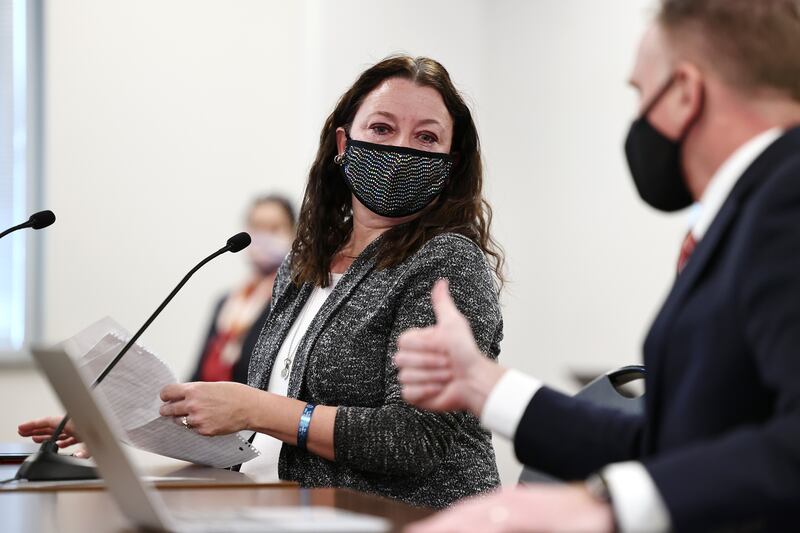
Jenny Brotherson, mother of West Valley police officer Cody Brotherson, who was killed in the line of duty on Nov. 6, 2016, left, looks over as Rep. Craig Hall, R-West Valley City, gives her a thumbs up during the presentation of HB67 to the House Judiciary Standing Committee at the Capitol in Salt Lake City on Wednesday, Jan. 27, 2021. Hall’s bill would close a gap in Utah’s justice system that has allowed certain juvenile offenders who commit new crimes to actually be released early. Scott G Winterton, Deseret News
SALT LAKE CITY — One of the most painful moments tied to her son’s death came almost four years after Jenny Brotherson laid him to rest.
She learned this summer that the teenage brothers convicted in the death of Cody Brotherson, a 25-year-old West Valley police officer, were released early due to a gap in Utah law. Ironically, they walked free because they’d committed new crimes while in juvenile detention, only to be arrested again once they were back on the streets for their involvement in new alleged crimes.
Photo Gallery: 1 of 8
1 of 8
Jenny Brotherson, mother of West Valley police officer Cody Brotherson, who was killed in the line of duty on Nov. 6, 2016, speaks about HB67, sponsored by Rep. Craig Hall, R-West Valley City, right, before the House Judiciary Standing Committee at the Capitol in Salt Lake City on Wednesday, Jan. 27, 2021. Hall’s bill would close a gap in Utah’s justice system that has allowed certain juvenile offenders who commit new crimes to actually be released early. | Scott G Winterton, Deseret News
Photo Gallery: 2 of 8
2 of 8
Rep. Craig Hall, R-West Valley City, left, sits with Monica Diaz, director of the Utah Sentencing Commission, as he presents HB67 to the House Judiciary Standing Committee at the Capitol in Salt Lake City on Wednesday, Jan. 27, 2021. Hall's bill would close a gap in Utah’s justice system that has allowed certain juvenile offenders who commit new crimes to actually be released early. | Scott G Winterton, Deseret News
Photo Gallery: 3 of 8
3 of 8
Jenny Brotherson, mother of West Valley police officer Cody Brotherson, who was killed in the line of duty on Nov. 6, 2016, talks with members of the media after speaking in support of HB67 at the Capitol in Salt Lake City on Wednesday, Jan. 27, 2021. The bill, sponsored by Rep. Craig Hall, R-West Valley City, would close a gap in Utah’s justice system that has allowed certain juvenile offenders who commit new crimes to actually be released early. | Scott G Winterton, Deseret News
Photo Gallery: 4 of 8
4 of 8
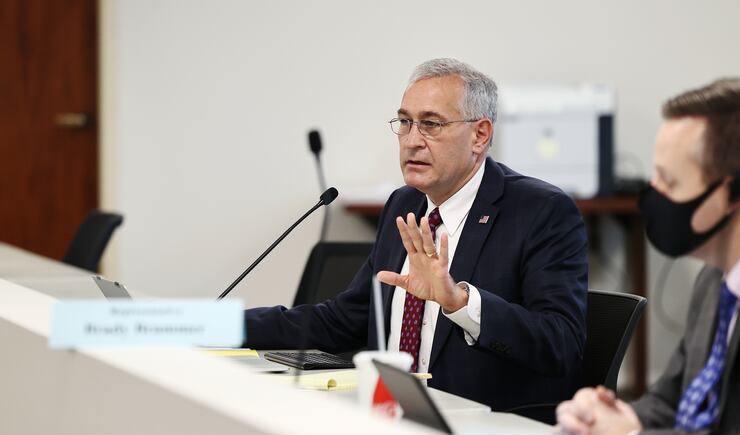
Rep. Lowry Snow, R-Santa Clara, questions Rep. Craig Hall, R-West Valley City, about HB67 during a hearing before the House Judiciary Standing Committee at the Capitol in Salt Lake City on Wednesday, Jan. 27, 2021. Hall’s bill would close a gap in Utah’s justice system that has allowed certain juvenile offenders who commit new crimes to actually be released early. | Scott G Winterton, Deseret News
Photo Gallery: 5 of 8
5 of 8
Rep. Nelson Abbot, R-Orem, questions Rep. Craig Hall, R-West Valley City, about HB67 during a hearing before the House Judiciary Standing Committee at the Capitol in Salt Lake City on Wednesday, Jan. 27, 2021. Hall’s bill would close a gap in Utah’s justice system that has allowed certain juvenile offenders who commit new crimes to actually be released early. | Scott G Winterton, Deseret News
Photo Gallery: 6 of 8
6 of 8
Rep. Craig Hall, R-West Valley City, presents HB67 to the House Judiciary Standing Committee at the Capitol in Salt Lake City on Wednesday, Jan. 27, 2021. Hall's bill would close a gap in Utah’s justice system that has allowed certain juvenile offenders who commit new crimes to actually be released early. | Scott G Winterton, Deseret News
Photo Gallery: 7 of 8
7 of 8
Jenny Brotherson, mother of West Valley police officer Cody Brotherson, who was killed in the line of duty on Nov. 6, 2016, speaks about HB67, sponsored by Rep. Craig Hall, R-West Valley City, right, before the House Judiciary Standing Committee at the Capitol in Salt Lake City on Wednesday, Jan. 27, 2021. Hall’s bill would close a gap in Utah’s justice system that has allowed certain juvenile offenders who commit new crimes to actually be released early. | Scott G Winterton, Deseret News
Photo Gallery: 8 of 8
8 of 8
Rep. Craig Hall, R-West Valley City, prepares to present HB67 to the House Judiciary Standing Committee at the Capitol in Salt Lake City on Wednesday, Jan. 27, 2021. Hall’s bill would close a gap in Utah’s justice system that has allowed certain juvenile offenders who commit new crimes to actually be released early. | Scott G Winterton, Deseret News
“It was both shocking and painful to be told that both brothers had essentially been rewarded for their additional crimes,” the mother of the slain officer told a legislative panel Wednesday at the Capitol in a voice thick with emotion.
The House Judiciary Committee agreed that a change is needed. It voted unanimously in favor of a bill to fix a disconnect that allows certain juvenile offenders who commit new crimes to be released earlier, rather than held longer.
The case prompted Rep. Craig Hall, R-West Valley City, to sponsor the measure he said would ensure that a youth who has been sentenced to detention for the maximum possible time — until age 21 — ultimately will remain in the state’s custody for at least that long.
The teenagers convicted in Brotherson’s death, Lawrence and Christopher Boggs, faced new charges after getting into fights at an Ogden juvenile detention center. They were kicked out of the juvenile system, the charges were filed in adult court and the brothers served short sentences for the adult crimes. They were then released in April and May without any further penalty for Brotherson’s death.
Officers pulled over a stolen car in July to find the pair inside. Lawrence Boggs, 18, was critically injured with gunshot wounds, West Valley police confirmed, and was wanted following a shootout. Christopher Boggs pleaded guilty in December to a reduced charge of theft, a second-degree felony, for the stolen car.
Christopher Boggs, left, and his brother, Lawrence Boggs, were convicted as juveniles in the 2016 death of West Valley police officer Cody Brotherson. Both were expelled from juvenile detention and sent into the adult justice system after committing assaults but they were released from jail shortly afterward. They were later arrested again after police say they committed new crimes, including a shooting. | Salt Lake County Jail and Utah Department of Corrections
“They would have stayed in detention until they were 21, but because they committed the additional offenses, these offenses ironically led to shorter sentences,” Hall said.
His measure would clarify that the juvenile system can still keep a youth in its own detention center after the young defendant pleads guilty of a crime in the adult system, and allows for coordination between youth and adult parole authorities.
It also allows judges to decide whether a young defendant can chip away at an adult sentence while in the youth system, or whether the sentences should be consecutive, meaning additional time in jail or prison is needed upon a youth’s release from detention.
Monica Diaz, director of the Utah Sentencing Commission, said there’s long been a misconception in Utah’s legal community that transferring a case to the adult system will surely result in tougher penalties.
“I just think the community perception is that juvenile court would be the hand slap and the district court is the hammer,” she told the Deseret News, but the brothers’ cases illustrates that’s not always how it works out.
Brett Peterson, director of Utah Juvenile Justice Services, spoke in favor of the bill, saying it would help ensure accountability in the system.
View Comments
Brotherson expressed relief after the legislative meeting, saying she wasn’t sure how the panel would receive the bill.
“I think Cody is very proud,” she said.
If the measure passes, she added, other families won’t have to endure the same experience that hers has. And the change would better protect the public, she noted, “which was always Cody’s drive for being a police officer.”