

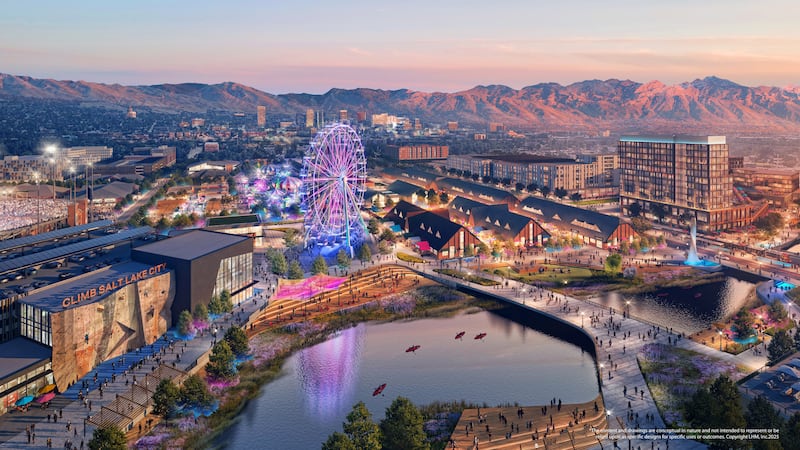

- The Larry H. Miller Company hired Field Operations to redevelop a stretch of the Jordan River.
- About 2.5 million people live near the river but it has been neglected for decades.
- The river restoration is part of the Miller Company's $3.5 billion Power District project.
Field Operations, a renowned international landscape architect and urban design firm, has turned derelict waterfront and riverfront properties in major U.S. cities into beautiful and vibrant gathering spaces.
It counts the High Line on Manhattan’s West Side, Domino Park along the East River in Brooklyn, Waterfront Seattle, Presidio Tunnel Tops in San Francisco and Queen Elizabeth Olympic Park in London among its transformational projects. All were neglected, underutilized areas that had fallen into disrepair. The resurrected sites now attract residents, tourists and business.
Up next? A half-mile stretch of the Jordan River in Salt Lake City.
Larry H. Miller Company hired the firm to rediscover, revitalize and reactivate the trashy river as part of its $3.5 billion mixed-use development in the Power District on the city’s long-neglected west side that could someday include a Major League Baseball stadium.

“Sometimes beauty is in the eye of the beholder. You might go out and think the Jordan River can’t compare to those great landscapes. On the other hand, it is a green corridor running through the city,” Richard Kennedy, a Field Operations partner based in San Francisco, told the Deseret News.
“It does have the possibility of being a center point in a way. It’s not just a divider. It’s not just a piece of infrastructure. But a meeting ground that really brings the whole valley together. That might seem aspirational, but we’ve seen it happen. We’ve worked with cities in creating places that become the calling cards of their communities.”
The Miller Company revealed the partnership with Field Operations on Thursday at the Utah State Fair Park, which will also undergo improvements as part of the plan. State and local leaders were on hand for the announcement.
“We have the best people in the country that I could dream of partnering with the best possible private citizens and company in the state of Utah to make the kind of investment that this neighborhood and our Great Salt Lake and our Jordan River has always needed and deserved,” Salt Lake City Mayor Erin Mendenhall said of Field Operations and the Miller Company.

“It will change the ecosystem of the Great Salt Lake. It will change Salt Lakers’ relationship to this valley and the water that sustains us here.”
Salt Lake City’s ‘front porch’
The company unveiled its ambitious west-side project in February 2024. The 100-acre development includes plans for green space and trails, a riverwalk, office buildings, residential housing, hotel, dining and retail. It will be walkable, bikeable and transit connected.
Utah lawmakers subsequently created a reinvestment and restoration district north of I-80 between 1000 West and Redwood Road that aims to clean up the river and improve the fairgrounds. They also approved a rental car tax increase that would put $900 million in public funds toward a ballpark should the Miller family land a major league expansion team.
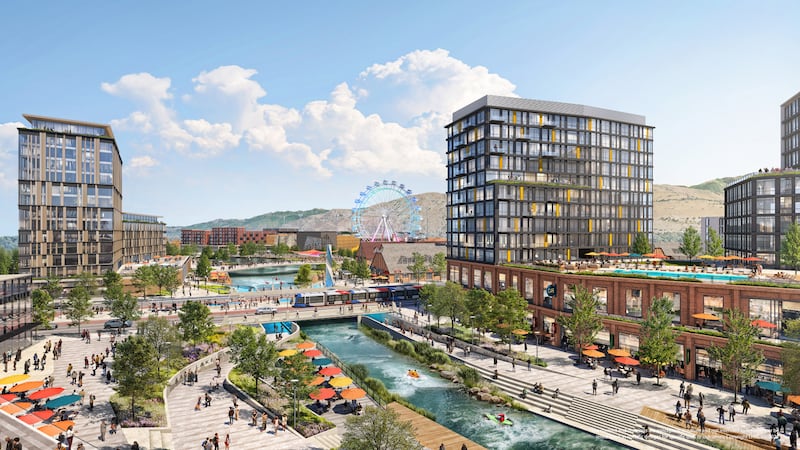
Steve Starks, Miller Company CEO, said the proposed redevelopment of the Jordan River and the Power District is a “once-in-a-generation” transformation intended to turn the long-neglected river into a “front porch” for the community.
“For far too long, we believe that portions of the river in urban areas have been overlooked, channelized, industrialized, hidden behind fences. And yet this river runs through the heart of our capital city,” he told the Deseret News.
“I like to remind people that it’s the same width as the San Antonio River, and San Antonio’s built their whole identity around that river.”
The San Antonio River Walk ranks as one of the top destinations in Texas.
A foundational element of the Power District plan, the Jordan River restoration is an “eight-figure” investment, Starks said. The project will encompass a one-mile loop, meaning both banks of a half-mile section of river.
Baseball stadium design underway

Since the Miller Company announced the Power District project two years ago, much of the work has been underground installing off-site water and storm sewage improvements. Ground was broken on the new 10-story Rocky Mountain Power headquarters last October, the tallest commercial project in Utah right now.
The Miller Company has not marketed the site to other companies but it’s already drawing looks from outside.
“One of the things that maybe has caught us off guard a bit has been just the level of interest that people have reached out to us proactively, including hospitality,” he said, adding a larger hotelier has called.
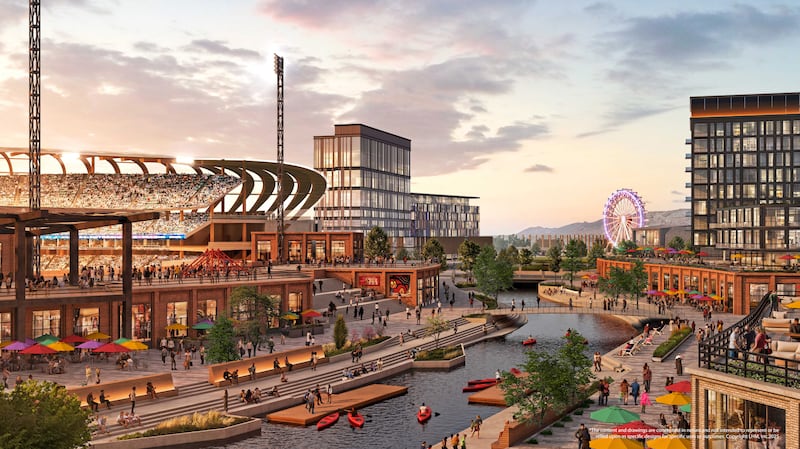
At the same time, Starks said the company is working with ballpark architects on site plans for where a stadium would go, how it would be oriented and seating capacity. Generally, it would be located on the west side of the river facing the Wasatch Mountains. The river could become a splash zone for home run balls like McCovey Cove outside Oracle Park in San Francisco.
Starks said he doesn’t know the dimensions of the park yet but “that will be a really cool feature. . . . but I’m assuming Aaron Judge could probably knock one into the river.”
Salt Lake City is one of several cities competing for a baseball expansion franchise. MLB commissioner Rob Manfred has indicated he wants the expansion process in place before he retires in January 2029, but has yet to describe how it would work. A recent story in The Athletic deemed Salt Lake City a frontrunner given its shovel-ready stadium and proximity to the airport, downtown and public transit.
Restoring the ‘big flow’
The river project is just one more step in what will be a decade-long project.
The 51-mile Jordan River runs north — one of few rivers to do so — from Utah Lake to the Great Salt Lake. Indigenous Shoshone and Goshute peoples referred to it as “pia okwai,” meaning big flow. Latter-day Saint pioneer Heber C. Kimball named it the “Western Jordan” in 1847 because of its resemblance to the Jordan River in the Middle East. Those early settlers also built a network of canals to divert water from the river for agriculture and industrial use.
Today, about 2.5 million people in Utah, Salt Lake and Davis counties live near the river and its tributaries. The Jordan River Parkway is a greenway of open space, parks, natural lands and trails, and Salt Lake City has made improvements such as Three Creeks Confluence Park.
But nothing on the magnitude of what the Miller Company and Field Operations envision as it flows through Salt Lake City has ever been contemplated. The section in the Power District is often littered with trash and drug dealing and drug use has been open and rampant at the North Temple bridge.
Starks recognizes that historically there have been some challenges in the area. “And yet that’s what calls to us for the need to do something like this,” he said. Salt Lake City has made major efforts to reduce crime and make the area safer. It has also removed eight blocks of phragmites and other invasive species along the river.
State Sen. Lincoln Fillmore, R-South Jordan, said the state is investing “millions of dollars” to restore the riparian corridor with native grasses and plants and create a recreational asset “to get people in and on the river.”
The Jordan River project isn’t just cosmetic but an ecological restoration of the waterway, Starks said. One of the design firm’s tasks will be to clean up the river, which will require a permitting process. Goals include remediation, water quality improvements and the reintroduction of native vegetation and aquatic life.
“I think that’s in all of our projects. We use landscape in the form of greenery and plantings to help improve the health and quality of the environment,” Kennedy said.
Soren Simonsen, executive director of the Jordan River Commission, said every improvement along the river that complements the planning and work from the river’s stakeholders helps the ecosystem and communities thrive.
“A healthy Jordan River means a healthier future for all of us as people, and the abundant wildlife that shares in the life-giving elements of this resource,” he said.
Simonsen said the project is about recentering community and culture around the river as it was thousands of years ago. He said it would enhance, preserve, protect and connect people to it in new ways.
Starks and Kennedy said the design process will be collaborative and inclusive. Local partnerships and organizations and community leaders will help create the finished product.
“Our best and most successful projects have been informed by the people who are using them,” Kennedy said. “We’re designers and we have ideas, but those ideas are best shaped by the particular site and, as I said, the people who are using the place.”