

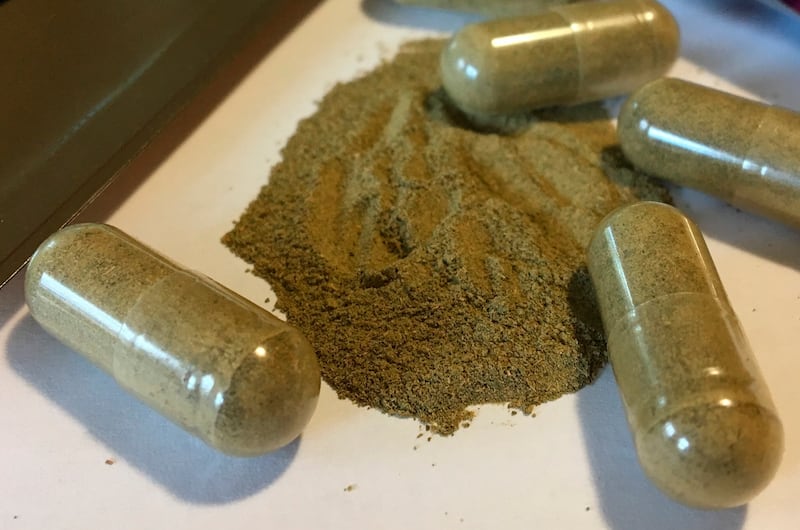

- SB45 passed the Utah Legislature Wednesday as a “near ban,” allowing only pure kratom leaf sales in smoke shops.
- Manufacturers have until March 2027 to stop producing products other than pure kratom leaf.
After starting as a proposed full ban on kratom sales, a bill restricting what products can be sold in Utah and where passed through the Utah Legislature on Wednesday.
Along the way to Gov. Spencer Cox’s desk, the bill experienced a number of changes and brought a few surprises.
SB45, sponsored by Sen. Mike McKell, R-Spanish Fork, was presented on the House floor on Wednesday morning. There were multiple amendments and substitutes presented, including one that featured the Word of Wisdom doctrine from The Church of Jesus Christ of Latter-day Saints.
The bill originally started as a complete ban on kratom and any related products in the state, but after working with some representatives in the House and other stakeholders, McKell changed the legislation to what he calls a “near ban.”
The final version of the bill that passed would make it so only pure kratom leaf can be purchased in Utah and only in certain shops by those who are 21 or older. It also gives kratom manufacturers one year to stop producing anything other than pure kratom leaf in the state.
The bill was brought for a House floor vote on Wednesday morning, passing with a vote of 63 to 10. In the afternoon, the bill returned to the Senate for a final vote on changes made to the bill.
SB45 passed through the Senate unanimously and will now go to the governor’s desk for his signature.
The path to passage
“Well, I did start with ban. I’d still prefer ban, ultimately, but look, we took that a long, long ways,” McKell said.
“We’re not gonna sell any extracted kratom in the state. And some of the most dangerous products, all of those products are gone. The only kratom that’s going to be sold is pure kratom, and it’s going to be sold at a smoke shop,” McKell said.
Kratom comes from a tropical tree, Mitragyna speciosa, in Southeast Asia. Based on dosage, it can have both sedative and stimulating effects and is used by some people for pain management. Kratom leaf contains two main psychoactive ingredients: 7-hydroxymitragynine, better known as 7-OH, and mitragynine.
Kratom is not approved by the FDA for any medical use. The most harmful products, according to some medical experts, are kratom extracts and synthetic 7-OH.
SB45 gives manufacturers 1 year to stop producing anything other than pure kratom
A substitute introduced by the bill’s floor sponsor, Rep. Katy Hall, R-South Ogden, deals with the manufacturing of kratom products in the state.
“It will allow them to prepare, possess, distribute and sell kratom products that are not pure-leaf kratom products until March 6, 2027, so long as the sale happens outside of Utah and does not exceed 0.4% of 7-hydroxymitragynine,” Hall said.
This fourth substitute was adopted and is part of the final bill that passed. After a year, any products produced that aren’t pure kratom leaf can’t be sold in Utah under SB45.
Hall said this is meant to give kratom manufacturers “time to ramp down or change into the production of the pure-leaf kratom only.”
She said she feels this substitute “really addressed all of the stakeholder concerns in a compromised way like we do in the Legislature. Sometimes you have to compromise on things.”
Like McKell, Hall said she would have also preferred a full ban.
Rep. Jon Hawkins, R-Pleasant Grove, tried to introduce an amendment that would allow the production of all kratom products past March 6, 2027.
“All it does is allow manufacturing to continue in the state for an indefinite period of time,” the representative said.
He said that there are 49 kratom manufacturers in the state that involves tens of thousands of jobs and generate half a billion dollars in annual revenues.
Hawkins said he understands the harm kratom can have on individual lives and appreciates the effort to restrict it, but emphasized that this would have a negative impact on businesses.
“I think there’s good business and bad business,” McKell said during Senate media availability on Wednesday. “This is a business that has addicted and killed people, and to me, it’s gas station heroin, and I don’t want to be part of it as a state.”
“If we’re not OK with our kids having access to these products, we shouldn’t be OK with kids in Arizona, we shouldn’t be OK with kids in Evanston, kids in Wendover,” said Rep. Andrew Stoddard, D-Sandy.
Lawmaker introduces a substitute using scripture
During the House debate, Rep. Matt MacPherson, R-West Valley City, introduced a substitute titled “Word of Wisdom Amendments.” The substitute, which failed to be adopted, “enacts a word of wisdom.”
The piece pulls text directly from the Doctrine and Covenants, a book of scripture used by The Church of Jesus Christ of Latter-day Saints. The text used is known as “the Word of Wisdom.” While presenting the substitute, the representative said the state needs a “moral health code.”
“What I think has become apparent to me, at least, is that one of the roles of the Legislature is that we impose moral health codes upon the citizens of Utah,” MacPherson said.
He continued: “So rather than taking small little bites at this and kind of think Whack a Mole, and every new product that comes on the market, I just assume that we just go all the way and put into a health code that’s already been adopted (by) vast areas of Utah.”
The Word of Wisdom addresses the consumption of alcohol and other harmful substances as well as the use of tobacco.
After MacPherson’s presentation, Hall said she did not appreciate MacPherson’s lightheartedness about this kratom bill.
“To me, I’m sorry, this isn’t a light, positive issue,” she said, adding that when someone sees how opioid addicts’ lives are impacted, they will see how serious an issue this is.
McKell was also asked about MacPherson’s substitution.
“It got a little weird,” he said. He added that while he understands having levity during the session, he appreciated Hall emphasizing the seriousness of the issue.
“Sometimes we try and get some levity. Not sure this was the right place,” Hall said later.
MacPherson said he had no further comment.
The issue with kratom
MacPherson wasn’t the only representative to argue that lawmakers shouldn’t only be focusing on kratom when there are other vices that cause death and health issues in the state.
Rep. Trevor Lee, R-Layton, echoed that sentiment and said that the main issue with kratom is the synthetic versions of 7OH.
“I’m not aware of anything else where we say, hey, we know what the issue is, so we’re just going to get rid of anything that has to do with this instead of the actual problem,” Lee said.
He called the move unfair to the manufacturers.
Hall said every researcher and expert on kratom that she and McKell talked to confirmed that kratom itself is an opioid agonist. She said that means it hits the opioid mu receptors.
“When it hits those opioid receptors, there’s something that changes biologically,” Hall said. “You create a tolerance to it, and you create a dependence.”
She continued: “It is a little different than cigarettes and alcohol. It’s those opioid receptors have a different, different physiological response for people.”
The representative said that this is just another piece of the opioid epidemic that people have been fighting for years.
Hall doesn’t believe the economic impact will be as large as some think, and believes many companies will be able to transition to either just pure kratom leaf or other non-kratom products.
McKell says he believes there could be legislation about kratom that comes up in next year’s session. Hall agreed that the kratom industry will not give up easily.
SB45 bill was not the only piece of legislation dealing with kratom introduced this session. Sen. Evan Vickers, R-Cedar City, ran a bill that was absorbed into SB45 when it was in the Senate a few weeks ago and Rep. Jennifer Dailey-Provost, D-Salt Lake City, also introduced a bill dealing with kratom regulation.
McKell said that there is a coordinating clause in SB45 to absorb language from Dailey-Provost’s bill, HB387.