

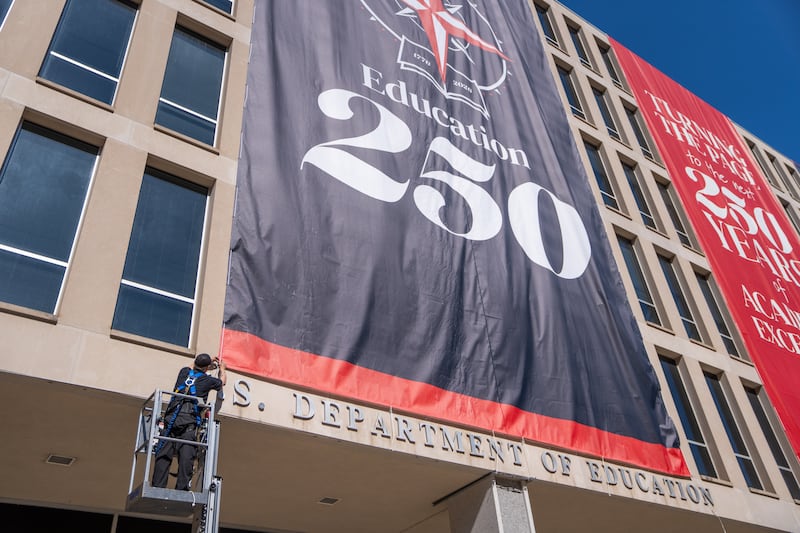

- The past year for the Education Department has been defined by change, disruption.
- President Trump has signed an executive order seeking the federal agency's demise.
- The Education Department frequently takes action against institutions it deems "woke."
One year ago Wednesday, the Education Department handed pink slips to almost half of its workers — a dramatic signal that the Trump administration was making good on its pledge to scrap the federal agency.
A few days later — March 20, 2025 — President Donald Trump signed an executive order formally seeking the elimination of the Department of Education.
Trump’s ire for the 47-year-old agency was no secret when he issued last year’s order. He had long called the Education Department “a big con job.”
“We’re going to shut (the DOE) as quickly as possible. It’s doing us no good. We want to return our students to the states.”
Shortly before the executive order signing, Utah Gov. Spencer Cox threw his own support behind Trump’s actions against the DOE, writing in an op-ed that “education is, and always has been, a state and local responsibility.”
In the year since Trump’s executive order, the DOE is still breathing — at least as an active public agency. But it looks far different than it did when the president took his pen to the executive order in the East Room of the White House.
The Trump administration said “significant progress” has been made over the past year — adding that the past year’s historic disruptions have shattered “the federal education bureaucracy” while prioritizing students and families.
But others disagree.
“The machine is just broken in ways that we can’t see,” Antoinette Flores, director of higher education accountability and quality at New America, a left-leaning think tank, told Inside Higher Ed.
“You won’t know that something has gone wrong until it’s too late.”
Last April, several Republican senators introduced the “Returning Education to Our States Act,” which, if passed, will force DOE’s demise.
While opinions of the DOE’s actions under Trump are divided, all would surely agree it has been a year like no other for the agency.
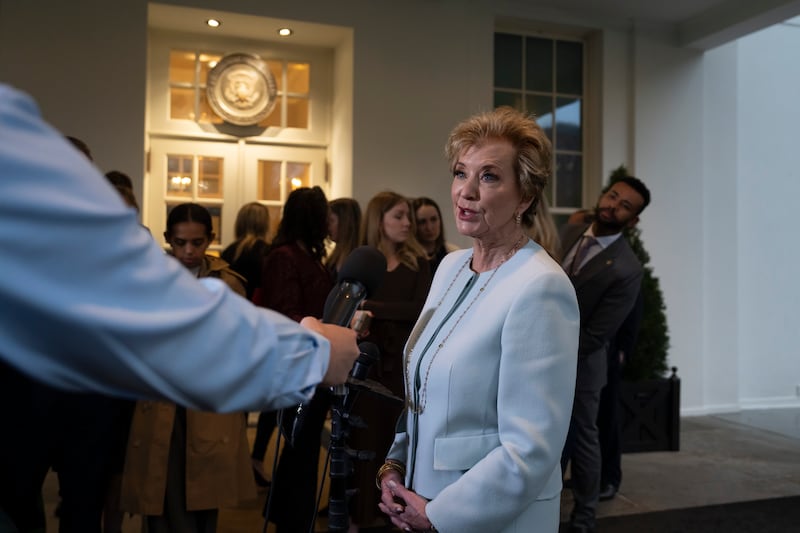
An unforgettable year: DOE highlights/disruptions
While signing his “Scrap The DOE” executive order, Trump said that many of the Education Department’s “useful functions” — including Title I funding and resources for children with disabilities — would be “fully preserved” and “redistributed to various other agencies and departments.”
And, as pledged, the president’s budget maintained Title I funding at the prior levels of $18.4 billion.
The Education Department’s 2026 budget included a proposed “K-12 Simplified Funding Program,” consolidating many federally funded grant programs for elementary and secondary education into a single “state formula” grant program.
“States and localities would have flexibility to use (Simplified Funding Program) funds for any number of elementary and secondary education activities, consistent with the needs of their communities,” noted the DOE’s 2026 budget request.
Last year, more than 108,000 Utah K-12 students were benefiting from Title I money.
Several prior Education Department-funded programs were eliminated as stand-alone programs — and instead were recommended for consolidation into the K-12 Simplified Funding Program — including programs promoting literacy; enhanced library programs; education services for “Neglected, Delinquent & At-Risk Children”; the McKinney-Vento programs assisting homeless students; rural education programs; and arts education for students, including those with disabilities.
Handing traditional DOE duties to sister agencies
Last November, the DOE shifted administrative duties of several of its key programs to other federal agencies — including the departments of Labor, Interior, Health and Human Services, and State.
The varied interagency agreements, according to DOE, were expected to move billions of dollars in grant programs to sister federal agencies to halt education bureaucracy and “ensure efficient delivery of funded programs.”
Notable modifications included shifting several key K-12 education programs such as Title I money for schools in low-income communities from the DOE to the Labor Department.
The DOE and the Department of Labor also established the Elementary and Secondary Partnership that promised to streamline agency administration of elementary and secondary education programs — while connecting DOE programs with Labor Department workforce programs “to better align the nation’s education and workforce systems.”
The DOE and the Labor Department also established a Postsecondary Education Partnership to better coordinate postsecondary education and workforce development programs, according to the DOE. The Labor Department is assuming a greater role in administering most postsecondary education grant programs authorized under the Higher Education Act.
Another new interagency agreement — the Indian Education Partnership — connected the DOE with the Department of the Interior.
And last month, the DOE announced two additional interagency agreements “to further break up the federal education bureaucracy.”
One of the recent DOE agreements established a partnership with the State Department designed to improve the accuracy and transparency of foreign gift and contract reporting for “certain public and private institutions of higher education.”
The partnership, according to the DOE, ensures that data gathered from the foreign funding reporting portal “can be easily used by national security experts, allowing potential threats to be addressed decisively and proactively.”
Meanwhile, a new DOE partnership with the Department of Health and Human Services is hoped to improve safety at educational institutions.
“The partnership will better keep American students, teachers, and administrators safe and secure in education institutions by consolidating resources and initiatives to provide a unified federal strategy focused on school support and related issues,” the DOE noted.
DOE ‘civil rights’ action against several universities — including a Utah school

While last year’s sweeping layoffs at the DOE have reportedly slowed the work of the department’s Office for Civil Rights, the agency has aggressively utilized the office to go after schools they accuse of discriminatory or “woke” practices.
Last week, for example, the DOE’s civil rights office initiated a Title IX investigation of Wisconsin’s New Richmond School District following reports that the district was allowing “biological men to use female restrooms” based on students’ “gender identity.”
The department has also taken high-profile action against San Jose State University for “allowing a male to compete on the women’s volleyball team.”
One of the DOE’s most powerful tools is the ability to pull federal funding from schools that violate civil rights laws. Facing that threat, schools usually have agreed to make changes when pressed by the agency.
Such power was evident last July when Columbia University reached a deal with the Trump administration to pay more than $220 million to the federal government to restore federal research money that was pulled in the name of combating antisemitism on campus.
The school had been threatened with the potential loss of billions of dollars in government support, including more than $400 million in grants canceled earlier in 2025. The administration pulled the funding because of what it described as the university’s failure to squelch antisemitism on campus during the Israel-Hamas war, according to The Associated Press.
The department’s investigative arm also reached into the Beehive State last March when it alleged the University of Utah and dozens of other higher education institutions were practicing “racial preferences and stereotypes in education programs and activities.”
The DOE announced it was investigating Utah’s flagship university and 44 other American schools for allegedly violating Title VI of the Civil Rights Act (1964) by partnering with “The Ph.D. Project” — an organization “that purports to provide doctoral students with insights into obtaining a Ph.D. and networking opportunities, but limits eligibility based on the race of participants,” according to the DOE.
The University of Utah later settled with the DOE’s Office of Civil Rights after terminating its partnership with the Ph.D. project.
The Utah school’s connection with the organization was fairly limited.
In recent years, the university paid an annual fee to participate in the Ph.D. Project’s Annual Conference. Meanwhile, only two students involved through the Ph.D. Project had been admitted into the University of Utah’s David Eccles School of Business.
What about DOE changes to federal student loans?
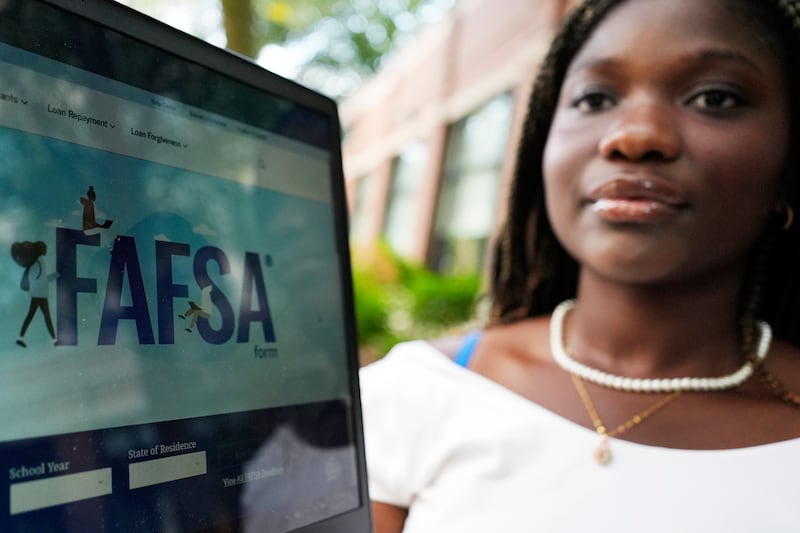
Regarding federal student loans, Trump’s “Big Beautiful Bill” introduced new borrowing limits for graduates — while raising challenges to the Public Service Loan Forgiveness program, reported The Associated Press.
More than 5 million Americans were in default on their federal student loans as of September, according to the Education Department. And millions are behind on loan payments and at risk of default this year.
Last month, the Education Department announced that it would delay involuntary collections for student loan borrowers in default until the department finalizes its new loan repayment plans. The date for this is still unclear, according to The Associated Press.
Meanwhile, the president’s “Big Beautiful Bill” changed the amount graduate students can borrow for federal student loans. Previously, graduate students could borrow loans up to the cost of their degree.
Now, the new borrowing rules cap the amount depending on whether the degree is considered a “graduate” or a “professional” program.
Under the new plan, students in professional programs would be able to borrow up to $50,000 per year and up to $200,000 in total. Other graduate students, such as those pursuing nursing and physical therapy, would be limited to $20,500 a year and up to $100,000 total.
The Education Department, noted The Associated Press, defines the following fields as professional programs: pharmacy, dentistry, veterinary medicine, chiropractic, law, medicine, optometry, osteopathic medicine, podiatry and theology.