

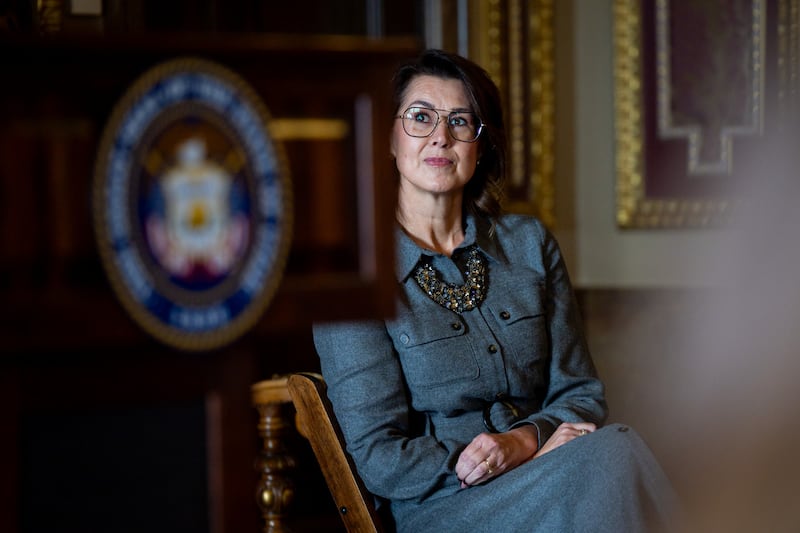
Utah Lt. Gov. Deidre Henderson said she received a letter from the U.S. Department of Justice Tuesday threatening her with criminal prosecution over her administration of state elections, describing the agency’s behavior as “truly bizarre.”
“Got another love letter this morning from the DOJ sprinkled throughout with threats of criminal prosecution,” Henderson wrote on social media. “I’m sure I’m not the only chief election officer of a state who is being targeted for following state and federal laws by resisting DOJ’s demands for private voter data that have thus far been ruled illegal by at least a dozen courts. This is truly bizarre behavior by the federal agency that is supposed to be protecting civil rights.”
The letter, obtained by KSL, states that state and local election officials are subject to federal election laws. It includes a memo of legal requirements for election officials, which outlines responsibilities and “potential criminal penalties for those who fail to carry out their duties.”
The letter focused on laws aimed at preventing noncitizens from voting in federal elections and suggested top election officials could face criminal charges for “knowingly retaining noncitizens” on voter lists. It even suggests state election officials could be prosecuted for “aiding and abetting” crimes if noncitizens claim to be citizens in order to register to vote.
“In conclusion, any election officer, including the chief election officer of the state, who knowingly retains noncitizens on the state’s (voter list) or facilitates noncitizens in receiving and casting ballots could be subject to criminal liability,” reads the letter, which was signed by Harmeet Dhillon, assistant attorney general for the Civil Rights Division.
Henderson is one of at least 11 state election officials to receive similar letters from the Department of Justice, according to the New York Times.
The letter is the latest in an ongoing back-and-forth between Utah’s Republican lieutenant governor and President Donald Trump’s administration, after the Department of Justice sought complete access to Utah’s voter rolls — including private, identifying information — last year. Henderson did not comply, so the department sued the state earlier this year.
The department has filed multiple lawsuits against other states but has failed so far to force states to turn over voter information.
Henderson pushed back on the lawsuit in February, saying “neither state nor federal law entitles the Department of Justice to collect private information on law-abiding citizens.” In court documents, she has argued that the lawsuit would “upset” the balance that gives states authority to set their own election rules.
Trump’s push for information on voters comes as the president has railed against noncitizen voting, something that is illegal under federal law and not widespread.
Henderson’s office recently concluded an audit of the Utah’s voter rolls, which found only a “small handful” of noncitizens who were registered to vote, out of more than 2 million registered voters. Utah lawmakers passed a law earlier this year that requires Utahns show proof of citizenship in order to vote in state and local elections.
The department’s letter asks Henderson to respond within five days detailing how Utah plans to comply with the federal laws and how the department can help, but it does not say what will happen next if Henderson does not respond.