



Firefighters are working around the clock to manage one of Utah’s most devastating wildfire seasons to date, but wildfires continue to turn up the heat in Utah long after the flames are put out.
“Everybody is tuned in when a wildfire happens,” said Jamie Barnes, Utah state forester and director of the Division of Forestry, Fire and State Lands, in an interview with the Deseret News. “But then when it’s done and over, we need to remember that there’s impacts in those communities after the wildfire is gone.”
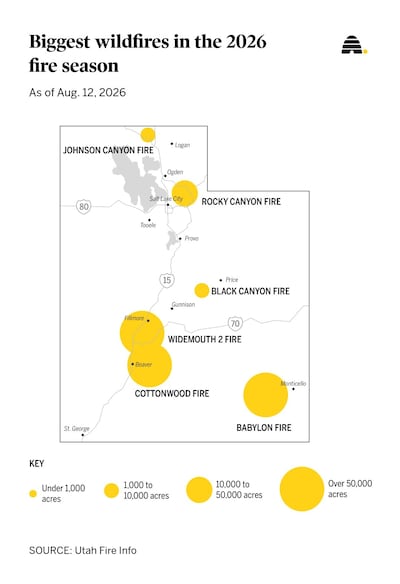
The 2026 wildfire season in Utah has destroyed hundreds of structures, caused thousands of Utah residents to evacuate their homes and cost millions of dollars in firefighting resources — and it’s not done yet.
The wildfire season runs through the beginning of October, meaning there are still two months to go. And even though the cold autumn air will ease the summer’s dangerous, fire-prone weather conditions, Utah will see the effects of this year’s wildfires for years to come.
“Recovery after a big fire such as the ones we’ve seen this year are multiyear recovery efforts,” Barnes said.
Dangerous flooding and polluted water could pose risk ‘for several years’

One of the most immediate natural consequences of wildfire is the effects on the water, which becomes polluted from ash and charred material.
Wildfires “can affect drinking water sources during and immediately after the fire or for months to years afterwards,” the National Park Service said in an online article.
Barnes said water quality is “something that we’re watching closely.”
In addition to the concern of unsafe drinking water, water also raises concerns as monsoon rains create a risk of flooding on soil with no vegetation to absorb the precipitation.
Barnes said she is “definitely concerned about the impact of water,” especially in Beaver, which has already seen flooding following the 97,000-acre Cottonwood Fire.
Barnes said there is still flooding taking place from the 2025 Monroe Fire that burned 73,746 acres in Sevier and Piute counties.
“It’s expected that you will see flooding in these areas for several years after a wildfire event,” Barnes said, adding that even areas not directly impacted by fire are impacted by flooding.
Utah’s economy will suffer millions in losses from crucial industries

Barnes said the estimated total for resources used to fight wildfires this year, just including costs paid by the state, is $33 million as of Wednesday.
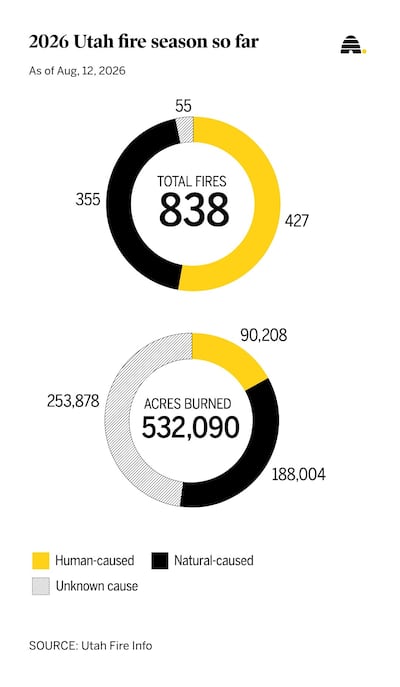
The actual costs are hard to estimate, however, because they are changing “by the hour,” Barnes said. Even after the season ends, state and federal agencies continually send invoices that are added to the total cost.
The cost of the 2025 season was officially counted up just recently, and added up to $240 million. It is likely the cost of the 2026 season will not be totaled until around this time next year.
In addition to the costs of firefighting resources, wildfires impact Utah’s economy by adversely affecting the outdoor recreation industry. Utah’s outdoor recreation industry contributes 3.4% of Utah’s GDP and supports nearly 72,000 jobs, according to data released by the U.S. Department of Commerce’s Bureau of Economic Analysis.
Tourism is affected too. Visitors spent approximately $13.3 billion in Utah’s economy in 2024, with similar revenue in 2025, according to the 2026 Economic Report to the Governor. The loss of this revenue could be devastating to Utah businesses.
Wildfire also decreases air quality throughout the state, which in turn affects the economy. A 2020 BYU study found that air pollution costs Utah’s economy $1.8 billion through costs such as healthcare expenses, lost earning potential and a further decline in tourism.
Destroyed infrastructure is a contributing cause as well. Records published by the Great Basin Coordination Center that outline damage caused by large fires in 2026 in Utah report that 3,773 structures have been threatened by large fires in Utah, and nearly 250 have been destroyed.
Utah’s infrastructure is one of the most successful parts of the state, according to the U.S. News & World Report Best State Rankings.
The effects felt by this loss last long after the fires are gone.
Wildlife and ranching operations will take years to recover
Farmers and ranchers are particularly vulnerable to wildfire damage.
“Wildfires can change the course of a ranching operation in a matter of hours, but recovery often takes years,” said Utah Department of Agriculture and Food Commissioner Kelly Pehrson. “Our livestock producers are facing the loss of animals, grazing land, and the resources they depend on to sustain their operations.”
Recent fires are taking the lives of Utah wildlife, including 100 cattle that recently died in the Widemouth 2 Fire. Replacing animals and reviving their grazing land takes “significant financial investment and time,” UDAF said in a statement, and it can be several years before the livestock and the land are productive.
Wildfire has also been found to release greenhouse gases into the air, which negatively affects the environment.
Barnes said she is “working closely” with state wildlife resources officials to determine how best to address these issues.
How will Utah recover?
Though the lingering effects of wildfire damage loom over Utah’s future, there is hope in the large-scale efforts to combat them.
The State of Utah and U.S. Forest Service recently launched an $18 million post‑fire recovery initiative to support rehabilitation efforts following the Cottonwood Fire.
“The Cottonwood Fire didn’t end when the flames were extinguished. Utahns are still living with the consequences, from damaged watersheds and washed-out roads to impacts on ranchers, recreation, and local economies,” said Utah Gov. Spencer Cox in a release. “This partnership allows us to move quickly to stabilize these landscapes, restore access, and reduce the risk of future flooding and erosion. I’m grateful to Chief Schultz and the Forest Service for matching Utah’s commitment and standing with the communities working to recover.”
Individual cities and counties within the state have also been organizing local efforts to support residents who have been affected by wildfires.
Barnes encouraged Utahns to “stay strong” amid difficult and dangerous circumstances.
“It’s a really heartbreaking scenario that a lot of these communities are in. The devastation is real,” Barnes said. “We’re going to do what we can to get them on their feet again. And, you know, these communities are strong and the state’s here to support them.”