



- Utah leaders returned from Argentina optimistic about new partnerships on the Great Salt Lake and critical mineral processing.
- Utah and Argentina hope to collaborate on research and management strategies for their shrinking saline lakes, which share striking similarities.
- Utah leaders see Argentina’s mineral resources as an opportunity to strengthen U.S. supply chains and reduce reliance on China.
Utah has a new friend in South America, and the relationship could bring the state significant economic opportunity and answers to its most difficult ecological problems.
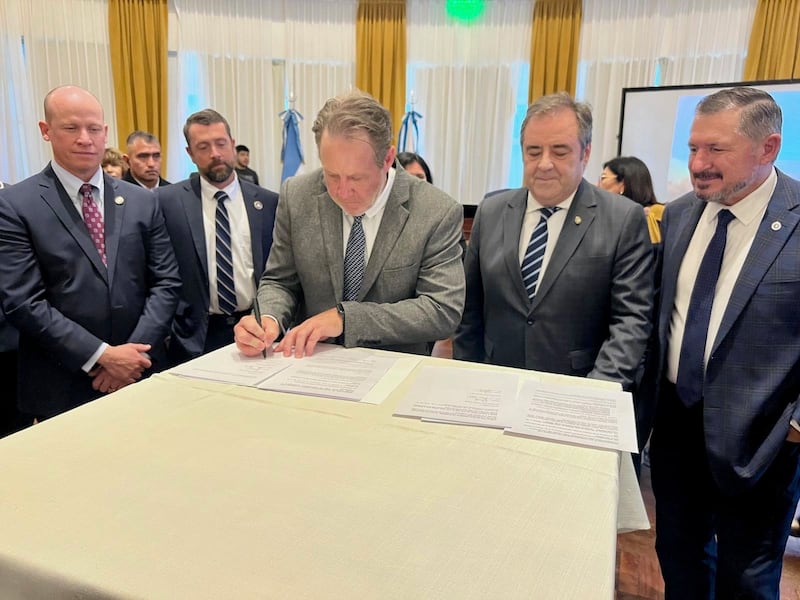
Joel Ferry, the executive director of Utah’s Department of Natural Resources; Rep. Casey Snider, R-Paradise; Sen. Derrin Owens, R-Fountain Green; and Jeff Moss, the executive director of the Governor’s Office of Economic Opportunity, told the Deseret News about their 10-day venture in Argentina through various provinces and cities.
Flying home to Utah on Wednesday, the small trade mission is coming away with optimism on two somewhat-related issues: the shrinking Great Salt Lake and critical mineral processing.
Realizing Argentina’s economic and ecological struggles and goals was “an eye opener for how small this world really is,” Ferry told the Deseret News, describing the trade mission as mutually advantageous.
“The information we’ve learned and the value from meeting with Argentine government officials and professors have been invaluable,” he said.
Utah leaders are hoping to return to Argentina in the next couple of months to solidify the new partnership, and they hope Utah Gov. Spencer Cox will visit in the next year or two.
The Great Salt Lake can learn from its southern sister, Mar Chiquita
Just as Salt Lake City is home to North America’s largest saline lake, Córdoba, Argentina, is home to South America’s — and both are shrinking away.
The Great Salt Lake and Argentina’s Mar Chiquita Lake have similar sizes, depths and salinity, and they serve as habitat for the same migratory bird, the Wilson’s phalarope.
For the last year, the Great Salt Lake has lived under a “serious adverse effects” designation, with state leadership worried that further evaporation will lead to the collapse of the lake’s brine shrimp population and economic uses.
The lake’s newly appointed commissioner, Hannah Freeze, recently told the Deseret News that if the state can add 250,000 acre-feet of water (81.5 billion gallons) to the lake, it will stabilize.
To add water, the state has pursued a variety of incentives for Utahns, including water leasing and water optimization programs for farmers.
“Doing partnerships, especially as it relates to the Great Salt Lake, is the only way to ensure ecological viability moving forward,” Snider told the Deseret News. “Coming down here to partner with the Argentines on research would be invaluable.”
University researchers, businesspeople and government officials joined Utah’s trade mission through their various meetings, Moss said. “They look at the research done on the Great Salt Lake by Utah State University and the University of Utah; they asked if they could partner with our universities, so we’re opening the door to that,” he said.
Ferry added that there was “recognition across the board” that Utah was pursuing things related to the Great Salt Lake that Argentina was not aware of and vice versa. “If we only focus on the Great Salt Lake, we’re focusing on half the equation,” he said.
Mineral extraction

Utah’s trade mission purposefully visited Argentine provinces that are rich in minerals, Ferry said.
“One of the goals of ‘Mission Critical’ is to increase Utah’s mineral processing capabilities, and part of that comes from having the feedstock,” he explained. “Right now, when ores are mined, they’re being shipped to China.”
China controls over 90% of the world’s refinery production of key components in electronics. The country also produces about 70% of the world’s rare earth elements and more than 60% of global titanium mining and aluminum smelter production.
As the president of the Council on Foreign Relations, Michael Froman, wrote last year, “China maintains significant economic leverage over access to inputs that are necessary for everything from everyday products like smartphones to advanced weapons systems like the F-35.”
At any point, “China could restrict global access to critical mineral products, including rare earth magnets, and bring much economic activity to a screeching halt,” he said.
Utah has pledged to be part of the solution to bring mineral processing to the United States.
Gov. Cox unveiled plans earlier this year for Utah to meet 25% of the United States’ critical mineral demands. “Mission Critical” also seeks to cut the average permitting timeline by 50% and ensure that at least 50% of mined minerals are processed in Utah.
In 2026, the state produces or processes copper, gold, silver and molybdenum in Bingham Canyon Mine, uranium and vanadium in the White Mesa Mill, beryllium in Spor Mountain Mine, iron in Iron Springs, phosphate in Simplot Vernal Mine and more.
“I’ve been on a number of these trade missions, and we’ve never had this level of interest in so many ways,” Moss said regarding potential mineral and ecological partnerships with Argentina.