

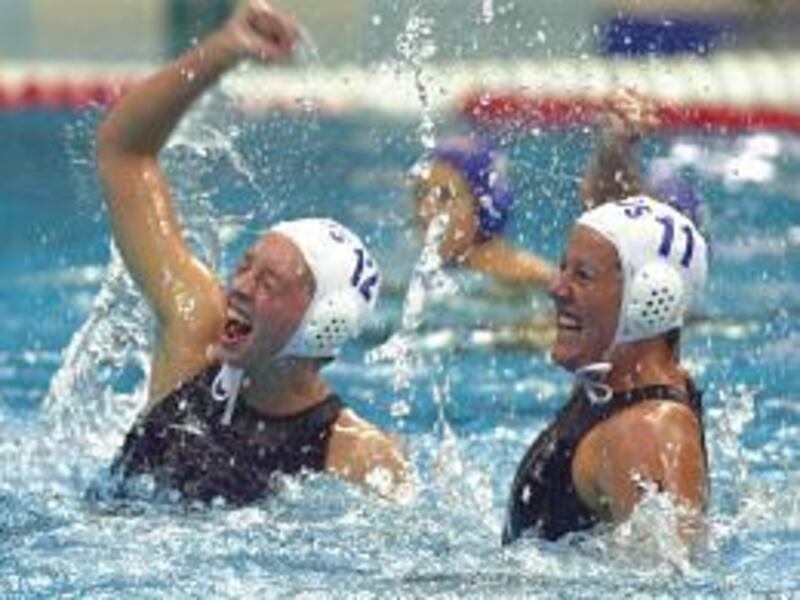
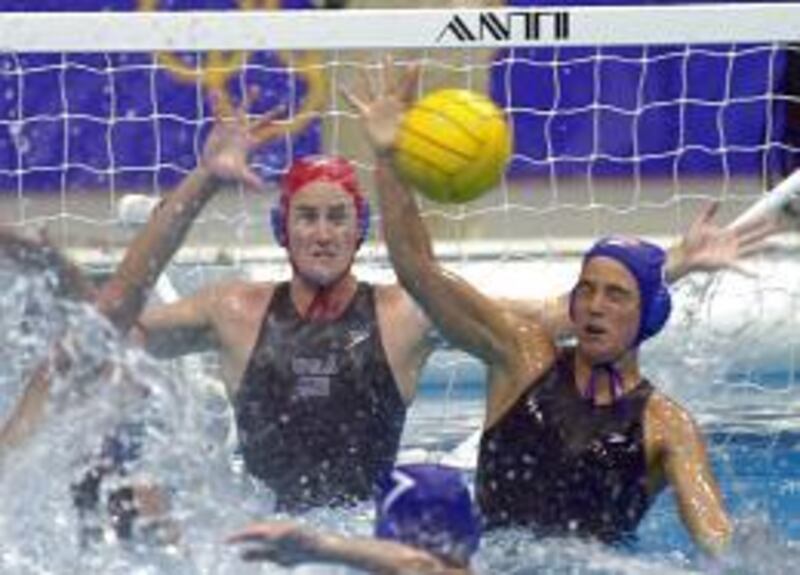
SYDNEY — In last-second scoring controversy not seen at the Olympics since Russia's basketball upset at the 1972 Munich Games, host Australia claimed the inaugural women's water polo gold medal with a thrilling 4-3 victory over the United States Saturday night.
The near-capacity crowd at the 17,000-seat venue used for swimming competition roared with approval as the Australians shook off a game-tying goal by the Americans with just 13 seconds remaining to fire in their game-winning score with no time remaining on the clock.
Actually, the Aussies appeared to have broken the 3-all tie with 1.4 seconds remaining, but the goal was waved off by the officials, who called an exclusion penalty on the United States and awarded Australia a 6-on-5 player advantage .
When play is stopped — for a minor violation or a player exclusion — the ball normally has to be tossed out beyond seven meters from the goal. After the disallowed Aussie goal, an Australian player flipped the ball out from close to the goal area to Yvette Higgins, who buried the ball back into the U.S. goal as time expired.
The U.S. team unsuccessfully protested.
In the end, the referees put a half-second back on the clock for an unanswered desperation heave by the Americans. And FINA, the international aquatics federation that oversees swimming and water polo, said the referees' decision to allow the kick-in throw was a judgment call.
"It was chaos, and they (the referees) didn't make it clear," said Salt Lake native Courtney Young Johnson, a driver and center back on the U.S. team. "But it was a great shot, and they put it away."
U.S. coach Guy Baker admitted his players were confused at the time of the penalty, saluted Australia for taking advantage and squelched any post-match criticism of the referees.
"That was their decision," Baker said. "I might look back at it later, but I agree with it. I admire Australia's composure with 13 seconds to go. They were great to get that goal."
Yes, the Americans tried to put their best foot forward after the match, but their faces — especially the red, misty eyes — told the true story.
"We claimed a medal — that was our first goal," Johnson said. "Gold would have been what we wanted, especially when you get this far. But we're Olympic medalists, and that makes it pretty special, regardless of whether we won or lost."
In a defensive, low-scoring battle, the United States struck first, scoring midway through the first of four seven-minute periods with Brenda Villa scoring as the Americans enjoyed a player advantage. Less than a minute later, Australia countered with a Melissa Mills goal.
The Americans posted the sole second-period score, with Ericka Lorenz earning a goal during another six-on-five advantage. The Aussies evened the score with the only third-period goal on a shot by Bronwyn Mayer, making it 2-2 with one quarter remaining.
The rowdy Sydney masses at the Aquatics Center pulled out all the stops to encourage the Australian women. As if the flag-waving, the green-and-gold wigs and the constant "Aussie! Aussie! Aussie! Oy! Oy! Oy!" chants weren't enough, they threw in a boisterous chorus of "Waltzing Matilda" just for good measure in the fourth period.
Australia took its first lead with 1:50 left to play on a Naomi Castle score on a player advantage. Villa scored her second and Team USA drew even at 3-all on an Australian player exclusion with just 13 seconds remaining.
Then came Higgins' quick-thinking and quick-shot heroics. "I was trying to tell (teammate) Simone Hankin to hurry up and give me the ball because I knew I was outside seven meters and we only had a second left, so I knew I had to shoot."
For Johnson, the shot relegated her medal prospects from gold to silver — still a considerable reward for a player who picked up the sport as a 14-year-old playing on a Skyline High club team.
"I think I'll be happy once it sinks in," she said. "We're a little disappointed now because we thought we could have won the game. But a silver medal at the Olympics; I'll take it any day."
E-mail: taylor@desnews.com