

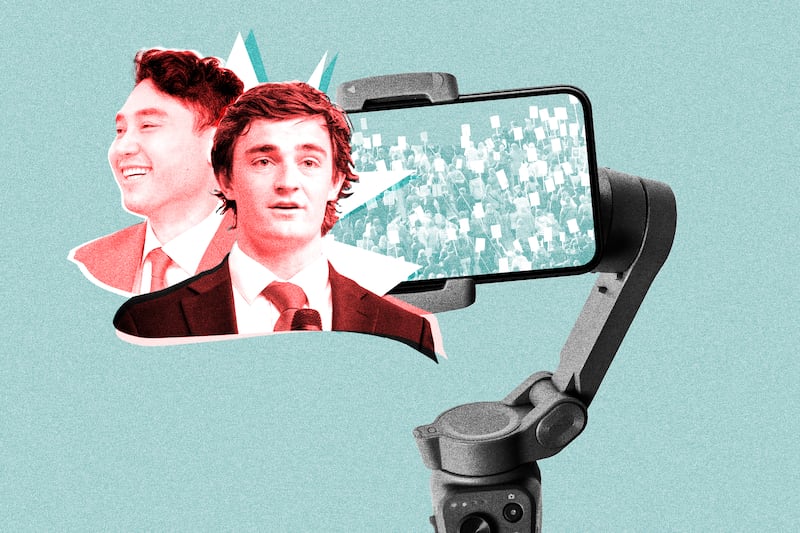

The day after Christmas last year, 24-year-old Nick Shirley posted a video about suspected fraud in Minnesota. In it, he and a man named Dave Hoch knocked the doors of tax-funded daycare centers, then attended a meeting about fraud at Minnesota’s State Capitol. At the conclusion of its 42 minutes, Shirley reported they’d uncovered more than $110 million in fraud.
The video lit a fire on social media. Within a week, it had been viewed 4 billion times across all platforms, Shirley said, including X, YouTube, Facebook and others.
Responding to the outrage, the Department of Homeland Security launched an investigation. On Jan. 5, Minnesota Gov. Tim Walz announced he would not seek reelection. On Jan. 6, the U.S. Department of Health and Human Services froze billions of dollars in federal funding to five states, including Minnesota.
In late May, the Justice Department leveled fraud charges against 15 people in Minnesota, alleging $90 million of fraud in Medicaid programs.
Shirley, a self-described independent journalist, was not the first to discover and allege fraud in Minnesota, but his video helped make it widely known. Testifying before Congress in late January, Shirley said his video “created instant change.”
As his audience has grown, Shirley has garnered praise as well as criticism.
People questioned whether he did a thorough fact check. Did he try to minimize harm for those he interviewed? Did he show up to the daycare centers outside of operating hours? Did a preexisting bias shape his reporting?
As trust in the media has spiraled to its lowest-recorded point, independent journalists have found substantial audiences. Shirley now has 1.6 million followers on X, and many others on the political left and right (most appear to have some kind of bias) have gained significant audiences as well.
Will independent journalism help build back the deteriorating information environment, or will it cause further decay?
T. Becket Adams, a 12-year reporter for the Washington Examiner and columnist whose work has appeared in The Wall Street Journal, National Review and elsewhere, described independent journalism’s strengths and weaknesses.
“The greatest crisis in journalism is the credibility gap; not AI, not social media, and not the decline of local newsrooms,” he told the Deseret News. “Nothing we do matters if no one trusts us. And right now, practically no one trusts us.”
Independent journalists can either benefit or suffer from this low-trust environment.
To these new journalists’ advantage, “audiences are hungry for credible information and are quick to abandon established brands for anyone who seems honest,” Adams said. “It has never been a better time to go independent. The audience is right there, starving, massive and eager to be served.”
On the other hand, “an already distrustful public is quicker than ever to question independent reporting,” he said.
“This is on top of the fact that, along with having to work twice as hard as their legacy counterparts to establish trust, they must work twice as hard in general. Independent journalists often have to perform every role themselves: reporter, editor, fact-checker, copy editor, legal advisor and social media manager,” he said.
To understand independent journalism, its ethics and how it works, I spoke with two of the biggest players in the field: Nick Shirley and Andy Ngo.
From Utah suburbs to the political spotlight
As a teenager in Farmington, Utah, Shirley spent his free time making YouTube videos.
In his channel’s first publicly available video, 16-year-old Shirley vlogged himself flying to New York City alone. In the two-part series, his teenage friends drop him off at the airport, he tries to keep his mom out of the know, then he runs around the Big Apple, at times shouting, “Like and subscribe!”
At one point to interject commentary, Shirley sat shirtless atop a plastic horse in his basement. A plaid blanket draped over his shoulders, and a gold crown rested on his head as he described how his mom found out he’d flown across the country without telling her.
Shirley referenced this experience while addressing College Republicans at the University of Utah in April.

“I learned that you could just go do things,” he said. So Shirley has just been doing things ever since.
At 17 he snuck into Jake Paul’s wedding; at 18 he documented Jan. 6, 2021, protests in Washington, D.C.; then at 19 he left the U.S. to serve a two-year mission for The Church of Jesus Christ of Latter-day Saints in Santiago, Chile.
When he got back in 2023, Shirley decided to switch gears and focus on “covering things at interesting places.” So he spent a month power washing homes, made $10,000, then traveled to Arizona to attend Turning Point USA’s America Fest and conduct interviews.
From there, he flew down to the southern border to interview people entering the U.S. Up until his viral Minnesota video, Shirley was pumping out about a video a week on YouTube.
All of a sudden people were like, ‘Oh hey, you’re a journalist’
— Nick Shirley
In a conversation with the Deseret News, Shirley said, “I just want to show people what’s happening.” His mission statement, he said, is “showing the reality of things as they are.”

“I was just curious about the world, so I investigated it,” he said. Shirley has reported on the ground from Cuba, Brazil, Ukraine, Greenland, the U.K., El Salvador and more.
Adams referenced this freedom to go anywhere and report.
“Freed from the usual newsroom constraints, independents enjoy greater flexibility, freedom of movement, and, most importantly, freedom from groupthink,” he said. “They frequently tackle important stories that major outlets overlook or ignore, making them invaluable to the profession and extremely attractive to disillusioned audiences who’ve no idea where to seek credible, trustworthy information.”
Even with this potential benefit, independent journalists face an uphill battle of establishing credibility. “Being a complete or relative unknown and unconnected to any brand carries a distinct disadvantage: an already distrustful public is quicker than ever to question independent reporting,” Adams said.
And if independents publish faulty reporting, there is little accountability for them. The journalist is his own boss; he can issue an apology and a correction if he wants to, but there is no one to compel him to get things right — except the public and social media critics.
From his reporting, Shirley said he’s learned that there is corruption everywhere. “There’s a lot of corruption, and evil is very real,” he told the Deseret News. “And there are a lot of great people, but there’s a lot of stuff you should be concerned about.”
This desire to document the world naturally aligned Shirley with an existing field: “I thought I was just making YouTube videos, and all of a sudden people were like, ‘Oh hey, you’re a journalist,’” he said at the University of Utah event.

Critics of Shirley, like UnHerd columnist Richard Hanania, argue that the 24-year-old’s lack of journalistic training are a detriment to him.
In a piece published shortly after Shirley’s Minnesota fraud video blew up, Hanania described Shirley’s reporting as “the equivalent of a reporter covering the mafia randomly showing up at Italian-owned butcher shops and restaurants with a prefabricated narrative that criminal activity must be going on.”
In a conversation with the Deseret News, Hanania described how he saw Shirley’s video. “Somebody doesn’t answer the door — ‘OK, they stole another $10 million. Here’s another $5 million.’ And, you know, he’s just talking to some old guy — who knows if he knows anything," Hanania said.
Like Adams, Hanania said thorough and accurate independent reporting is achievable, it just takes a lot of work.
“It’s not impossible to do it right,” Hanania said. “You just have to take pride in your work. The pride in your work has to overcome what you would get out of just being sloppy and getting the clicks and giving the audience what they want.”
Andy Ngo and the rise of independent journalism
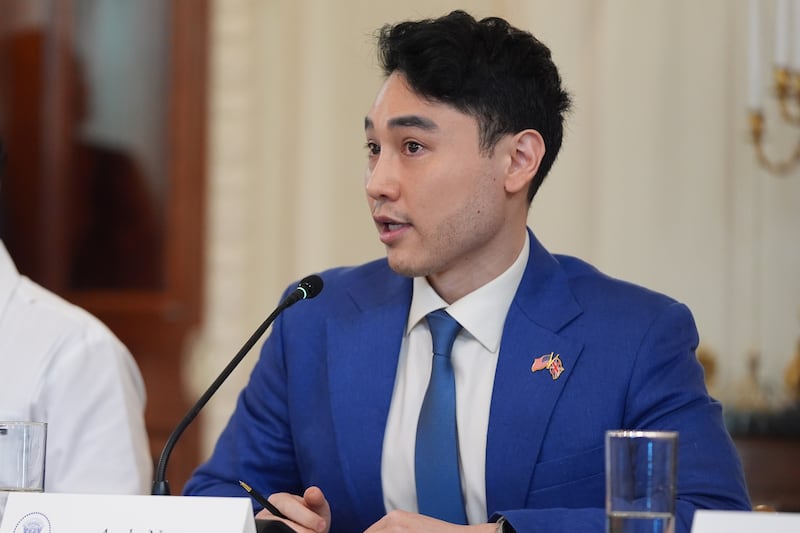
Andy Ngo didn’t set out to pioneer the field of independent journalism. In 2017, he was an editor for Portland State University’s student newspaper, where he was studying as a graduate student.
That April, he attended an interfaith panel titled “Unpacking Misconceptions,” and one attendee asked whether the Quran permitted the killing of non-Muslims.
Ngo recorded the student panelist’s response: he said non-Muslims could be killed or banished in a state governed by Quranic law. Ngo posted the video to Twitter without commentary. Then his editors called him into their office.
“I was accused by a student activist on campus of Islamophobia, and it escalated up to the editor in chief and the administration,” Ngo said in an interview with the Deseret News. “So I was fired.”
The student newspaper, PSU Vanguard, published a front-page story that Ngo had separated from the newspaper. In 2017 if someone searched Ngo’s name on Google, Vanguard’s article would pop up, as would Ngo’s response piece published in the National Review, titled “Fired for Reporting the Truth.”
“So I felt at that time, very early on — this was before I had any social media following — that my prospects of going into a mainstream journalism career were destroyed,” he said.
Around the same time, violent protests erupted in Portland in response to President Donald Trump’s first inauguration, “So I started going out with my iPhone seven,” Ngo said.
“This was years before there was monetization, so it wasn’t like a business decision. I saw that there were certain gaps in what I was reading in print from legacy media, which I at that time had a lot of respect for, in regard to violence and political violence from Antifa and other militant left-wing groups. That truth was not being reflected in broadcast, local broadcast media or the legacy print media,” he said.
The absence of mainstream coverage “motivated me to continue to go out and record these videos,” he said.
High-profile accounts began retweeting Ngo’s work, and national news outlets invited him on evening shows to talk about what was happening in Portland. He also wrote pieces for The Wall Street Journal and Newsweek.
“I didn’t really have anyone to look up to, to follow a path. At that time, I was kind of carving it out along the way,” he said.
Ngo described his own journalistic ethics to the Deseret News. When covering a protest in person, he said he refrains from providing commentary. His newsroom training taught him to remove himself as much as possible from the story, which he has carried on with his independent reporting.
Adams described the increased workload for journalists working independent of a newsroom.
“Independent journalism is a net positive, but it demands a great deal from those who practice it,” Adams said. “You must be twice as thorough and twice as hardworking. Not everyone is cut out for it. That’s why my first piece of advice for anyone interested in this path is simple: avoid partisan commentary.”
He continued, “Don’t hide your perspective, but don’t make it the main character either. Don’t give readers any unnecessary reason to doubt your work. You already face an uphill battle for credibility, so focus on the reason anyone should read you in the first place. As the man said: Just the facts, ma’am.”
‘Influencer’ vs. ‘independent journalist’
As Ngo steadily gained recognition as a journalist, Wikipedia contributors battled over how to label him.
In June 2019, his page described him as a “freelance journalist.” The next month, he was a “conservative American journalist,” and by August, he was an “American pseudo journalist.”
In 2020, the “pseudo” label fell away, but Wikipedia contributors tacked on the descriptor, “social media personality,” which morphed into “right-wing social media influencer” on Sept. 12, 2022.
Though it will likely change again, Ngo’s current Wikipedia description is “an American right-wing social media influencer, who is known for covering and video-recording demonstrators.” Wikipedia also references his position as a journalist and editor at The Post Millennial, which he has held for about eight years.
Ngo referenced this labeling phenomenon during a conversation with the Deseret News.
“A lot of the legacy media reporting on me, particularly from liberal publications, will call me an influencer, which is a term that I do take offense to,” he said. “I think it really undermines my nine years of writing work.”
Influencers don’t do investigative reporting, and they “influence” for a brand, he said. The label doesn’t fit him.
“I’ve never sold merchandise. … I really want my journalism to be all that people know me for,” he said.
The term “influencer” is not a kind label, he continued. “They say it because they want to downplay what I do. It’s nothing more than somebody who’s just posting on social media, like people who influence for makeup brands or food products or something.”

Ngo and Shirley told the Deseret News they believe many in legacy media try to delegitimize them because of their open conservative leanings.
“I do think they dislike me on a personal level because of my open conservative bias in my work,” Ngo said.
In a separate conversation, Shirley told the Deseret News, “I’m just out there, showing people what’s going on. Any time you actually show what’s happening, they’re going to depict you as far right. Even the most moderate person is going to be depicted as a far-right individual if you’re showing and exposing the other side.”
Interestingly, mainstream publications are looking for opportunities to partner with content creators, showing they understand there is a benefit to the audience that comes with online content creation.
The dangers posed to reporters in a politically hostile environment
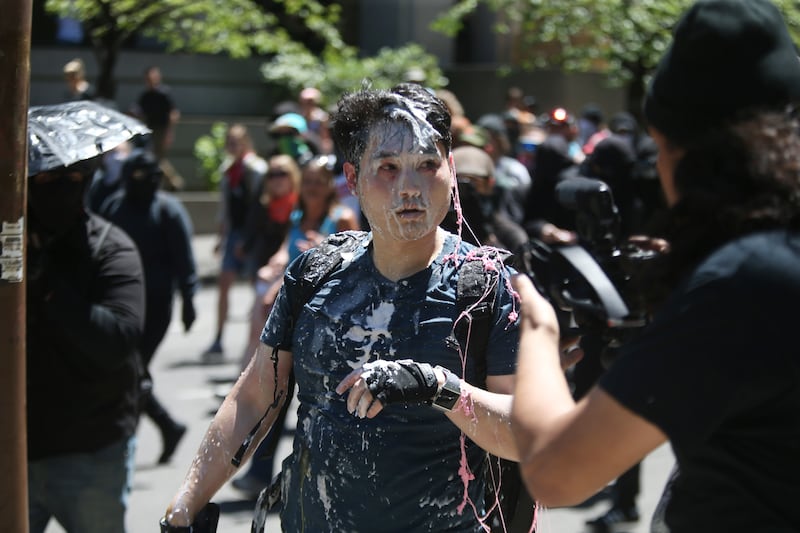
In 2019, while covering a riot in Portland, Oregon, Ngo was attacked and beaten by Antifa members. He suffered a subarachnoid hemorrhage (bleeding in the brain) and other injuries. Rioters also stole his recording equipment. Again in 2021, Ngo was chased and beaten by Antifa members, before escaping to a nearby hotel.
“So I’ve largely retired from the riot coverage scene,” Ngo said. “And I had to retire entirely from doing it in Portland. There was just no way to do it safely.”
“If you’re covering extremeness in places where law enforcement isn’t active on the streets, you really are gambling with your life. And I know that might sound quite dramatic, but I speak from experience,” he said. “I was really lucky to not suffer lifelong, serious cognitive disability from the brain injury that I had.”
Ngo referenced other independent journalists including Shirley, Jonathan Choe and Nick Sortor who have been on the receiving end of threats of violence.
Violence is “definitely something you think about,” Shirley told the Deseret News. He referenced walking into the auditorium at the University of Utah event. “It’s a shame that people have to be on the roof just for me to walk 100 feet,” he said.
Shirley said he thinks about potential violence when he’s in public, recording videos. “I do think about it. I try not to, but it is crazy how some people are so deranged to the point where they want to kill others,” he said.
He gets negative messages every day, he said. “I try not to read them. There are a lot of messages that come through my phone.”
Currently when he travels, Shirley has security who accompany him.
After Shirley did similar reporting on fraud in Los Angeles, California lawmakers passed a bill dubbed the “Stop Nick Shirley Act” through their state assembly.
Assembly member Mia Bonta, the wife of California’s attorney general, sponsored the bill, which would outlaw the sharing of photos or personal data of “immigrant service” providers on the internet, if done as “harassment.”
The bill has not yet been introduced in California’s Senate.
The necessity of good self-editing

In a typical newsroom, a journalist’s report will be read by a handful of editors, who fact check and copy edit, before the article is sent off to readers. If a piece is extremely sensitive, it might even go through legal review before being published.
As an independent journalist, fact checking, corrections and accuracy are all up to the reporter. “There are no institutional safety nets,” Adams said. “The independent reporter is the safety net.”
“In a traditional newsroom, serious errors or fabricated stories can end a career,” he said. “For independents, no such mechanism exists to enforce accountability. What are you going to do, write a letter to the editor?”
Ngo referenced the difficulty of thorough editing in his conversation with the Deseret News.
“I think for new independent journalists who are gonzo and really excited to go out, perhaps some of them don’t have enough of the groundwork to make sure they avoid some of the pitfalls,” Ngo said.
He continued, “It’s really easy to make a lot of mistakes when you’re new, and particularly when you’re working in a very fast environment with incentives to get things out in a clickbaity or sensational way.”
In his near decade experience being independent, Ngo said he hasn’t been sued for defamation. “Granted, I’ve been really, really careful,” he said. “I’ve made mistakes that I’ve had to issue corrections for ... when I’ve made mistakes, it’s important for me to apologize to my audience when I’ve gotten something wrong.”
Since his reporting is independent, Ngo said he believes it receives higher scrutiny than it would if it were published by a large newsroom.
Thorough self-editing “means I cannot get things out as fast as some people, but it also means that if you look at my whole body of work, you’re not going to see as many mistakes,” he said.