

NAUVOO, Ill. — As members of The Church of Jesus Christ of Latter-day Saints around the globe anticipate the dedication of the reconstructed temple here Thursday, many will reflect on the "keys" that early church leaders spoke of as the underlying purpose for such an edifice.
While the term was used then, as today, to connote spiritually significant doctrines taught in the temple, another set of keys — these made of metal — have been much discussed by LDS historians and now apparently reproduced at the direction of President Gordon B. Hinckley.
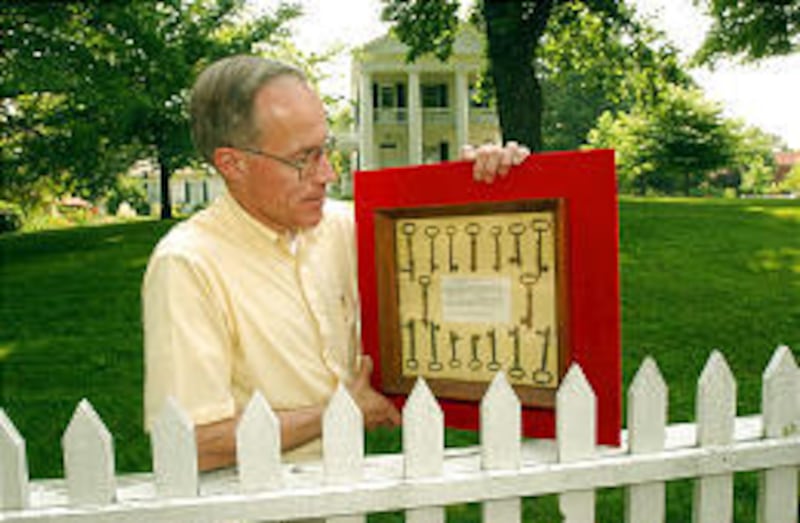
Housed about 50 miles south of Nauvoo in Quincy, Ill., an original set of 16 keys to the first Nauvoo Temple reside with the Historical Society of Quincy and Adams County. According to the society's executive director, Phil Germann, about 18 months ago a craftsman was sent by the church from Salt Lake City to Quincy to photograph and measure the keys "in order to make a replica" so reproductions could be made.
"I understand the original plan was to give them out at the dedication ceremony," he said Tuesday. But those plans may have changed, Germann said, noting the last plan he is aware of is that the replicas would be available for President Hinckley to use "when he visits abroad or encounters foreign leaders or dignitaries in the U.S."
Germann said the original plan called for 40 to 50 replicas to be made, but he's not sure whether those plans changed as well.
Wednesday, the church confirmed only that a limited number of reproductions of a key had been made for commemorative use.
Nauvoo historian C. Michael Trapp, who has been researching the history of the area since 1964 with a specialty in the history of Quincy, said he has also been told the keys may be a part of the dedication ceremonies, but only the church knows for sure.
Trapp said Wednesday he has never come across any information that would lead him to believe the keys in Quincy are not authentic. "But that's one thing about history. It's hard to ever know anything for sure" unless you were actually there, he said.
Germann said there is no doubt in his mind about whether the keys are authentic. The historical society received them decades ago from descendants of Artois Hamilton, who operated the Hamilton House Hotel in Carthage, Ill., about two blocks from the jail where church founder Joseph Smith and his brother, Hyrum, were martyred on June 27, 1844. Following the murders, while many residents of Carthage fled fearing retribution by church members, Hamilton "remained behind to prepare coffins for Joseph and Hyrum Smith and sent the bodies back to Nauvoo for burial," according to an official account provided by the historical society.
When the Latter-day Saints were forced at gunpoint to leave Nauvoo in 1846, Brigham Young, who would subsequently become church president, gave the keys to Hamilton. The gesture was done "out of gratitude to him for sending the bodies back to Nauvoo," but Germann wonders if there is more to the story.
"It's interesting to speculate why they were given to Hamilton. I think it was possible that Brigham Young thought they would be coming back, but we don't know" and can't be certain what all the motives were, he said.
When Hamilton's son, Gen. Elisha B. Hamilton, moved to Quincy in the 1890s, he was in possession of the keys and in time became vice president of the historical society. He passed them along to his children, E. Bentley and Mrs. Allan F. Ayers, who donated them to the museum in the 1940s. They have been housed there ever since, Germann said.
LDS Church leaders apparently first became aware of their existence in 1947, according to a letter from President George Albert Smith to an employee of the historical society, thanking her for sending along photos of the keys.
Dated Dec. 4, 1947, the letter opines that "if the inhabitants of Hancock County had all had the same kind hearts as (historical society director) Mr. Sinnock has, not only would the keys still be in existence but the temple."
Thanking her for his thoughtfulness in making a photo of the keys available, President Smith said the picture would be retained in the church historian's office.
Since that time, several LDS historians and scholars and researchers from Brigham Young University have examined the keys, Germann said. As word about their existence has trickled out, a larger number of visitors have made their way to the historical society in recent weeks as the Nauvoo Temple open house has been under way.
One woman from California came with a key in hand, convinced that her ancestor had a key to the first temple, he said. But a comparison of the keys showed they didn't match any of the 16 in the collection.
Germann believes because of the size of the keys owned by the historical society, they were probably used to unlock interior doors of the temple, rather than the larger, exterior doors. To his knowledge, they are the only Nauvoo Temple keys known definitively to have survived.
Yet a Utah man believes his family owned a key to the Nauvoo Temple and that it now resides at the Daughters of the Utah Pioneers Museum in Nephi. And a key among memorabilia from the Nauvoo Temple now on display in the Museum of Church History and Art in Salt Lake City includes a key that may have been from the temple.
Richard H. LeDosquet, retired forester with the Bureau of Land Management, told the Deseret News recently that a man named Henry I. Young (no relation to Brigham Young) was a custodian at the Nauvoo Temple and brought a key with him west to the Salt Lake Valley, and later took it with him to Mona, Juab County, when he settled there.
Young was his third great-grandfather and was a member of the committee for the church at the time they met with the Quincy Committee at the Battle of Nauvoo, just before the last church members left the city in 1846, he said.
According to LeDosquet, historical accounts relate that Young turned a set of temple keys over to the mob in Nauvoo in accordance with the agreement that was struck between anti- Mormon leaders and the Quincy Committee in August or September 1846.
But he retained one and, according to the description in the Nephi museum, the key "was found in the home of Henry I. Young when the home was being torn down and presented to the Daughters of the Utah Pioneers by Iona Young Kay."
Glen Leonard, director of the Museum of Church History and Art, said he has seen the keys in Quincy "and all the others that came forward recently from a family in Utah." He can't verify whether they were actually the keys to the temple, he said.
"What we know is that the temple had keys to various rooms. There were some presented to the church museum years ago and some even more recently, but we haven't had a chance to determine what kinds of locks they would be used with or how they would be used."
Leonard said it wouldn't be unusual to have several keys to the same doors in the temple. "Apparently many people had keys, including custodians and later occupants who all had access to keys and saved them. It wouldn't be unusual for them to turn up as a small reminder of the building."
E-MAIL: carrie@desnews.com