

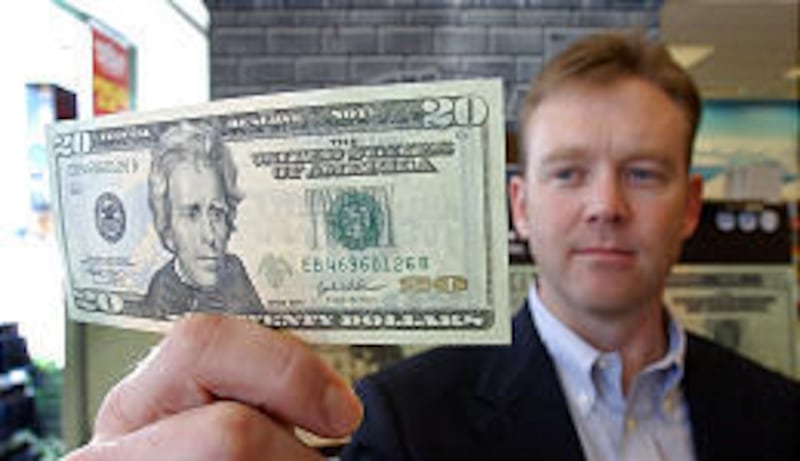
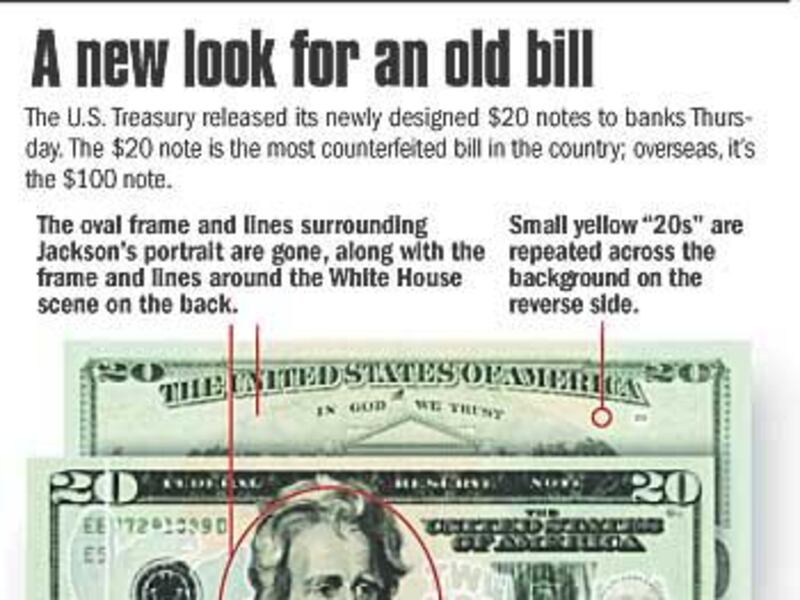
The "color of money" is now several colors.
One of the nation's redesigned $20 bills went into circulation in Utah Thursday morning at Maverik Country Store, 1927 S. 3230 West. It was the first of $20 million in new bills released in Salt Lake City Thursday, said Steven G. Allred, manager of cash and securities services at the Salt Lake branch of the Federal Reserve Bank of San Francisco.
"The 2004 series bill was created to deter counterfeiting," Allred said. "Currently, there are about one or two counterfeit notes out of every 10,000 notes in the U.S. The $20 is the most widely counterfeited."
When the previous series of $20 bills was released in 1996, the Fed determined that a new series should be introduced every seven to 10 years, Allred said. The new $20, then, is right on schedule.
A new $50 bill is schedule to debut next year, followed by the $100 bill, which is expected to be released in 2005. A redesign of the $5 and $10 notes is under consideration, the Fed said in a statement Thursday. There are no plans to redesign the $1 and $2 notes.
The new $20 bill's security features include a watermark similar to the portrait of President Andrew Jackson, which is visible from both sides of the note when held up to the light; a security thread, which is a vertical strip of plastic embedded into the weave of the paper; and the number "20" in the lower-right corner on the face of the bill, which changes colors (from copper to green) when the note is tilted. The bill also is multicolored, its background subtly layered in peach, green and blue.
"The new note is safer because it is easier to check and harder to fake," Allred said. "It is smarter, because it stays ahead of the tech-savvy counterfeiter. And it is savvy, because it maintains the integrity of U.S. currency."
According to The Bureau of Engraving and Printing, adding the new features to the currency increased the cost of producing the notes about 19 percent, or approximately 1 cent per $20 note. The new bills cost 8.2 cents per note.
Counterfeiting U.S. currency is a federal felony punishable by up to a $250 million fine and 20 years in prison, said Kim Fitzgerald, a special agent with the Secret Service.
The Secret Service has found that counterfeiting in Salt Lake City occurs at "relatively high" levels for a city its size, Fitzgerald said. That might be linked to the disproportionately high levels of methamphetamine production in the area.
Though the new bill may not drastically curb meth production in the state, Fitzgerald said the Secret Service hopes it will help to protect the public by making counterfeit bills easier to spot.
Larry Milburn, a Taylorsville resident who stopped by the Maverik as the new bill was put into circulation, said he liked the new features but wondered whether he'd do much more than "glance at it."
"I'd glance at it, but I don't know that I'd pay much attention to it," Milburn said. "I like it. But I don't care if it's pink, purple or polka-dotted. Money is money."
E-mail: jnii@desnews.com