


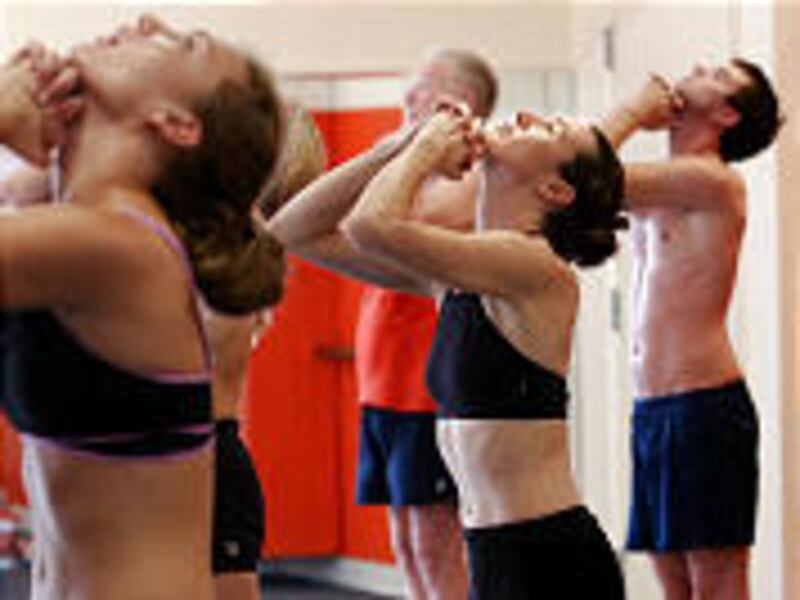

Some hate the heat inside the Bikram Yoga College of India, but they go anyway. Others who frequent the Sugar House Commons studio say it's like being in a foreign country. One calls it "an hour and a half of pure hell."
But the luckier students float out at the end of class, feeling light, clean, euphoric. Ninety minutes, 105 degrees, 26 poses and two breathing exercises do the Bikram number on these devotees. They find themselves able to stretch like never before, and they love perspiring away all that accumulated stress.
Coming back outside into the fresh air, however, Bikram students soon find that everything is not cool on planet yoga.
Bikram Choudhury, Calcutta yogi turned Beverly Hills multimillionaire, has built an empire on his specific, copyrighted series of poses. The poses, or asanas, are thousands of years old. Yoga is a Sanskrit word meaning union with the spirit. But when linked to the word Bikram, yoga becomes something else: a marriage of capitalism and healing. Choudhury's series is taught in more than 600 studios, all heated to his prescribed 105 degrees.
So far Utah has only the Salt Lake Bikram studio, and owner Jay Jones has yet to receive a bill for Choudhury's franchise fee. But at least two more Yoga Colleges of India are to open soon in the Beehive State. And all of them will probably have to pay some $200 per month to Choudhury, if they want to keep teaching his yoga.
The more you hear about yoga in America, the more it sounds like a religion. In his manual, "Bikram's Beginning Yoga Class," Choudhury writes: "The solution to your physical and mental problems is in doing these 26 postures and two breathing exercises. That's why I always say, 'It's never too late, it's never too bad, you're never too old, you're never too sick to start from scratch once again, to be born once again.'"
As in other world religions, some yoga practitioners disagree on which way is best. And in a sense, Choudhury's followers are persecuted.
"The whole yoga community is down on Bikram," Jones acknowledged. But unlike a religious leader, she readily shows a visitor her thick binder of articles that are critical of Choudhury. And she urges her customers to sample any and all forms of yoga. "Do everything, try everything," she says.
At Jones' place, you can sit and read those articles from Yoga Journal, the New York Times and other publications across the country. But you may be distracted by the converts, disciples and evangelists around you.
"I never had any intention of opening a studio," said Jones, 60. But after taking Bikram classes in 1999, two of her recurring injuries vanished. It was a simple equation, she said. "Every problematic thing in my life disappeared after doing this."
Running a Bikram Yoga College is also simple: It's the same class for everybody, regardless of fitness level, age or ailment. "There's no multitracking here," she said. "People who are old and fat can come here and get the benefits."
In the introduction to his manual, Choudhury, now 57, declares that medication, surgery or even regular exercise fail to heal what ails Americans. "What you are looking for," he writes, "is yoga. You are looking for my Beginning Yoga Class."
He explains that when he went to Mumbai, India, as a young man, he found "more people who needed me than I could help . . . I thought that if there was some way I could teach everyone the right postures in exactly the correct order, no matter what their disease condition was, then I could teach people in groups and then help more people."
Thus his series was born, which begat his training program, which begat hundreds of Bikram Yoga Colleges around the world, which begat his thousands of acolytes, who begat the millions flowing into Choudhury's coffers.
Yet such followers don't begrudge him his success. One Salt Lake teacher said she "adores" the man, and others proclaim his profound effect on their general well-being.
"I've seen so many drastic changes in people: personality, body, from the inside out," said Alex Wheeler, a Bikram teacher. He added that after people experience the intense heat of a Bikram class, they start to crave it.
"The heat makes your muscles more pliable," said student Lori Van Ness, 30. "You can go farther into the stretches. . . . You can get better every time. And it's calming, knowing what's coming."
Choudhury's book continues: As yoga has grown more popular, "uninitiated people . . . do not know that they are getting ripped off, even getting hurt," Choudhury goes on. "My teachers go through rigorous physical, mental, and spiritual training. . . . My teachers know the medical benefits of each posture. Most yoga instructors do not."
Americans can now try various yoga classes like they try ice-cream flavors, and most think that's wonderful, he writes. "I tell you it is disastrous."
A pair of veteran Salt Lake area teachers decline to say anything too negative about Choudhury. If a student asks Charlotte Bell about Bikram, she says, "If you're curious, you should try it." But for her personally, two things cause discomfort: the heat and the idea of copyrighting a series of poses.
"I believe that yoga belongs to everyone," Bell said.
Some students, she acknowledged, like Bikram's sweat-intensive classes for their detoxification aspect. "My own body doesn't like that kind of heat. I like to enjoy (yoga) while I'm doing it." Bell, 48, has been teaching classes at the First Unitarian Church in Salt Lake City and at Millcreek Yoga for 17 years.
"A lot of people are asking me to do 'hot yoga,' and I say no because that implies Bikram," said Dana Baptiste, who owns three yoga studios in Utah. Most recently she opened Centered City Yoga, 918 E. 900 South, but emphasizes that she is not trying to keep up with Jones or with Choudhury.
"What I do is better. I like it better for my body," said Baptiste, 37. She added that she prefers to raise her core body temperature gradually instead of having the class start right out on high heat.
Choudhury himself was Baptiste's first yoga teacher in 1989. "He's never done anything but help me," she says. Bikram yoga has "changed the lives of so many people. Has he gone too far with the franchising thing? I wouldn't do it."
At the same time, Baptiste adds, "This is America. This is a capitalistic country. Whether that's right or wrong, Bikram saw an opportunity." Back in the 1980s, "he was charging $25 per class and people were paying it. I thought, well, this is what America's about."
Bikram yoga is one of the few forms of suffering for which Americans intentionally fork over their cash. Its teachers say that "yoga doesn't discriminate" against age, color or creed, but Bikram classes might screen out those who don't have $10 to $14 per session. That's the cost at Jones' studio, where classes are taught 31 times a week.
Yes, there is suffering, said Jackie Young, a Bikram teacher who plans to open a Yoga College of India in Sandy next month. But suffering "expands your limits."
During the camel pose about halfway through a Bikram series, teacher Pam Crowe-Weisberg warned students that they may feel "dizzy, nauseous, happy (or) sad." The pose opens the chest to release pent-up emotion, she said. "Just experience it, and let it go."
The Bikram series fits all comers, added Crowe-Weisberg, 57. "It's the McDonald's of yoga: Everywhere you go, you know what you're going to get." She plans to open a yoga studio in Park City early in 2004. "Only Bikram," she said. "We are Bikraminis."
As they soak their towels with sweat, Bikraminis may be cleansing of their sins from the night before. Jones said that on some weekend mornings "the room stinks," as people perspire away their cocktails and other intoxicants. "I don't have to say anything," Jones added. The stench of recycled alcohol and other drugs sends the message about body pollution.
The heat never really gets easy to take, said Gary Larson, a 47-year-old real estate agent and builder who began Bikram classes about a year ago. "I wanted to get more limber and feel younger," he said. As for Choudhury's franchising plan, "He ought to get paid for what he's doing. It doesn't bother me."
Several teachers and students said the same thing: Self-improvement gurus are all angling for the consumer's dollar, and Choudhury should be free to capitalize on his particular mode of healing.
"People are making tons of money doing yoga," Jones said. "It isn't just Bikram."
E-MAIL: durbani@desnews.com