

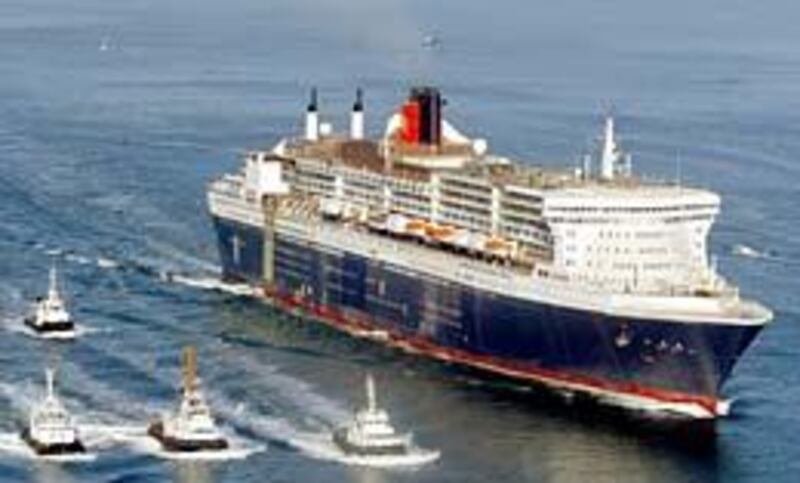
When the Queen Mary 2 begins its maiden voyage from Southampton, England, to Fort Lauderdale, Fla., on Jan. 12, the "wow" factor is sure to follow in its wake.
The $780 million ship, the first new ocean liner to be built in three decades and the biggest ever made, will be more than twice the size in tonnage of the Queen Elizabeth 2: From its water line, the Queen Mary 2 is the height of a 23-story building. One hundred and thirty-five feet wide, it stretches nearly four football fields in length. And its operator, Carnival Corp.'s Cunard Line unit, is offering amenities that include deluxe penthouses, a planetarium, the first Chanel and Dunhill shops at sea, a Veuve Cliquot champagne bar and a "pillow concierge" offering nine types of pillows.
But the biggest "wow" of all may be this: The last thing the cruise industry needs is another big ship. Industry capacity — measured by the number of total berths — rose 27 percent in the past three years, two of which were haunted by post-9/11 terrorism fears and an economic slump. That has led to some of the biggest discounts ever in recent months as the cruise lines seek to fill their berths.
The arrival of the 2,620-passenger QM2 at a time when there are plenty of berths to go around is partly driven by the three- to four-year lead time for building cruise ships. (The QM2 was ordered three years ago.) But it also shows the intense competition among the passenger-ship giants to have the latest and biggest vessel, even if new capacity promises to keep pressure on prices.
Most passenger ships are built in Europe, where the weak U.S. dollar has made construction increasingly costly. Some cruise companies have consequently tried to slow their ship orders, an onerous process that entails contract renegotiations. But even as some orders have been cut back, others have been added. Royal Caribbean Cruises Ltd. recently let two options for new ships expire. On the same day, however, it ordered a new, as yet unnamed megaship that would rival the Queen Mary 2 in size. Norwegian Cruise Line, a unit of Malaysia's Star Cruises, also ordered two new ships on the same day.
Cunard is hoping that its regular six-day trans-Atlantic crossings aboard the QM2, scheduled to begin in April, will help restore the luster to its brand. The ship will also do periodic longer sailings to the Caribbean and South America during the winter. With the QE2 abandoning Atlantic crossings to concentrate on cruises in the British Isles, the QM2 will be the only ship offering regularly scheduled service between New York and Southampton, in the style of grand old liners.
Partly because voyagers favor cruises — stopping at ports to shop and see the sights — other lines stay away from the lanes of the North Atlantic. In addition, unlike ocean liners, most cruise ships aren't very comfortable riding in rough ocean water. Cunard answered that by building the QM2 with a narrower profile to smooth the voyage. (Its ancestor, the Queen Mary, was a notorious roller in rough weather.)
The QM2's first sailing is sold out. And the line says 60 percent of the ship's early bookings are from people new to the brand. The question is whether that will continue after the initial burst of publicity. "Is it sustainable?" asks Glen Reid, a cruise-industry analyst at Bear Stearns.
The QM2 could be in for some rough sailing with its multiple-class service, competing with mainstream and ultraluxury brands. Deluxe penthouses, two-story apartments and so-called Queen-level suites have their own restaurants, off limits to hoi polloi, with haute cuisine menus. A grand two-story apartment overlooking the stern is priced at as much as $37,499 per person on the 14-day maiden voyage, in line with prices for 14-day ultraluxury cruises that offer more intimate surroundings. Down below, inside cabins are going for $1,499 per person, still pricey compared with mainstream cruise brands battling against each other with steep discounts.
Pamela Conover, Cunard's president, acknowledges that the past year has been a particularly difficult time to sell luxury cruises. "When you're at the top of the pyramid, your market is smaller," she says.
"We will position the (QM2) as grand without being old-fashioned," says Conover, noting that even those in the cheaper inside cabins will have access to some of the deluxe amenities, including a branch of the Canyon Ranch spa.
Cunard had its start in 1839 as British & North American Royal Mail Steam Packet Co. In 1912, Cunard's Carpathia rescued the Titanic survivors. Its Queen Mary, officially launched in 1938, and her slightly younger sister ship, the Queen Elizabeth, ferried troops across the Atlantic in World War II. In peacetime, they were long vessels of choice for the rich and famous.
In 1954, ocean liners carried one million passengers on trans-Atlantic routes, and airplanes carried 600,000. But by 1965, ships carried 650,000 transatlantic passengers, while airplanes carried 4 million. In 1971, Cunard sold the Queen Mary for use as a museum and hotel in Long Beach, Calif., where it still operates. The following year, the Queen Elizabeth, about to be converted into a floating university, was destroyed by fire in Hong Kong harbor.
The QE2, which made its official maiden voyage in 1969, made an initial splash but struggled with an increasingly poor image. In 1994, after a purported renovation, passengers boarded to find overflowing toilets and uninhabitable cabins. "It truly was a dying brand; there were no investments being made," says Micky Arison, chairman and chief executive of Carnival, which bought Cunard in 1999.
The 150,000-ton ship QM2 is being built by Chantiers de l'Atlantique, the shipbuilding unit of French conglomerate Alstom SA. Recently, Conover led guests at the shipyard in St. Nazaire, France, around scaffolding through the QM2's grand lobby. She pointed out a small corner where travelers might sit and watch the world sail by, a touch intended to recall the old liners. Grand staircases entice passengers to make a grand entrance for dinner. A teak-floored promenade encircles the ship, inviting a leisurely stroll at a time when cruise lines have largely done away with promenades.
Local billboards boast of what's to come. "St. Nazaire construit des Geants," says one. "St. Nazaire builds giants." Carnival is planning new docking facilities in New York because the current one will be a tight fit. The QM2 is too long and too wide to fit in the Panama Canal, and its size makes it difficult to dock in some ports. No matter, says Conover. "The QM2 will be the destination."