

"The moon is down," said Hark. I have not heard the clocks."
"You'll never hear them!" screamed the Duke. "I slew time in this castle many a cold and snowy year ago."
Hark stared at him emptily and seemed to be chewing something. "Time froze here. Someone left the windows open."
— James Thurber, "The 13 Clocks"
Ahh, Sunday is the end of daylight-saving time. Go to bed. Sleep in. Magically gain an hour of time.
Pretty nice, huh? Creation of time ex nihilo with a simple twist of the clock dial.
But wait a minute, you say — that hour didn't appear out of nowhere. It's the repayment of a one-hour loan we granted the universe back in April, when we set our clocks one hour ahead. All right — so where has that hour been all this while?
Being as it is an amalgam of nature and artifice, time is a tricky thing. The only natural divisions of time we use are years (the time it takes Earth to orbit the sun), days (one rotation of the Earth) and lunar months (the time it takes the moon to wax and wane). Hours, minutes and seconds are all human constructs.
Twenty-four-hour days, for example, are a carryover from ancient Egyptian sundials that arbitrarily divided the daylight into 12 equal segments. Sixty-minute hours and 60-second minutes are a carryover from the ancient Mesopotamian sexigesimal (base 60) numbering system.
After their revolution, the French attempted a short-lived time-keeping system based on the more common decimal (base 10) system, but it never caught on.
"We could no more find our clock time in nature than we could find a wooden chair sprouting from the soil or a sweater growing from a sheep's back," said Jo Ellen Barnett, author of the book "Time's Pendulum."
Deseret News graphic
Cesium atomic clock diagram
Requires Adobe Acrobat.
This new birth of time, this new Nature, begotten by science upon fact, has pressed itself daily and hourly upon our attention, and has worked miracles which have modified the whole fashion of our lives. — Thomas Huxley, "The Progress of Science"
Time was inextricably tied to nature — the sun, the moon, the seasons — through most of human existence.
Eventually, however, the Greeks and others began imposing themselves on time by, for example, marking gradations on sundials indicating divisions of time during the day.
Water clocks, which measured time by the flow of water through a basin's hole, were developed to tell time indoors or on overcast days or at night. Hourglasses did the same thing with sand. Simple (and wildly inaccurate) mechanical clocks were created.
Then, a revolution. Nineteen-year-old Galileo Galilei, the account goes, got bored during prayers at the Cathedral of Pisa in 1583 and began watching the swinging altar lamp. Using his own pulse, he timed it and found the swings took the same amount of time whether they were wide or narrow. The pendulum clock was born.
The pendulum clock vastly improved timekeeping, staying accurate within an unheard-of 10 seconds, then a single second, per day. (The differences were measured at noon when the clocks were calibrated by the sun's zenith.) Other clocks were developed. In 1759, an obscure Yorkshire carpenter named John Harrison unveiled H-4, his superbly accurate chronometer for the determination of longitude. The Swiss took up the mantle of clockmakers. Clocks became fine pieces of craftsmanship, worthy of collection.
"I was always just really fascinated with how clocks worked," said Penny Allred, owner of Antique Time in Salt Lake City.
Allred sells all kinds of clocks — angel clocks, chess clocks, glass clocks, wood clocks, grandfather clocks, Napoleon clocks. Some of them were made as long ago as the 1700s. Her shop is a cornucopia of handcrafted timekeepers.
"They're almost alive," Allred said. "They have hands and faces. They tick. They have movement. If these clocks could tell you where they've been . . . "
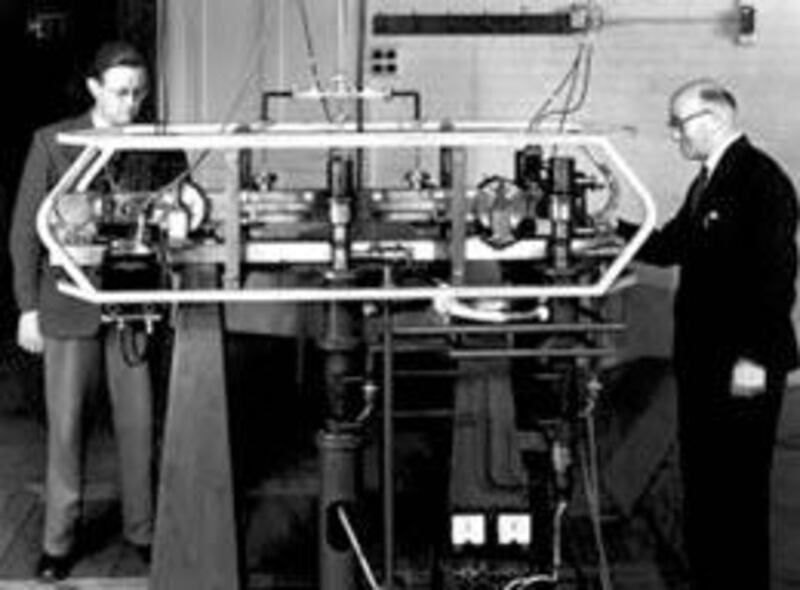
Alas, time marches on. In 1928, those lovingly crafted clocks were instantly rendered obsolete by a clock with no moving parts: the quartz crystal clock. Then, in 1955, the ultimate (and aggressively unromantic) timekeeper: the atomic clock.
Deseret News graphic
History of timekeeping
Requires Adobe Acrobat.
Atomic clocks are regulated by an isotope of the cesium atom, cesium-133. When the atom's outermost electron flips its magnetic direction, or "spin," relative to the nucleus, it emits or absorbs a quantum of radiation with a frequency of 9,192,631,770 cycles per second.
Just like that, man wrested time away from the Earth's rotation. No longer was a second defined as 1/86,400th (24 hours x 60 minutes x 60 seconds) of a day. In 1967 the 13th General Conference of Weights and Measures formally defined a second as "9,192,631,770 periods of radiation corresponding to the transition between the two hyperfine levels of the ground state of the caesium-133 atom."
The only thing that now connects human time with natural time is the year. The Earth's orbit around the sun is currently measured by the positions of a variety of stars and quasars.
Since an official atomic second is slightly shorter than a "natural" second (it takes about 86,400.002 atomic seconds to fill an average solar day), every so often the Bureau International des Poids et Mesures outside Paris, the official worldwide arbiter of time, inserts a "leap second" into the year to make up the difference.
The Bureau International collects data from dozens of atomic clocks throughout the world, statistically compares them and comes up with an official worldwide time. The Directorate of Time at the Naval Observatory in Washington, D.C., and the National Institute of Standards and Technology in Boulder, Colo., are two of the contributors.
The NIST's cesium fountain atomic clock is accurate to the point that it will neither gain nor lose a second in 20 million years.
When you sit with a nice girl for two hours, it seems like two minutes; when you sit on a hot stove for two minutes, it seems like two hours. That's relativity. — Albert Einstein
Far from a steady, flowing stream, time is relative: The faster one moves through space, the slower one moves through time and vice versa (and that's not even taking into account gravitation).
Everyone moves through combined space-time at the speed of light — we humans, moving very slowly through space, make it up through rapid movement in time. Electromagnetic radiation, moving at the speed of light through space, doesn't move at all through time. For light, time stands still.
But Einstein was right — we experience relative time every day. Numerous studies have shown that people perceive time to pass quickly when they are doing something enjoyable or concentrating hard, while time passes slowly while they're waiting or bored. Time, in other words, really does fly when you're having fun.
Relative time is helped by the fact that most humans have lousy internal clocks. Put a person in a room with no stimuli and tell him to call in an hour and he'll usually miss the mark by a wide margin.
Some people, however, have trained themselves to sense time. An elite athlete, for example, can tell through a thousand tiny signs whether he's moving fractionally faster or slower. Coaches take advantage of that innate sense with "tempo trainers" — tiny metronomes that sound tones in the athlete's ear to time his movements.
"It's a skill that takes a long time to learn," said Deward Loose, swimming coach at Lone Peak High School in Utah County. "It's kinesthetic awareness. Call it feel. It's amazing to me. . . . The elite swimmers can tell the difference in 100ths of seconds."
Great hitters see the baseball slow down to the point that they can count the stitches. The ball becomes huge for great tennis players. And it's not only them. "A number of psychological studies have demonstrated that time expansion is well within the reach of common mortals," said social psychologist Robert Levine.
Thus we can, with enough effort, implement Thomas Mann's instruction:
"Hold fast the time! Guard it, watch over it, every hour, every minute! . . . Hold every moment sacred. Give each clarity and meaning, each the weight of thine awareness, each its true and due fulfillment."
E-mail: aedwards@desnews.com