

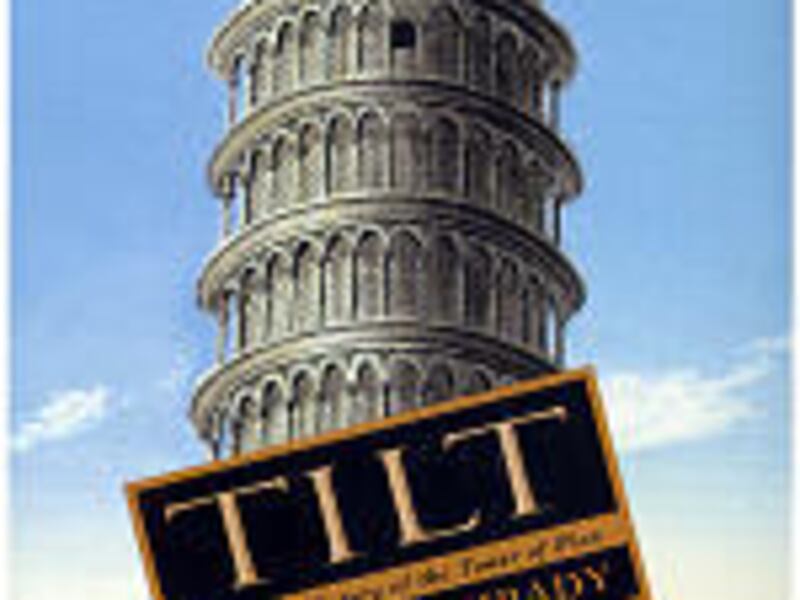
TILT: A SKEWED HISTORY OF THE TOWER OF PISA, by Nicholas Shrady, Simon & Schuster, 161 pages, $21.95.
The eye-catching cover design of "Tilt: A Skewed History of the Tower of Pisa," was not the author's idea — and, in fact, it worried him. But it fits nicely with this interesting and beautifully written book.
Nicholas Shrady, a gifted magazine writer with one other book to his credit ("Sacred Roads: Adventures from the Pilgrimage Trail"), has given the 180-foot tower, with its delicate arches and columns, the tedious and difficult research it needed to come to life as a historic icon.
Completed in 1370, the Romanesque tower's distinctive tilt, 1.6 degrees from vertical when construction was completed, has been a curious mystery that every generation since has worried about.
Nearly a thousand years later, it stands four meters — or five degrees — askew, thus defying both gravity and logic. It was built with a marble and lime faade, a symbol of the power and wealth that Pisa enjoyed in those early days. The campanile — or bell tower — supports seven huge bronze bells, adding significantly to the weight.
But it is the annoying slant that has generated the most interest as engineers time and again have tried various methods to set it right. Benito Mussolini's effort was the worst — he ordered 361 holes to be drilled in its base so concrete could be injected into its foundation.
During World War II, the "Tiltin' Hilton" was used as an enemy hideaway and it came close to being bombed. Beginning in the early 1990s, a $30 million stabilization project was undertaken that lasted more than a decade.
Pisa is no longer the richest and most awesome town in Italy, but it still draws crowds who want to take a long look at the leaning tower. Had the structure fallen, there would probably be little reason for tourists to visit Pisa.
Theories about what has caused the tilting have been numerous, but Shrady has conclusively demonstrated that it's more simple than any of the conspiracies suggested — it is the alluvial, unstable soil of Pisa and surrounding areas. Shrady found that several other buildings in Pisa are also "off-kilter." The author believes the entire area was once a bog.
Shrady tells this ingratiating story with skill and style, noting that Pisa's greatness in the Middle Ages lay in the gifted artists and architects it drew or produced. They "were blessed with a rare aesthetic genius," he says. Unfortunately, the architect of the tower remains unknown, even though all the other buildings in the square, including the great cathedral, were signed.
Other myths are also exploded by Shrady — for example, there is no evidence that Galileo conducted any experiments from the top of the tower.
Now that the lean has finally been stabilized, the tower is said to be safe for another 300 years. Whether you have personally climbed the 293 steps to the top or not, this story of the tower's history may very well enchant you.
E-mail: dennis@desnews.com