

Like it or not, the "hotter" radioactive waste from Fernald, Ohio, is headed to Utah, the contractor conducting the cleanup said.
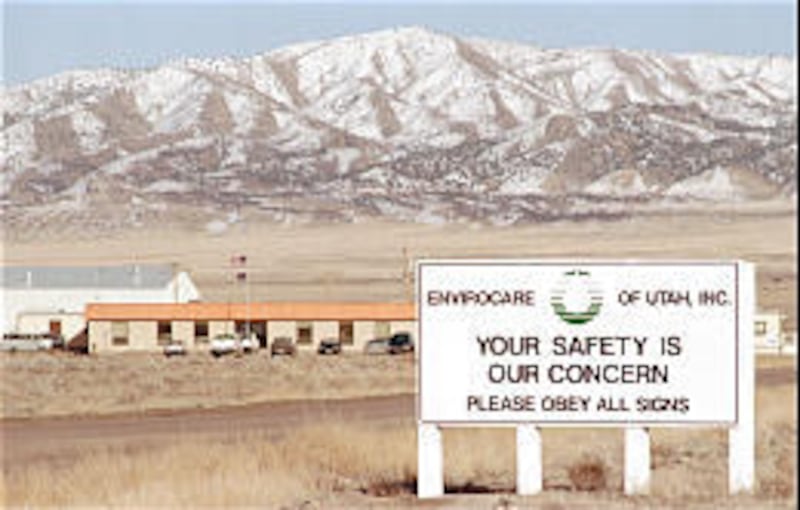
The radium-bearing waste stored in concrete silos will either come through Utah by the truckloads or be dumped at Envirocare of Utah's landfill 75 miles west of Salt Lake City.
"Currently, right now our only option is to send it by truck to the Nevada Test Site," said Jeff Wagner, spokesman for Fluor Fernald, the Energy Department's contractor. "We will ship the waste off-site."
By the end of 2006, Fernald hopes to complete the cleanup of the Fernald plant, where atomic bomb fuel was made. The Fernald Performance Management Plan, released 17 months ago, specifies that 8,890 cubic yards of the silo waste would be shipped to Envirocare. It set a target date for removal of April 2005.
In order to do that, DOE would first pursue a reclassification of the Fernald tailings so that commercial companies could bid on the waste. The plan specifically mentions Envirocare by name.
"(Fernald officials) came to us," said Tim Barney, senior vice president of Envirocare. "They said we have this material. We've looked at our options and we think sending it to you would be safer and cheaper."
Without the congressional reclassification, waste would have to be shipped to the DOE-owned Nevada Test Site, a lengthy, expensive process that would require about 3,800 truckloads across the nation's highways, including I-80 through Parley's Canyon to I-15 and south to Nevada.
Envirocare has said it plans to ship the waste by rail, and that the 27 train-car loads would ultimately save U.S. taxpayers $30 million.
Recent opposition to this plan has prompted Envirocare to hold off on taking the waste until Utah wins regulatory oversight for uranium mill tailings from the Nuclear Regulatory Commission and after a state task force completes its study at the end of next year. The earliest the waste would come to Utah, provided Envirocare even wins the bid, would be 2005, and then it would come only after state regulators gave their approval.
Fernald plans to move forward with or without Utah's support.
"We just need to keep moving along in this process," said Wagner. "We're obviously disappointed."
But critics say the waste doesn't have to come through Utah at all. They say Fluor Fernald is limiting its options to Nevada or Utah because it's in a rush to complete the $1.6 billion cleanup job in order to receive a substantial bonus.
"The contractors are unwilling to think outside the box because there is a bucket load of cash available to them staying within the box," said Jason Groenewold of Healthy Environmental Alliance of Utah (HEAL).
Claire Geddes of Utah Legislative Watch said other options exist, such as vitrifying the waste, a process that turns the waste into a glasslike substance.
"DOE is now trying to get rid of this on the cheap and easy," she said.
At one point, Fluor Fernald suggested building a rail spur into Nevada but officials there opposed the move because it would open the door for nuclear waste shipments, Geddes added.
Still Envirocare wants the business, but it needs a change to its federal license to be allowed to take the waste. And the Fernald tailings would have to be reclassified by Congress as "commercial."
At the request of the Department of Energy, Rep. Rob Bishop, R-Utah, wrote a letter to House and Senate negotiators requesting a provision in the energy bill to reclassify the waste. Unbeknownst to Utah lawmakers, Ohio lawmakers had successfully included the same provision in the water and energy appropriations bill.
In the firestorm of opposition that has erupted over the Fernald waste, Bishop cut a deal with Envirocare wherein Envirocare agreed to hold off on the waste.
But critics say Envirocare really hasn't given up anything since the company is on target to receive the waste in April 2005 anyway, based on the Fernald management plan.
In a letter to Envirocare's president and owner Khosrow Semnani, HEAL Utah formally asked Envirocare to withdraw its license modification before the NRC.
"It's a question of credibility, of whether actions speak louder than words," Groenewold said. "The only meaningful way to ensure the state has the decision-making power over the feds is if Envirocare withdraws its request."
Envirocare officials say they have already backed down quite a bit.
"By deferring and pushing out the timetable, we risk losing the business. What that means is 3,800 trucks coming through Utah," Barney said.
Bishop has asked the NRC to reopen the public comment period on Envirocare's application to modify its license to accept hotter radioactive waste.
Currently, the facility's limit is 4,000 picocuries per gram, (a picocurie is a measurement of radioactivity that is one trillionth part of a curie). The company petitioned to have it raised to 100,000 picocuries per gram. That would allow Envirocare to dispose of the waste that contains radium-226, an isotope outlawed in Utah because of its hot radioactivity and the time it takes to decay.
Those factors have Gov. Olene Walker and other critics opposing it.
"I don't think I would ever change my opinion," Walker said Thursday at her monthly KUED news conference. "I don't want hotter waste than we now accept."
GOP gubernatorial candidate Jon Huntsman Jr. also came out in formal opposition Friday to Envirocare accepting the waste.
Few disagree the decision on whether to take the waste or not should remain with the state and not the federal government. And if state regulators are in charge, then Utah public policy will play a greater role in those decisions.
"I look at it as somewhat of an ace in the hole," Walker said, adding she hopes it will occur by March or April. "I think then we can determine our own future. But I don't think that's a cure-all because I think you'll find even within the state vastly different opinions so it won't end the debate."
State Rep. Steve Urquhart, R-St. George, who is co-chair of the legislative task force studying waste issues, plans to introduce legislation that would require Envirocare to seek legislative and gubernatorial approval for the Fernald waste or any other waste that has radioactivity in excess of 10,000 picocuries per gram.
Under the current system, Envirocare falls outside the legislative and gubernatorial approval process when it takes wastes regulated by the NRC. And even after the state assumes the regulatory responsibility from the NRC, Envirocare wouldn't need political approval for the uranium mill tailings unless Urquhart's bill wins passage.
"My plan is to clarify that the state of Utah play an important role through legislative and gubernatorial analysis on this," he said. "I don't feel comfortable with the idea of only the waste policy task force taking a look and setting policy for the state. While I think the task force is competent and doing great work, I'm not presumptive to think the legislative task force speaks for the entire Legislature."
Barney doesn't think the legislation is necessary in light of their deal with Bishop.
"It seems there was some concern that this was a federal action slipped backed in the darkness of night that the state was being forced on them by doing this," Barney said. "If state regulators say it can't be done safely than we don't want to do it. We will voluntarily abandon our efforts."
E-MAIL: donna@desnews.com