

PROVO — The story goes that as Ira Fulton walked away, LDS Church President Gordon B. Hinckley turned to then-Brigham Young University President Merrill J. Bateman and asked, "Is this guy for real?"
Fortunately for BYU, the answer was yes.
Fifty million times.
It was September 1999, and President Hinckley spoke at the Marriott Center to celebrate the successful end to the university's "Lighting the Way" fund-raising campaign.
Some $380 million was raised for the school — well above the target of $250 million.
President Hinckley surprised the fund-raisers in the room when he issued a new challenge: Reach $400 million by the end of the year.
Afterward, Fulton stepped forward to meet President Hinckley. "You've got the $20 million," Fulton told the leader of The Church of Jesus Christ of Latter-day Saints.
To be sure, Fulton's spur-of-the-moment gift pledge was very much for real.
Fulton is so real that the Arizona homebuilder would likely be on his way to becoming a billionaire if he'd simply stop writing checks that end in six zeroes.
The real story is how the LDS man found BYU so late in life.
Fulton was 67 before he gave a cent to the church-owned school. In the four years since, however, he and wife Mary Lou have become the largest donors in the university's history.
In all, the Fultons have donated $50 million to BYU.
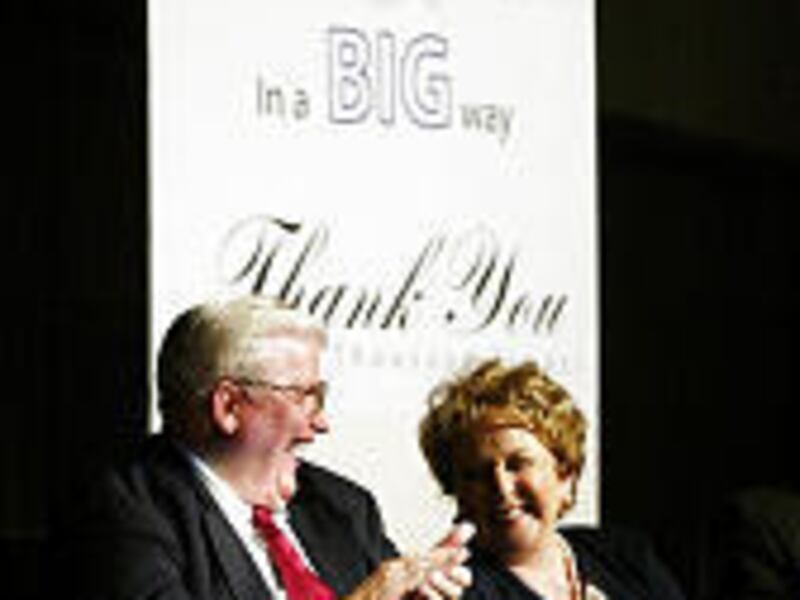
The school reciprocated Thursday with a major bash to announce a fresh name for a large portion of its campus — the Ira A. Fulton College of Engineering and Technology.
The Cougar Marching Band played "Happy Birthday" — Fulton turns 72 on Wednesday — as more than 1,500 people sang along in the Wilkinson Center ballroom.
It was a church connection that in 1999 put BYU fund-raisers in front of Fulton, who thought he'd "be nice but run them off real easy." Instead, a church fireside he attended with Bateman in Mesa, Ariz., piqued his interest in helping the school.
A visit to the Provo campus changed his life — and BYU's bottom line.
"I have the same feeling when I walk this campus as I do when I go to the (LDS) temple in Mesa," Fulton said after Thursday's party. "I believe that Brigham Young University is sacred ground."
In fact, Fulton's philanthropy is motivated by his desire to invest in the futures of BYU's students and to boost their earning power with the church's and university's benefit in mind.
"The church needs the tithing income," said Fulton, referring to LDS Church members who give 10 percent of their income to the church. "My payback is off the increase. If they make more money, they'll pay more tithing."
Tithing funds provide as much as one-third of BYU's operating costs, according to some estimates.
Fulton plans to keep giving the school money, but only if he keeps seeing results. He pesters Samuelson and Doug Chabries, the chairman of BYU's engineering and technology department, to make sure his money is considered an investment, not simply a donation.
"The College of Engineering and Technology has to be really careful now that my name is on it," Fulton said with a laugh. "I'll be calling even more, making sure my investments are paying heavy fruit."
So far, he's never been disappointed.
"Every department I invest in, they exceed my expectations immediately," he said. "I can't keep up with the intellects coming on this campus."
The most obvious example is the donation of a supercomputer — a powerful machine affectionately dubbed Mary Lou by BYU.
Soon after the supercomputer arrived, students and faculty were running so many programs on the machine that it was running at capacity.
At first, Fulton thought the university had purchased a subpar computer. Instead, he paid to double its capability, but the students and faculty reached its capacity again in just 48 hours.
After five upgrades, the supercomputer now handles eight trillion instructions per second. Fulton has agreed to provide the funds to double its capacity again at the beginning of the year to 16 trillion circuits per second. That power, which normally costs between $500 and $2,000 an hour, is available for free to BYU students who obtain approval for projects.
The presence of the supercomputer lured a separate donation of $313 million donation in software and technology to the campus last year.
Fulton lunched Wednesday with President Hinckley and members of the LDS Church's Quorum of the Twelve. The recognition has been difficult, he said, because it's easier to give than receive.
"I have fun making money," he said, "but I have more fun giving it away. I'm looking not at today or tomorrow, but future generations."
The Fultons give away 50 percent of their income. In June, they donated $50 million to Arizona State University, which also named its school of engineering after Ira.
Mary Lou Fulton told students during Thursday's celebration, "You're beautiful. You help us to do what we do. Because of your excellence, testimonies, hard work, deans and professors, you're probably the most prized students in the world. We'll be with you and help you as long as we can."
Fulton nearly hooked up with BYU 50 years ago when he considered playing football for the Cougars. When he saw how many of his friends went to BYU and wound up married, he scuttled that idea. He wanted to stay a bachelor until he was 25 — but he didn't make it.
He played a year for Arizona State before quitting to get on with business ventures.
Hard work is nothing new to Fulton, the youngest of seven children raised by a single mom. As a young man, he was named Arizona's top paperboy.
Fulton also was salesman of the year for the National Cash Register company, turned around struggling Eagleson's Big and Tall clothing stores and then built Fulton Homes into one of the most profitable home-construction companies in the United States.
One of his ancestors, Chabries pointed out Thursday, is Robert Fulton, who didn't invent the steamboat but made it profitable.
Fulton's profits will continue to steam into BYU.
"How many more tens of millions I'll give to the university, I don't know," he said after BYU presented him with a clay bust of himself, a portrait and the most coveted parking pass on campus, the omnipotent "O" pass.
"By the time I'm ready to retire I'd like to say I gave hundreds of millions."
E-mail: twalch@desnews.com