

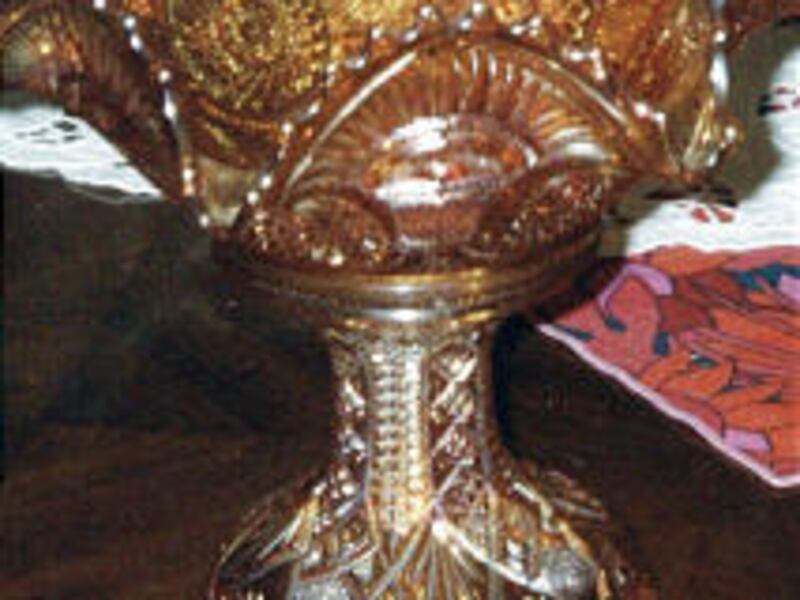
Dear Helaine and Joe: The fruit bowl was handed down to me by my grandmother, and it originally belonged to her mother. My grandmother told me that a dealer offered her $300 for it in the 1950s, and I saw an identical one in a Los Angeles antiques store for $900 in 1981. I have been told that these values are way off and the piece is pre-Carnival glass. Can you help me identify a value and provide information about age and origin.
Thanks. — K. M., Indianola, Ill.
Dear K.M.: As we have said before, we intensely dislike identifying pressed glass patterns with designs that imitate American Brilliant Period cut glass as this one does. Finally, after what seemed like a week (but was only an hour) we discovered that the pattern of this fruit bowl on stand is called "Twins" and that it was made by the famous Imperial Glass Co. of Bellaire, Ohio.
This company was organized in 1901 but it did not actually make glass until January 1904 — and Carnival glass, which is what K.M.'s fruit bowl and stand happen to be, was not made until about 1909.
For those who want to make their Carnival glass "over a hundred years old," it needs to be pointed out that no one made this product until the waning days of 1907 and into 1908, so no piece of Carnival glass will be "over 100 years old" for another four or five years at the earliest.
The first Imperial Carnival glass appeared in their 1910 catalog, and this colorful ware would continue to be made until about 1930. It should be mentioned, however, that Imperial reintroduced Carnival glass around 1962 but most of this latter production will be marked with a letter "I" running through the middle of the letter "G" (this mark was first used in 1951).
We could find no reliable information as to when Imperial began making the "Twins" pattern, but we do know that it was a very popular pattern and was produced in huge quantities. It is most commonly found in marigold, which is the color of the piece belonging to K.M., but it turns up in shades called "smoke" and "helios" as well. "Helios" is a shade of green with a silver/gold iridescence while "Smoke" is charcoal gray.
"Twins" was a pattern used on a relatively small number of shapes. It can be found on a 9 to 10 inch diameter master berry bowl, a 5 to 6 inch individual berry bowl, a bride's bowl in a metal holder and a fruit bowl and base.
The Imperial "Twins" pattern fruit bowl and base actually came in two varieties — one with the bowl having a sort of scalloped top edge and the other with a lovely ruffled profile. This latter type is what K.M. has inherited. So far, the ruffled edge examples have been found only in marigold, and they are extremely plentiful.
As for the monetary worth of this piece, its insurance replacement value is in the $100 to $125 range.
Distributed by Scripps Howard News Service, www.shns.com