

ST. LOUIS — A fruity scent fills the air as multihued tablets click and clack into plastic bottles and then zip away. A few yards away, the aroma turns minty as round, white wafers are sealed tightly into rolls.
The tasty tablets sit in jars and bowls on desks. Workers will occasionally pop a couple into their mouths as a snack.
"It's almost like candy to us," plant manager Glen Giles said.
But it isn't candy. It's TUMS.
More than 6 billion of the chalky indigestion blockers are made each year in the red brick building near its better-known neighbor, Busch Stadium, home of the St. Louis Cardinals. Representatives from GlaxoSmithKline, which makes TUMS, say few people are aware that the site is where the popular antacid and calcium supplement is made.
In the past year, TUMS had three of the top 10 antacids by sales in dollars, according to statistics from Information Research Inc. During that period, TUMS' extra-strength tablets, or TUMS EX, sold more units than any other brand-name antacid.
TUMS were born in St. Louis in 1928, the brainchild of pharmacist Jim Howe, who was leaving for an ocean cruise. He formulated a mint-flavored remedy for his wife's indigestion using calcium carbonate. It worked — not only for her but for other passengers on the ship.
Seventy-five years later, TUMS are known around the world.
Since 1930, the plant in downtown St. Louis has been making the antacid tablets. They were first made by the Lewis-Howe Co., which took its name from Howe and his uncle, A.H. Lewis, who was a pharmacist in Bolivar in southwest Missouri.
In 1885, a 14-year-old Howe came to work for Lewis at his drug store. Five years later, he was certified as a pharmacist in Missouri.
Historical accounts from TUMS indicate Howe developed the product in the basement of his St. Louis home and it was named in a radio contest by a nurse at Jefferson Barracks in south St. Louis County.
The downtown plant has produced every TUMS tablet containing sugar. Sugar-free TUMS, which make up less than 2 percent of sales, are made in Aiken, S.C.
The process begins on the ground floor, where 2,000-pound bags of sugar and calcium carbonate arrive by the truckload. They're tested for quality and safety, then hoisted to the fourth floor.
From there, the contents are vacuumed one floor up to the top level of the building, where starch and flavoring are added. There are 25 flavors of TUMS. Peppermint is the most popular, but assorted fruit flavors — from cherry and raspberry to strawberry-banana and mandarin orange — make up about 70 percent of the TUMS sold.
Once water is added, the powdery mix gains a mealy texture. The mixture is then dried and sieved before being sent down a tube to a machine on the fourth floor that presses the tablets into shape.
The machine spits out as many as 2,900 TUMS a minute.
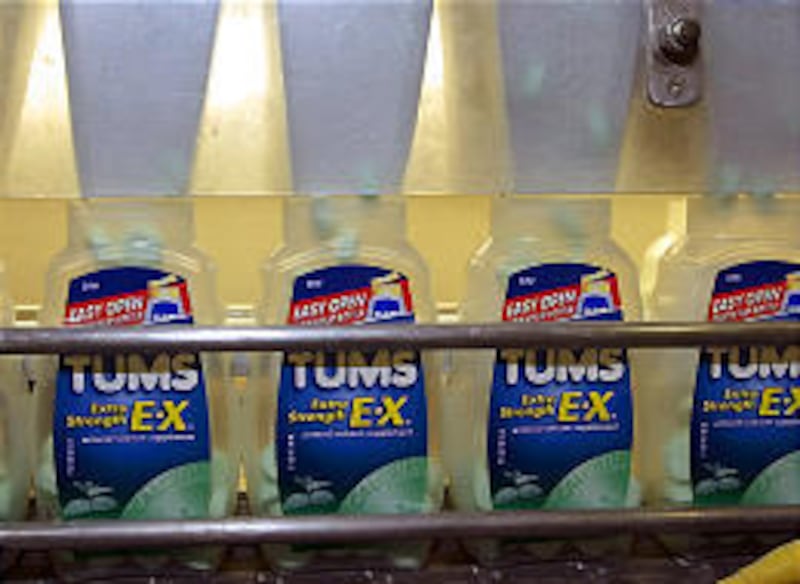
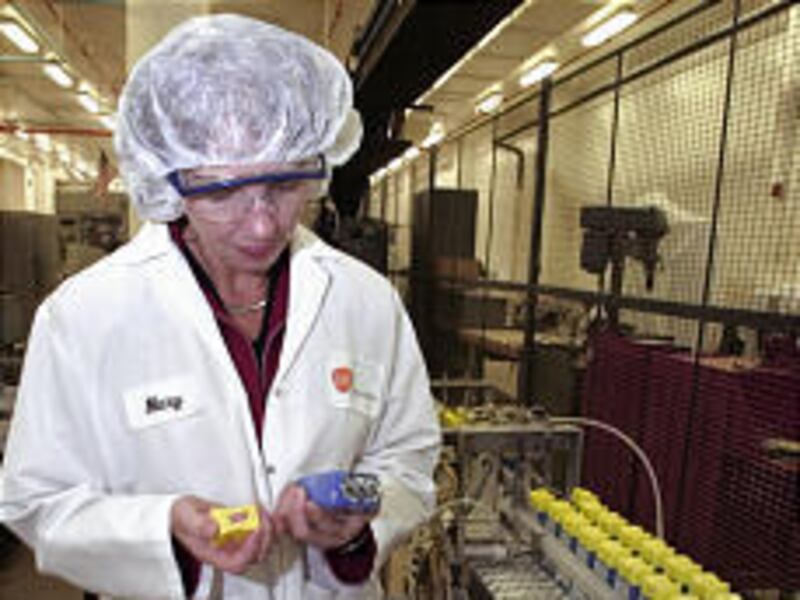
On the second floor, the now-hardened tablets skitter their way along machinery that tucks them neatly into a roll or drops them into a plastic bottle. One or two of the plant's 210 employees stand watch over each of the four bottling lines and three rolling lines.
Before the tablets ever reach the bottles, robotic arms stick adhesive labels on each side and a scanner double-checks each bottle to make sure it has the right label and expiration date.
The bottles and rolls are then sealed and boxed. More robots are trained to place the boxes on pallets back on the ground floor. The pallets get taken to distribution centers nationwide. TUMS are sold in the United States, Canada, Mexico, Kenya, Australia and the Philippines.