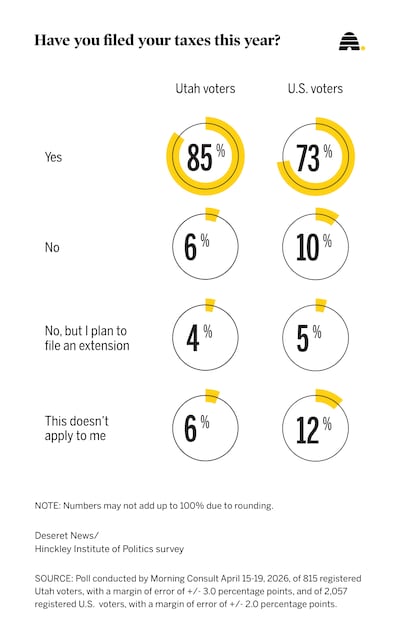
As the tax filing season kicked off in January, the White House issued a press release headlined “President Trump delivers largest tax refund season in U.S. history.”
Donald Trump does not shy away from hyperbole, but the administration cited articles from various news outlets that agreed that Americans were getting larger refunds this year. One economist said refunds might be up 15–20%; another said in January that refunds on average would be about $1,000 higher.
Did that happen?
Returns are still being processed, but new polling from the Deseret News and the Hinckley Institute of Politics shows that a little more than one-third of voters say their tax situation was greatly or somewhat improved by the changes this year, while slightly less than a third said their tax situation was about the same as last year.
And about a quarter of voters said their tax situation was worse than last year.
Perhaps a bigger problem for Trump and the GOP, however, is how Americans feel about their financial situation generally. While some say it’s improved in the past six months, a greater share say it’s gotten worse. With no tariff refund checks on the horizon for consumers, what does all this mean for the GOP?
Are tax refunds bigger this year?
The “Working Families Tax Cuts,” passed in 2025 as part of what was called “One, Big Beautiful Bill,” were part of the president’s plan to improve the fortunes of the working-class Americans who helped to elect Trump in 2016 and 2024.
“Tax Refunds this year, because of ‘THE GREAT BIG BEAUTIFUL BILL,’ are substantially greater than ever before,” Trump wrote on Truth Social in February. “In some cases, estimates are that over 20% will be returned to the Taxpayer. So, when you get your Tax Refund, think about what a wonderful President you have.”
While that may be true for some Americans, the Treasury Department’s numbers show increases that are more modest.
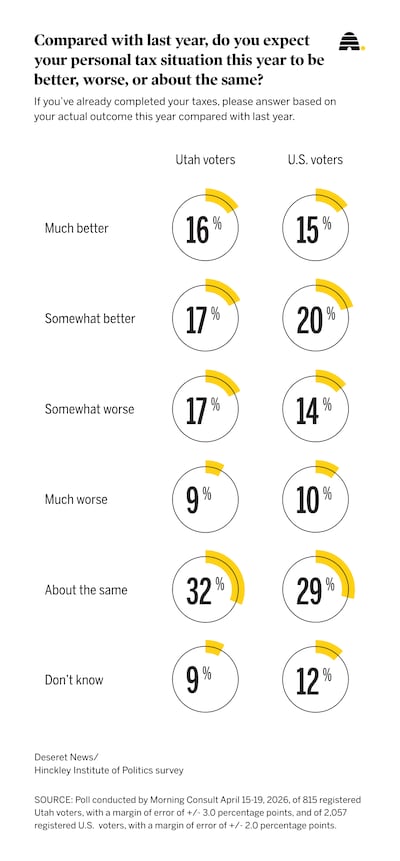
The Deseret News/Hinckley Institute of Politics poll found that 15% of U.S. voters said their tax situation was much better this year, and 20% said it was somewhat better.
Fourteen percent said it was somewhat worse, and 10% said it was much worse.
Twenty-nine percent said it was about the same as last year.
That amounts to 35% of U.S. voters — and 33% of Utah voters — saying their tax situation is somewhat or much better — which seems to fall short of the historic refunds that the Trump administration has been promising. And the numbers may not improve as the rest of the returns trickle in, since early filers tend to be people who are getting refunds, not people who are paying.
How many people benefited from tax changes?
According to data released by the Treasury Department on April 14, 53 million filers claimed one or more of the new tax deductions or credits established last year: with 6 million benefiting from no tax on tips, 25 million benefiting from no tax on overtime and 1 million benefiting from no tax on car loan interest on new American vehicles.
In addition, the administration said 30 million seniors had benefited from an increased personal deduction for people 65 and older, and 34 million had claimed the child tax credit that increased as part of the package passed last year.
The average refund, as of April 14, was more than $3,400, an increase of 11% from last year’s average, the administration said. For many Americans, that’s a significant windfall. But for some people, a refund that’s a few hundred dollars more than last year’s might not rise to the “golden age” that the Trump administration has been promising.
“The danger with the bombastic claims from the administration — or any president — is people see what they get when tax time comes and if it doesn’t feel like a huge increase as promised then they are disappointed, like the jelly of the month club from ‘Christmas Vacation,’” said Michael Kofoed, who teaches economics at the University of Tennessee, Knoxville, and is a research fellow at the Institute of Labor Economics.
“We do know that refunds are higher but the average refund increased by about 11%. Refunds have stayed pretty consistent over the last 10 years or so, which means that the real amount, after inflation, is actually a bit down or flat,” Kofoed said.
The nonprofit Tax Foundation, however, says that individual refunds aren’t necessarily the indicators to watch.
“Though refunds will be larger, the temporary and retroactive provisions providing the refund surge are not why we expect the new tax law to boost the economy. Instead, the new law’s permanent reductions in marginal tax rates will increase incentives to work, leading to growth over the long term,” wrote Erica York, vice president of federal tax policy with Tax Foundation’s Center for Federal Tax Policy.
Moreover, the Tax Foundation’s CEO, Daniel Bunn, noted in an analysis that without the changes made to the tax code last year, about 6 in 10 taxpayers had been facing tax increases because temporary cuts enacted in 2017 had been set to expire.
Those cuts roughly doubled the standard deduction through 2025, and last year’s legislation renewed the cuts and increased the deduction by around $1,000 for single workers and $2,000 for married ones.
The child tax credit also increased this year from $2,000 to $2,200 per child.
Are Americans better off in 2026?
In the new poll, respondents were asked to reflect on the past six months and say if they were better or worse off financially than they were six months ago.
Nine percent of both Utah and U.S. voters said they are much better off, and 15% of both Utah and U.S. voters said they are somewhat better off.
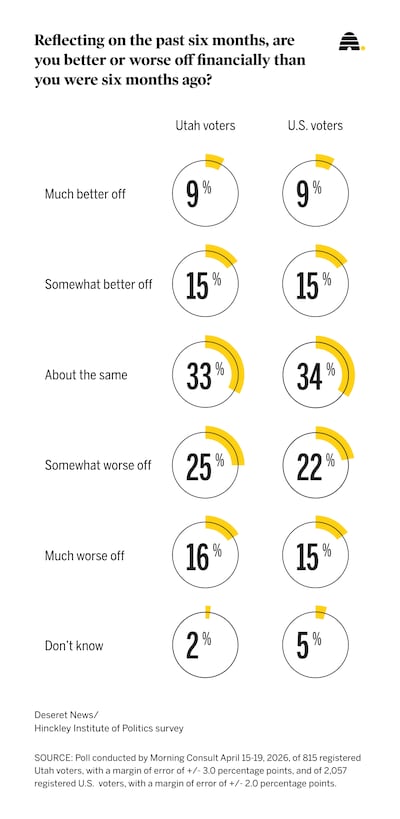
About a third of both groups said their financial situation is about the same.
A larger share said they are somewhat or much worse off.
Sixteen percent of Utahns and 15% of U.S. voters said they are much worse off. Twenty-five percent of Utahns and 22% of U.S. voters said they are somewhat worse off.
Steve Wamhoff, federal policy director at the Institute on Taxation and Economic Policy, said in an interview that all the talk about tax refunds is essentially a “fig leaf” that covers up other higher costs that Americans are experiencing. According to Wamhoff, “The net effect this year of all (Trump’s) tax policies is to increase taxes on the average American in all income groups aside from the richest 5%.”
In a recent analysis, Wamhoff included the effects of tariffs on American consumers.
“Economists would say that tariffs are a tax on American consumers,” he said. “Whether regular people think of it as a tax or whether they think of it as increased cost of living, either way that’s going to translate into a worse financial situation than six months ago or a year ago. Either way, that’s going to be bad news for President Trump and his party in Congress.”
Kofoed is also skeptical of how tax refunds will affect American consumers over time. “Given that the new deductions won’t apply to many workers, they either don’t encourage the labor supply response the administration is hoping for or, in the case of the vehicle interest write off, will make cars and trucks more expensive,” he said in an email.
But Kofoed also said no one should be celebratory about tax refunds anyway. “I always remind people that refunds are interest-free loans to the government. I am overtaxed when I get a refund, so the goal should never be to max out my refund. That is a personal finance disaster,” he said.
The poll surveyed 815 Utahns between April 15 and April 20, and it has a margin of error of plus or minus 3 percentage points. The national poll surveyed 2,057 U.S. voters with a margin of error of plus or minus 2 percentage points.