

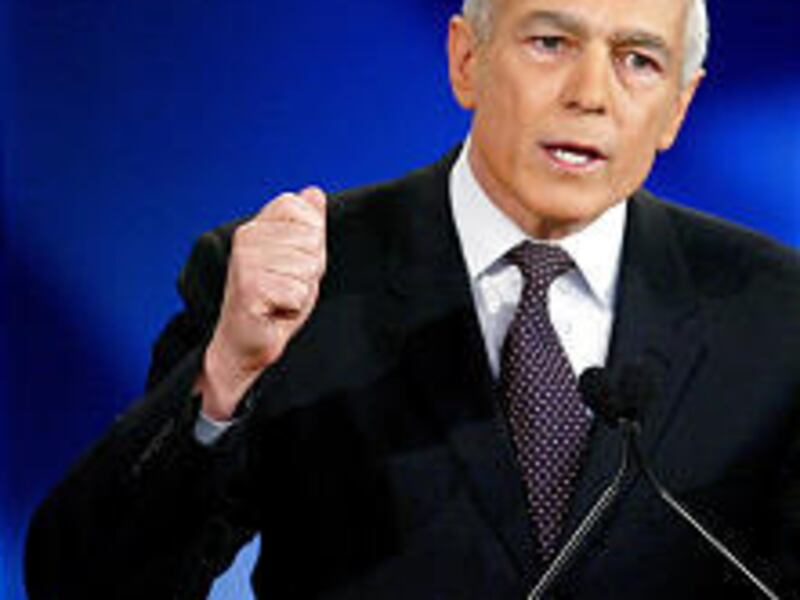
NASHUA, N.H. — A day after Gen. Wesley K. Clark was asked in a debate about his Democratic credentials, he was again confronting the subject, saying that the question by a Fox News anchor was "part of a Republican party agenda in the debate."
The anchor, Brit Hume, a moderator of the debate in New Hampshire, who told Clark that given his votes for Ronald Reagan and Richard Nixon, "I think it is not unreasonable to ask you when you first noticed that you were a Democrat?"
Clark responded by pointing out that he voted for Democrats in the last three elections, but the issue popped up again Friday when he was asked if he was frustrated by continuing questions about his credentials as a Democrat.
To some Democrats, Clark's inability to put to rest that issue and a number of other campaign distractions is yet another sign of the difficulties he faces in his first political campaign.
One week ago, at a Clark rally in Pembroke, N.H., the filmmaker and author Michael Moore, called President Bush a "deserter," a reference to his Vietnam-era service in the National Guard. Since then, Clark has faced questions about whether he agreed with the remark, and some Democrats say his answers — defending Moore's right of free speech but not saying until Friday that he disagreed with the remark — have not been entirely convincing.
When asked about Moore's comment during Thursday's debate, Clark said: "Well, I think Michael Moore has the right to say whatever he feels about this. I don't know whether this is supported by the facts or not. I've never looked at it. I've seen this charge bandied about a lot."
Tony Coelho, a Democratic strategist who served as Al Gore's campaign manager in 2000, said on Friday that the response "tells us that he is inexperienced at this business.
"His answer tells me he's not ready for the big time," Coelho said.
The issue was still alive on Friday. At a press conference in this southern New Hampshire city, Clark said, I can't agree with Michael Moore but I can't dispute his right to say what he feels," he said. But, he added, "I think there is a larger issue in here in this, and that is the issue of freedom of speech."
Chris Lehane, a senior communications strategist for the Clark campaign, dismissed the criticism, saying that the fact that Clark is not a practiced politician is exactly the point.
"I think he is not going to communicate like your antiseptic blow-dried, poll-tested typical Washington, D.C. politician," he said. "But there is no one else in the race who has run a war, who has negotiated a peace and ended a genocide," a reference to Clark's tenure as Supreme Allied Commander of NATO during the Kosovo war.
Howard Wolfson, former executive director of the Democratic Congressional Campaign Committee, said that Clark's questioning whether Hume's question was part of a Republican agenda indicated problems greater than merely being inexperienced as a candidate.
"That is not a good answer," Wolfson said. "I think a lot of Democrats are asking the same question. It is not limited to people who work for Fox."
Clark continues to get questions about whether he opposed the Iraq war from the beginning — he says he does, although some of his written and verbal statements have been ambiguous, at best — as well as questions about his position on abortion, saying first he favored no restriction then embracing the limits set out by the Supreme Court.
While Clark's advisers say his unpolished answers just show that he is not a typical politician, other Democrats say that they lead to credibility questions.
"When you run for president, there is a presumption of being a leader," Coelho said. "People don't care as much if they disagree with you. They just want to be able to trust you." Clark's responses in the last couple of weeks, however, "show that he is a little out of sync," he said.