

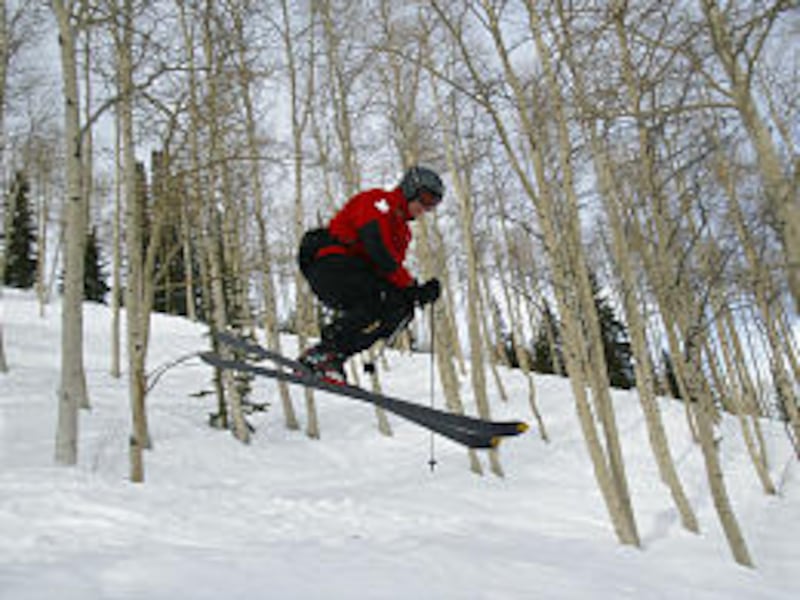
DEER VALLEY — The ski tracks tell the story: Parallel impressions in the snow running through the glades, winding like an old river between the trees, out the bottom and onto a groomed run.
There's one continuous series of "S-turns," uninterrupted and perfectly placed in the open areas between the trees. It takes a good skier to make those tracks. It takes a fairly open patch of trees to make those runs possible.
Nowadays, tracks in the trees are common, especially when the stands of trees are nestled between what are referred to as "black diamond" runs.
It's a smooth and easy transition from a steep black-diamond run into the trees and out again. And it takes the steeper slopes to make for continuous, flowing turns in the soft snow that are typically found in stands of trees.
On a resort's rating system, there are green
and blue boxes, and black diamonds assigned to various runs. The green runs are the gentlest, the black the most difficult.
Following the rating system, a skier is able to ski those runs best suited to his or her ability. More and more people are opting for the diamonds.
A dozen years ago, it was usually a mistake that took skiers into the trees — and usually they didn't stay there long. It was considered too extreme. That's no longer the case.
Interest in black diamond skiing is being fueled for a number of reasons, among them being that today's skiers are getting better and looking for more challenging terrain, and the new shaped skis are easier to turn and therefore make is possible for skiers to advance to steeper runs, said Chris Sherwin, guide and mountain host manager at Deer Valley.
All resorts offer black diamond skiing.
Alta, for example, rates 35 percent of its runs as expert, Brighton 39 percent, The Canyons 42 percent, Park City Mountain Resort 38 percent, Snowbird 35 percent and Deer Valley 35 percent.
More and more resorts are designating areas for "gladed," or tree, skiing.
Interestingly enough, Deer Valley, recognized for "pampering" its skiers with easy, glass-smooth runs, is becoming well respected for its black diamond and glade skiing.
In fact, Deer Valley offers free daily tours to black diamond runs, "just to familiarize skiers with some of the skiing we do offer. The impression is we don't have many challenging runs, when it fact we have many more than people think," Sherwin said.
There are listed on the trail map about 30 runs carrying the black-diamond stamp.
"But there are a good 50 that are black-diamond routes, but not all of them are on the map," Sherwin explained as he unfolded a trail map and began tracing his finger over specific areas.
"Add to that about 800 acres of tree skiing and that's just a start. One popular gladed area is three-quarters-of-a-mile wide. That accounts for only one run. There are a number of other areas offering tree skiing that are not on the map, which is one of the reasons we offer the free guided tours."
Skiers can show up at 9:30 a.m. at the lower lodge any morning of the week and join Sherwin or one of his hosts for the half-day black-diamond tour. They can, if they wish, request a tour onto any one of the four mountains within the resort's boundaries.
One mountain, Empire, offers 600 acres of nothing but black-diamond skiing, "with five gladed areas, three bowls and 11 chutes, all served by one high-speed lift," adds Sherwin.
At 1:30 p.m. each day, Deer Valley also offers free guided tours for advanced skiers, which includes visits to black-diamond runs.
Christa Graff, communications director at the resort, feels that part of the interest in Deer Valley's black-diamond areas was ignited by early snowcat tours.
Three years before the resort put the lift on Empire Mountain in 1999, the resort offered backcountry snowcat excursion, "for practically nothing, just $5 a ride, to introduce skiers to the area. It was extremely popular. Now those skiers are coming back to ski those same areas," Graff said.
It wasn't that many years ago that resorts preferred not to spotlight their black-diamond runs. Now, some skiers choose to avoid resorts without the black lines on the trail maps.
E-mail: grass@desnews.com
O U T D O O R S