

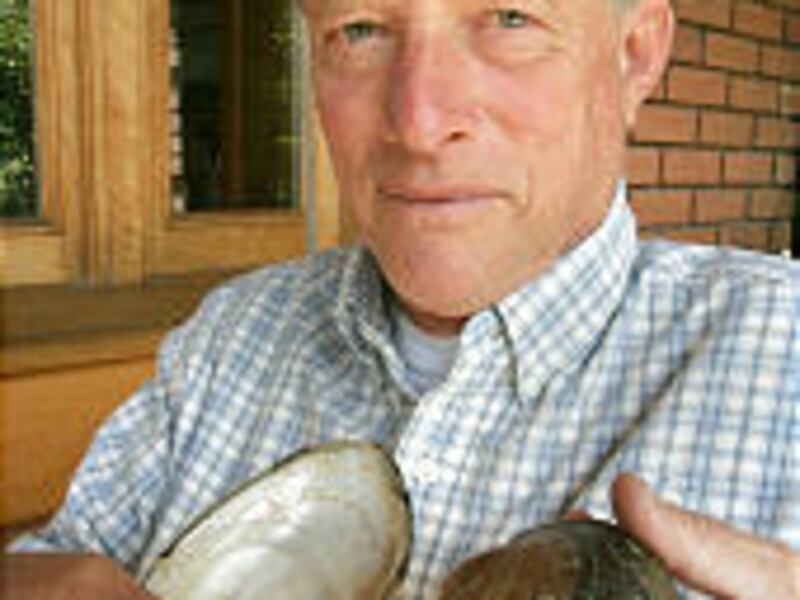

Scientific knowledge often comes through teams working in big institutions. But Peter Hovingh is proof that the lone researcher can still make valuable contri butions.
And in his 24-year project to map the range of certain freshwater mollusks of this region, he uncovered some mysteries about their distribution.
Hovingh, a retired biologist who lives in Salt Lake City's Avenues, has been working on this scientific labor of love since 1980. Now he has completed a survey of freshwater mollusks at 2,900 springs, marshes, lakes, streams and other sites in several states.
He looked through the Great Basin, Colorado River drainage, Green River region, along the Virgin River, plus other parts of Nevada and Oregon. He studied museum collections in Utah, Ohio, California, Michigan, Chicago, Boston, Washington and Philadelphia.
The result, published last month in Monographs of the Western North American Naturalist, is his paper, "Intermountain Freshwater Mollusks, USA." It is a comprehensive survey of where two gastropod species and several mussel species survive in the region.
Mussels are bivalve animals, while gastropods like snails and limpets have one shell.
Not only does he report on the past, exposed in fossils and shells in collections, and the present range of mollusks. The study is also a glimpse of the future in which some native animals may be imperiled.
As Hovingh noted in the paper, the mollusk populations in the region has been reduced in the past 150 years, since settlers began moving into the West.
"Range declines among these fauna are thought to be related to alterations of habitat caused by grazing, irrigation and urbanization, as well as the intensive management of sport fish in these waters," he writes.
One mussel, the western pearl shell (scientific name Margaritifera falcata) was "too rare to collect at all."
Beside the pearl shell, mussels he studied are the California floater (Anodonta californiensis), the giant floater (Pyganodon grandis) and the western ridge mussel (Gonidea angulata). He also examined snails in the Valvata family and the limpet called Ferrissia. The last is a specialized type that attaches itself to rocks.
When he began his self-appointed task, he said, he examined all the mollusks in these sites. But then he narrowed the project, working on the mussels and gastropods, he said.
Along the way he uncovered some puzzles.
The limpet was common in the Yampa River drainage, which goes from Colorado into Utah. But it "was not found in the White, which parallels the Yampa out of Colorado, nor the Duchesne in Utah," he told the Deseret Morning News.
"This is a phenomenon I don't understand." Finding the mollusk in one river system and not in nearby systems that are much like it may have resulted from "some event that happened millions of years ago, or modern usage of the rivers or local geology," he said, "but these rivers go through the same formations."
Some scientists think birds can transfer limpets. But these mollusks are not found in nearby wildlife refuges visited by birds.
"There's not any cross-river colonizations," Hovingh added. "It's limited to the Yampa River."
Also, the limpet's distribution does not continue to where the Yampa flows into the Green River. Why not? Hovingh has not been able to discover an answer to that.
"It could have to do with the water quality. It could have to do with the fish," he said. "At this time, I just don't know."
Since the end of the last Ice Age, the Pleistocene, about 10,000 years ago, the region has been getting much drier, and this has affected the distribution of freshwater mollusks.
"Exterminations have occurred since the drying up of the Pleistocene. There are shells all over, where they are not found any longer. The alteration of the habitat has been very hard on these animals."
Those impacts are from natural causes, related to climatic cycles. But Hovingh also recorded the impacts of humans on nature.
"Living creatures that were once found 100 years ago are no longer found" at certain localities where they were collected a century ago. "So there's a huge impact of water usage on these creatures."
Water diversions had an impact on the distribution of the mollusks. So did past grazing practices.
"Cows in particular love water and they will come down to almost any water and muddle in it and destroy stream banks," he said. Silt washed out of the banks because of this damage also can harm aquatic organisms.
Nowadays, ranchers are trying to keep cattle out of the streams, he said. "But earlier they just grazed along the streams and waded into the streams, and that might have done quite a bit of damage."
Urbanization also has impacted nature. When streams are developed and channeled into conducts, like City Creek, it takes a toll on the life of the creeks.
Much study remains to be done, and scientists are working on species like stoneflies and other insects. "Now things are starting to fall into place," Hovingh said. But seeing the whole picture is "a long ways away yet."
E-mail: bau@desnews.com