

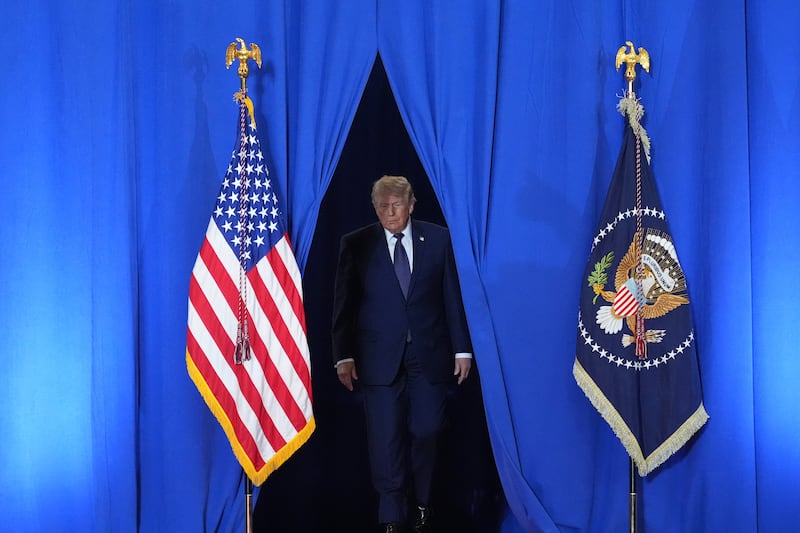

President Donald Trump’s approval ratings in Utah continued to be underwater in May, after sinking below 50% in April.
Just 48% of Utahns say they approve of how President Donald Trump is performing in the White House, according to a new Deseret News/Hinckley Institute of Politics poll.
Half of the state, or 50%, say they either somewhat or strongly disapprove of Trump’s job performance.
The number of Utahns who approve of the president’s job performance is up slightly from April, when 45% of Utahns who were polled rated Trump favorably.
Ahead of April’s drop, Trump’s job approval among Utah voters had consistently hovered around 50%. In March, 51% of Utahns said they approved of his job performance.
The survey was conducted by Morning Consult between May 15-18 among 802 registered Utah voters and has a margin of error of 3 percentage points.
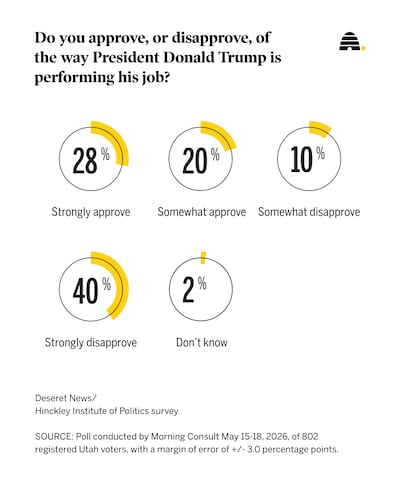
Trump is still performing well among Utah Republicans, with 75% saying they strongly or somewhat approve of the president, while 8% of Democrats and 26% of independents say the same.
Iran war affecting Trump’s job performance rating in Utah
Vice President JD Vance’s job performance is rated similarly to his boss, with 48% of Utahns approving of his performance and 44% who say they disapprove. Secretary of State Marco Rubio’s approval dips to 45%, with 38% who say they disapprove, and Defense Secretary Pete Hegseth is at 41% job approval among Utahns, with 42% who say they disapprove.
Hegseth’s approval being the lowest might not be a surprise given Utahns’ feelings about the war in Iran. Utah voters say they generally don’t approve of the U.S. military action in the Middle East.
“None of these officials really seem to be operating independently from Trump in the eyes of Utah voters. Rubio performs somewhat better, while Hegseth’s numbers show more skepticism and uncertainty,” Jason Perry, the director of the Hinckley Institute of Politics, said. “For most voters, these figures are still closely tied to the broader administration.”
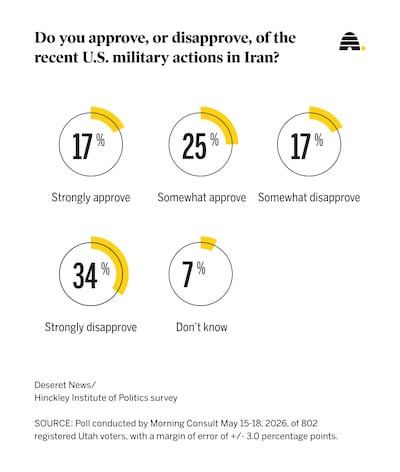
Fewer than half, 42%, of Utahns say they approve of the U.S. military actions in Iran and 51% disapprove. Just 7% say they don’t know what to make of the war.
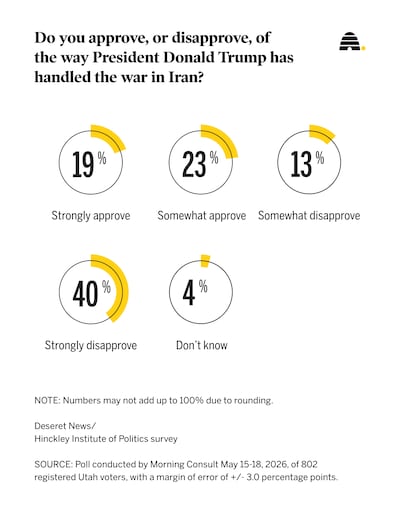
When asked if they approve of the way Trump has handled the war, it’s similar at 42% approval and 53% disapproval.
Utah Republicans notably have soured on the war. In an April survey, disapproval of the war was at 20% among GOP voters, but in the May survey that number jumped to 29%.
“The Republican shift is what stands out in this poll. Utah Republicans usually support a strong military, but they also do not love the idea of getting pulled into long conflicts overseas, especially when people start feeling it at home through things like gas prices and the economy,” Perry said. “I think you are starting to see some of that concern show up in these numbers.”

Perry said while Trump continues to have solid support among Republicans in Utah, the poll shows “the limits of that support statewide.”
“He continues to struggle with independents more than many Republicans do in Utah, and that keeps his overall numbers underwater,” Perry said. “You can also see some signs that voters are becoming increasingly uneasy with the political and economic uncertainty coming out of Washington over the past few months.”
The survey found that approval ratings for Trump and the war varied based on income level. Utahns who make more than $100,000 a year were more likely to approve of the military action and Trump than those who make $50,000-100,000 and those making under $50,000 a year.
Trump’s approval tied to gas prices?
Additionally, Utahns were asked about gas prices ahead of summer road trips. Just 17% said their travel won’t be impacted by rising gas prices due to the ongoing war with Iran, but 83% said their plans will be impacted. With Iran blocking and limiting traffic in the Strait of Hormuz, which is a waterway that is vital for about 20% of the world’s oil, prices have gone up per barrel globally, hurting the pockets of Americans at the gas pump.
According to the AAA, the national average for a gallon of gas was $4.552 as of May 22. In Utah, it’s slightly higher at $4.682 per gallon.

The U.S. is locked in a stalemate with Iran. After weeks of fighting, the two countries struck a ceasefire deal early last month.
Trump is growing frustrated with Iran, which has offered up proposals that he deemed unsatisfactory since Iran has so far refused to give up its nuclear program and materials.
Trump maintains that Iran cannot have a nuclear weapon and that the Strait of Hormuz can’t be tolled or closed. If Iran complies with those demands, he said he would lift the U.S. blockade on Iranian ports and sign a permanent ceasefire.
Gas prices and the lack of movement are likely going to be sticking points for voters who will head to the polls in November for the 2026 midterm elections.
Republican lawmakers and candidates are hoping that the conflict will be resolved long ahead of November, or else they worry voters will punish them at the ballot box.