

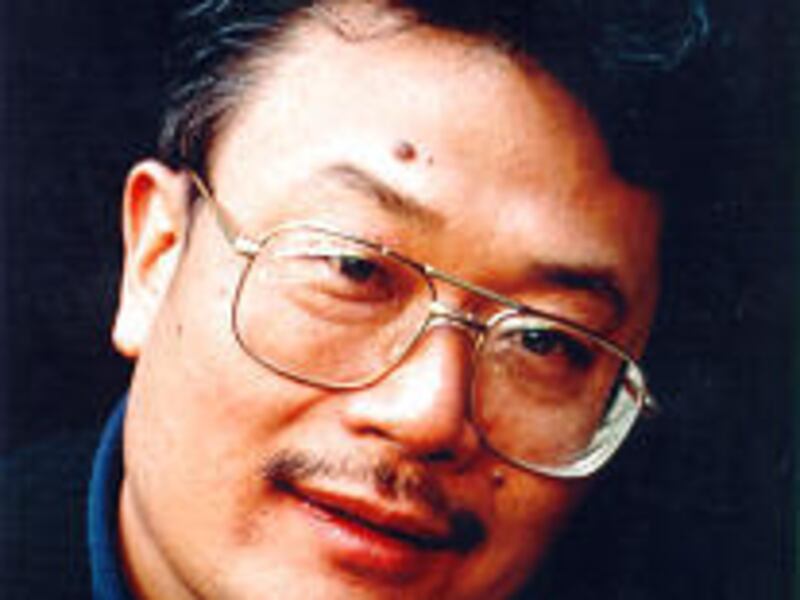
The raw experiences of life have helped Ha Jin become an acclaimed writer.
Born in northern China, he served nearly six years in the People's Liberation Army, beginning at the age of 14. He spent much of his time in a Korean village.
When his military service ended, he worked the night shift as a railroad telegrapher, where he listened to a radio program that taught English. He viewed English as a tool and, at first, worked on it only lackadaisically.
Ha then studied in Chinese universities, picking up BA and MA degrees in literature. In 1985, he moved to the United States to pursue his doctorate in English at Brandeis University in Walham, Mass.
When Ha started studying English more seriously, he still found it difficult. "I was always in the slow class, but when your survival is on the line you have no choice," he said during by phone from his home in Foxboro, Mass., a town near Boston.
Currently, he is an English professor at Boston University. He is also a prolific and highly acclaimed novelist and poet, having written several books, including "Waiting," winner of the National Book Award, and "The Crazed." Both books are set in China.
Ha's new book, "War Trash," is the compelling story of Yu Yuan, a young Chinese army officer who becomes a prisoner after being captured by Americans during the Korean War. It is Yu's knowledge of English that sees him through the terrible experience of living as a captive under extraordinarily oppressive circumstances in several camps. As an unofficial translator, he grabs opportunities that are denied to most POWs.
"I do miss China — but the China of today is not the one I remember or experienced," said Ha. "I'm an American citizen now, and I must function as a regular human being. If I were to fall into homesickness, it would be too much. I have to
teach and write, so I have to surpass any longing for home."
Ha has never been back to China. Prior to the Tiananmen Square Massacre of 1989, a massive student uprising that was quickly and brutally quashed by Chinese authorities, he had planned on returning. "During the massacre, I was outspoken in criticism of Chinese authorities, and afterward I couldn't get my passport renewed. I realized I could not return, so I decided that I should stay in the United States with my wife and son. Then later, when I became naturalized, I lost the desire to return."
He also realized he would have to improve his English so he could write in his second language. "Publications written in Chinese wouldn't count as publications in the United States. As I continued to study literature, I realized there have been major writers, such as Joseph Conrad (born in the Ukraine), whose first language was not English.
"But every book I've written has been a big struggle. Every one is a departure from the previous book. Most of the time I conceive the words in English, but sometimes I have to back up and find the right word — so I don't think my ability is natural."
"Waiting" is the only one of Ha's books that has been published in China, and Chinese authorities discouraged publishers from doing so. " 'War Trash' probably can't be published in China. If it is, it will make me much more disliked by Chinese authorities. But I want to be objective and factual. If it is translated into Chinese, I want them to say 'this guy didn't lie.' The Chinese authorities told a lot of lies about the Korean War."
Ha has spent several years reading and researching the background materials for "War Trash" — "out of curiosity.
"I read a lot of Fyodor Dostoevsky's descriptions of prison in 'The House of the Dead.' I was intrigued when I saw that American POWs returned as heroes, while in China they were disgraced. They were sent to prisons or labor camps. My wife heard me talk about it so much she encouraged me to make a novel of it.
"I had no knowledge of the atrocities of Abu Ghraib in Iraq when I started. I just wanted to be fair to all sides — the Chinese, the Koreans and the Americans. I had access to materials in both Korean and Chinese, so I wanted to be as objective as possible. I wanted to preserve the memories of the Koreans, even the fragmented ones, but I had to create the people who could make that idea work."
As a result, his characters are fictional — with the exception of Generals MacArthur and Ridgeway, to whom he refers as part of the larger story — and General Francis Dodd, who is kidnapped by POWs in the novel, but is renamed General Matthew Bell. " I really worked hard on it. It was stubbornness, I guess. When I showed the first draft — well over 400 pages — to my agent, I still didn't know if it would work. It's a depressing book."
Yet Ha sees the book as positive in its message. "It demonstrates there are always good people and bad people everywhere. My main character became more inward, reflective of his own experience. Yu Yuan is an outsider, an optimistic person who becomes more inward, more reflective of his experiences. Because of his isolation, he begins to think more and becomes a better person. He improved his English by reading the Bible in English — and then later, he became an English teacher.
"Knowing English gives me a sense of freedom, too. I can detach myself from Chinese and became a free writer, who can write as I like — but it can only be done in English."
E-mail: dennis@desnews.com