

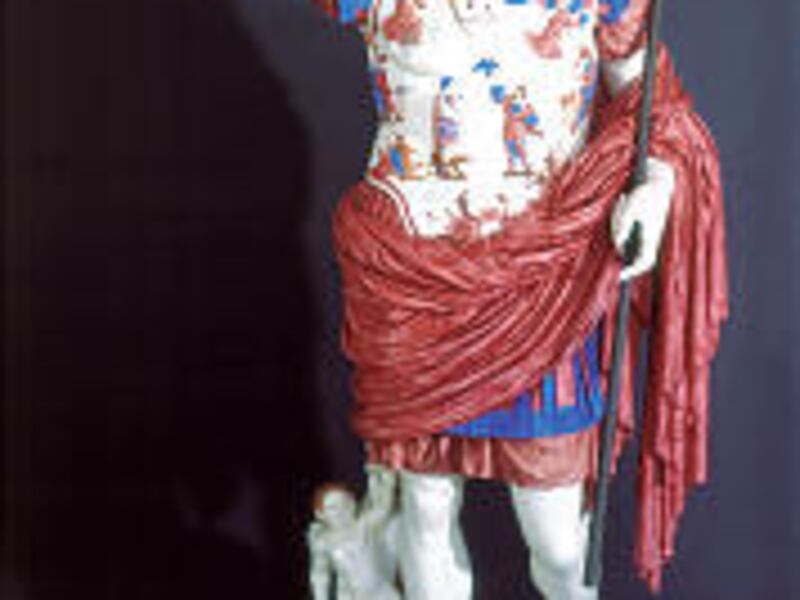
VATICAN CITY — For those who envision the ancient world of sculpture as a monotonous palette of muted grays, the Vatican Museums are offering an eye-opening exhibit of how the ancients viewed their art — in dazzling and rich shades of greens, ochres and blues.
"The Colors of White" exhibit, which opens Wednesday, features 15 reproductions, some alongside the originals, aiming to show the real colors with which the works were created, before the hues were washed away by rain and bleached by the sun over the centuries.
"It is an innovative and revolutionary proposal to read ancient art and understand what artists were looking for," Francesco Buranelli, director of the Vatican Museums, said Tuesday at a press preview. "It is as if these artworks were made right now by ancient artists."
In the 19th century, scholars knew that some ancient Greek and Roman sculptures bore traces of mainly lost pigments. But white was considered the color of ideal beauty then, following an exaltation of the ancient world by neoclassicists.
"The image of a white, immaculate beauty still prevails and has become popular among the majority of the public," Buranelli said.
The exhibit includes copies, made of plaster, of statues where traces of pigments were detected by ultraviolet and raking lights and scanners.
There are colorful reproductions of what are known as white statues, including a depiction of the goddess Athena (500-490 B.C.) in green, red and blue and one of Emperor August, discovered in 1863 in an ancient Roman villa north of Rome. The emperor is wrapped in a reddish drape and blue and red armor.
"The aim is not to delete the white but only to place it back to where it belongs, which is in the middle of all the other colors," said Paolo Liverani, technical and scientific curator of the exhibition.
The exhibit, with free admission, runs through Jan. 31.