

Utah voters last week elected a new governor to head the executive branch and retained several justices on the Utah Supreme Court, which oversees that branch of government.
Now, in a secret vote this week, lawmakers — many of whom were also elected Tuesday — will pick the new Utah Senate president and House speaker, leaders of the legislative branch.
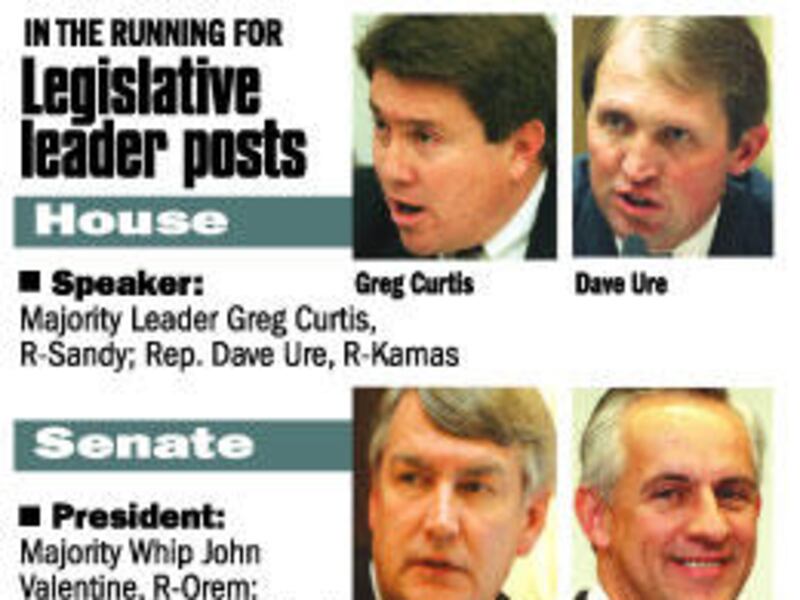
The top job in the Senate is between Sens. John Valentine, R-Orem, and Michael Waddoups, R-Taylorsville. The House speakership is between Reps. Greg Curtis, R-Sandy, and Dave Ure, R-Kamas.
In a way, says Ure, he is the outsider who wants to give more power to the GOP caucus and body as a whole. While Curtis, the current majority leader, says his experience and even-handed approach to issues is his selling point.
Valentine said he's "gone in to be a leader to do the will of the caucus, to not try to go in with an agenda to try to drive the caucus to a particular position." Waddoups said he's telling his colleagues he "won't be driving an agenda."
Six-year speaker Marty Stephens, R-Farr West, and four-year president Al Mansell, R-Sandy, step down the first of the year.
Stephens, who set a record with his three two-year terms as speaker, leaves office after failing to win the GOP gubernatorial nomination. Mansell has two more years on his current four-year term but is not running for Senate president again.
The two men — behind the governor — are the most powerful politicians in state government.
The 21 Republicans in the Senate and the 56 GOP House members will meet separately in private Tuesday night on Capitol Hill to listen to speeches by their colleagues seeking legislative leadership offices. A secret ballot will then be held.
The first Senate president candidate to get 11 votes wins; the first speaker candidate to get 24 GOP caucus votes likewise wins a two-year term.
Democrats in the Senate and House will also elect new leaders. But the minority party members have no say in who the new president and speaker are as majority leadership races are jealously guarded by the party in power.
Odd ducks
Leadership races are odd ducks. There is no formal candidate filing process, although tradition says you send out a letter to your caucus members announcing which leadership post you seek.
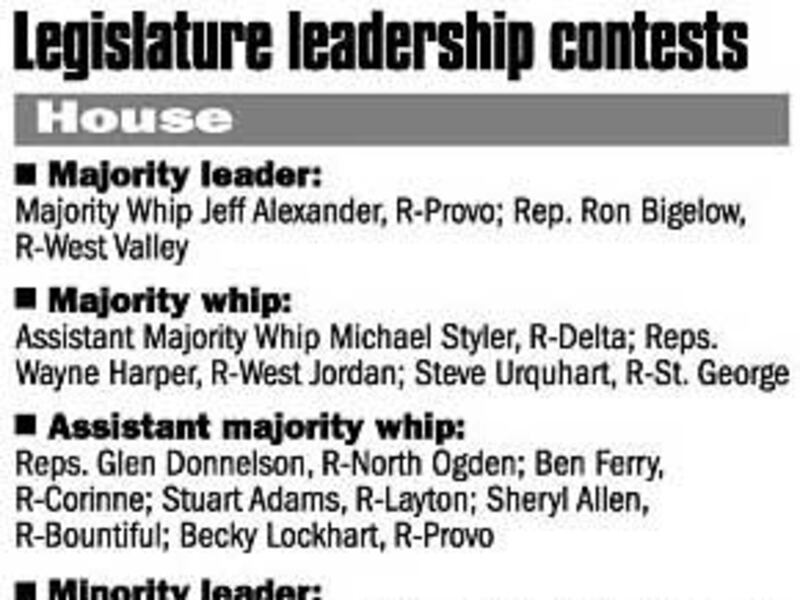
Offices for the majority are Senate president, majority leader, majority whip and assistant majority whip; and House speaker, majority leader, majority whip and assistant majority whip.
The leaders in both bodies then appoint other GOP caucus members to be the budget chairman and standing committee and budget subcommittee chairs and vice chairs. While they often deny it, past speakers and presidents have at times played hardball politics — holding bills, funding pet projects and punishing both Republican and Democratic lawmakers who stood against them.
Internal, and often secret, politics rule leadership races, which can at times be bitter contests.
For example, Ure lost to Stephens two years ago in a tough race where both candidates tied in the first round and Stephens won the second round by one vote.
Instead of sitting in the chamber according to his seniority, Ure decided to sit on the Democratic side next to the freshman GOP representatives. He seemed to relish his "outsider" status, taking the chairmanship of the Natural Resources budget committee, a minor post for a 12-year veteran. "I sat by the freshmen because in the speaker's race I'd promised to help them learn the process. I did enjoy being an outsider" the past two years, he added.
Curtis, meanwhile, was often seen as a Stephens ally and confidant, working his way up leadership ranks to be majority leader the past two years.
Indeed, the speaker's race is debated in those terms. "Forty-five of the 56 (people voting on speaker) have served with Dave and I at least two years," says Curtis. And they realize that Ure was a leadership whip for four of Stephens' six years as speaker, Curtis said, noting the "outsider" moniker won't work.
And Ure had plenty of disagreements with Stephens but dealt with them privately, said Curtis. "I don't get in fights with caucus members, it's not my style."
Ure says it was good that he was outside of leadership the past two years. "I've seen and felt the same frustrations as other" rank-and-file legislators, he said. "It's true that most (GOP House members) served with me. I'm a straight talker; they know that."
Curtis said he doesn't believe his problems in Salt Lake County are part of the speaker's race, although some of his detractors are trying to make them so. Curtis resigned in the late spring as embattled county Mayor Nancy Workman's legal adviser after he paid back state mileage he received when driving his county car to the 2004 45-day general session. He said the double-dipping in gasoline reimbursement was an oversight, and he was not charged with any wrongdoing.
It's become tradition for those seeking top party posts to raise a lot of campaign cash and then donate to fellow caucus members' races. Reports filed with the State Elections Office show that Ure gave $4,550 this year to GOP House candidates, many of them incumbents, and $4,850 to House candidates in 2002.
Curtis gave $11,123 to GOP House candidates this year, plus another $12,000 to the state Republican Party for candidate brochures. Curtis gave $5,570 in 2002 to GOP House candidates, many of them incumbents who will vote Tuesday.
Who was running for what House Democratic minority posts was in flux late last week, with several Democrats considering different races. There are 19 House Democrats; 10 votes wins a post.
Assistant Minority Whip Karen Morgan, D-Cottonwood Heights, says she's running against Minority Leader Brent Goodfellow, D-West Valley. Former minority leader Ralph Becker, D-Salt Lake, is also considering seeking his old post.
"I'm not running against anyone," said Morgan. "But Brent and Ralph had their times, now I want a turn. I have some good ideas about making (the minority Democrats) more effective."
Goodfellow could not be reached for comment.
Morgan would be the first female minority leader since Salt Lake County Democratic Rep. Milly Bernard held the post in the 1973-74 Legislature, House officials said.
'Gentlemanly' race
Utah has never had a female House speaker or Senate president. That's not going to change in the Senate, where two members of the current all-male leadership roster are vying for the top spot.
Valentine said he's "very encouraged" about his chances even though it's a choice between two "very good people." Waddoups said he doesn't believe either candidate has enough committed votes to declare victory.
Both said the race has been anything but contentious. "We've worked together (in leadership). We've been friends," Waddoups said. "We're going to work together afterwards." Valentine called it "gentlemanly."
Assistant Majority Whip Peter Knudson, R-Brigham City, is looking to move up to majority leader but faces a challenge from Sen. Thomas Hatch, R-Panguitch. There's even more competition for the remaining slots, with three senators battling to become the majority whip and four seeking the assistant majority whip position.
Hatch, who may be hurt because he has no experience in leadership, said the Senate "is one of the few places where friends run against friends, and also one of the few places where friends will look you in the eye and lie to you."
One of the candidates for majority whip, Sen. Curt Bramble, R-Provo, called campaigning for leadership among the 21 GOP senators "one of the most difficult things you do in a small group."
Sen. Carlene Walker, R-Salt Lake, who announced a year ago she was running for assistant majority whip, said she's not sure how any of the races will turn out. "I don't really have a feel," she said. "We just make phone calls and take each other out to lunch and talk about our vision for a leadership team."
The Senate's Democratic leaders, including Minority Whip Ron Allen, D-Stansbury Park, and Assistant Minority Whip Gene Davis, D-Salt Lake, are expected to seek re-election to their posts, when the eight minority party members meet in caucus on Wednesday to vote.
There are rumors that Senate Minority Leader Mike Dmitrich, D-Price, could be challenged by Minority Caucus Manager Karen Hale, who was the running mate of unsuccessful Democratic gubernatorial candidate Scott Matheson Jr.
Hale did not return a telephone call Friday, but Sen. Patrice Arent, D-South Cottonwood, said she'd "like to see her take a more prominent position in leadership."
E-mail: bbjr@desnews.com; lisa@desnews.com