

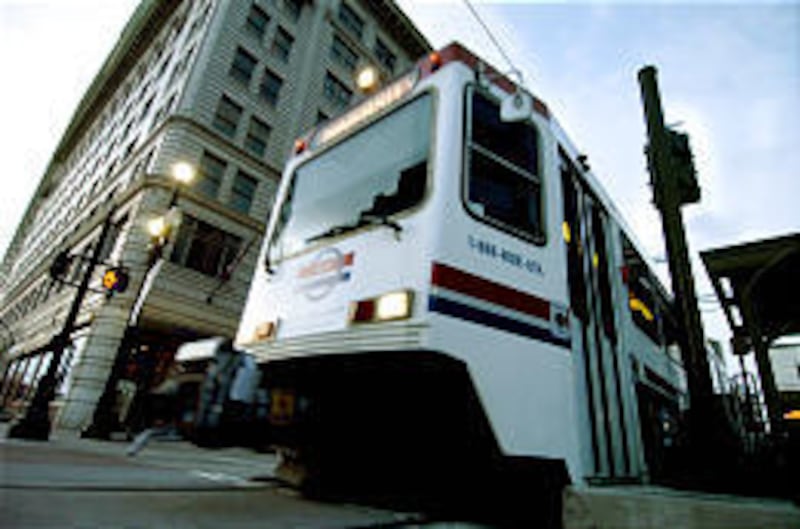
In the 1990s, few issues prompted more heated debate and emotional rhetoric in the Salt Lake Valley than light-rail
Despite feverish attempts to stop it, TRAX was built, has only expanded — and will mark its five-year anniversary this week.
The initial north-south line debuted Dec. 4, 1999. The 15-mile Sandy-to-Salt Lake City line now has a four-mile branch to the University of Utah and University Medical Center.
That doesn't mean everyone has accepted it. And it doesn't mean the public will support a possible sales tax increase in 2006 to expand it, nor that the controversy is dead.
TRAX carried an average of 43,205 passengers each weekday in September, the most recent month UTA data are available. The north-south line has an average weekday ridership of 28,133, well above UTA's projections five years ago.
Trains, running at their maximum length of four vehicles, are packed during morning and evening rush hours. U. students and employees have used TRAX to bypass packed parking lots on campus. TRAX extensions to Midvale and West Jordan, West Valley City and Draper, among other locations, are planned.
Failure or alternative?
Still, no matter how good the numbers look, the system is a failure to Drew Chamberlain, who helped organize a boisterous protest at TRAX's groundbreaking in 1997.
"It makes me feel good to know I was right about TRAX," said Chamberlain, a South Jordan resident and chairman of the local anti-light-rail group Coalition for Accountable Government.
"It did exactly what we expected it to do, and that's nothing. UTA is real good at shifting (ridership) numbers around, but they're not getting anybody else off the road. Their actual customer base is shrinking. They have more boardings, but boardings isn't customers, boardings is just transfers.
"Even with the padded numbers, TRAX is a failure and we should never build more lines," he said. "We should close this system. It has bankrupted UTA."
UTA officials, Envision Utah, the Wasatch Front Regional Council and a recent transportation task force commissioned by the Legislature agree that UTA needs more money to expand and operate its light rail, bus and planned commuter rail system. But they have concluded the investment in transit infrastructure is worth it to provide efficient, congestion-relieving transportation alternatives in the fast-growing metropolitan area.
And while officials in the governments of Salt Lake County and various cities within it questioned or formally opposed light rail before its construction, many of those same communities are now actively seeking TRAX spurs. That attitude is shared by counterparts in the western United States. Ballot initiatives to provide financial support for transit projects were recently passed in Denver, Phoenix and Sacramento and other U.S. cities.
"Many cities across North America that are considering building light rail look to the successful TRAX system as a prime example of safe, efficient and affordable service," said Donna Aggazio, spokeswoman for the American Public Transit Association.
"Their ridership has always exceeded expectations. And a lot of development is going on along with the lines . . . , and that's a very positive sign that the community has embraced it."
For UTA general manager John Inglish, the debate about light rail's appropriateness for the Salt Lake Valley is over.
"For a few of those diehards (critics), of course, the debate will go on," Inglish said. "They were in such an entrenched position to begin with. For the general public . . . a complete transformation has taken place.
"In fact, in some ways, it almost worked out positively for us because talk radio and anti-light-rail people were so adamant about what a horrible thing it was going to be . . . that when it didn't, in fact, turn out to be that — it turned out to be a great success — we gained even greater credibility in the public's eye than we would have if there had not been that same debate. People were truly converted."
The safety question
Safety was a big concern of opponents, some of whom held up "Light Rail Kills Children" signs at that 1997 groundbreaking.
In five years, TRAX has had eight fatal accidents. Four of the deaths were determined by police to be suicides. Three others were pedestrians who accidentally got in the way of oncoming trains, and one was an occupant of an automobile. There have been other nonfatal, car-train accidents as well, but UTA officials note accidents will continue to occur if drivers fail to obey traffic laws.
"If anything, we have a better-than-average safety record. We've been very fortunate in that way," Inglish said. "We had a series of accidents (recently) one on top of the other, but keep in mind we hadn't had any for months and months.
"All three of those (recent) accidents were in rain storms, and . . . there are a lot of distractions because of the rain."
Michael Packard, private construction safety consultant and a longtime light-rail opponent, claims that before light rail's debut UTA officials predicted there would be only one accident every other year.
"Light rail is not like the trolleys of old. Most of the trolleys were small cars and light rail is a 360-ton, four-car train with a stopping distance of about four or five times that of a semi," Packard said.
"But the way light rail kills is by diverting the money away from needed highways, like highway (U.S.) 6, and creating more congestion that creates more pollution. . . . And the whole bus system has become more inefficient since TRAX. The costs have gone through the roof and the performance has gone through the floor."
'Grow and develop'
But passengers keep coming through the doors of light-rail vehicles, which — unlike buses, affected by traffic congestion — have run remarkably on time.
UTA's light-rail trains initially operated every 10 minutes during peak hours and 20 minutes during off-peak times. But that schedule proved too confusing for some passengers, and UTA changed its schedule to run trains every 15 minutes throughout the day. Sunday service was also added in December 2000.
But there are times when TRAX trains appear empty. Packard, a former member of the Sandy Transportation Committee, suggests UTA should shut down the light-rail line during nonpeak hours and let buses transport passengers at those times.
That would seem unlikely. But what is unknown now is how quickly UTA can expand its existing system to serve outlying suburban areas and the airport.
A referendum, which could be on the 2006 election ballot, could give UTA an equal half-cent sales tax share (it now receives seven-sixteenths of a cent in Salt Lake County) throughout its service area and the ability to borrow money for capital projects using general obligation bonds.
"If we get funding in 2006, then we will go all out to build all of those things we've talked about in the next 10 years. It's doable," Inglish said of the planned light-rail extensions. "If we do it with the resources we have, then it's going to be a slow, painful process."
But it's not like UTA — which built light rail despite the failure of a ballot referendum in 1992 — hasn't overcome a few obstacles before.
"As the light-rail system evolves . . . , it's eventually going to carry hundreds of thousands of people," Inglish said. "But you have to give it the opportunity to grow and develop."
E-mail: zman@desnews.com