

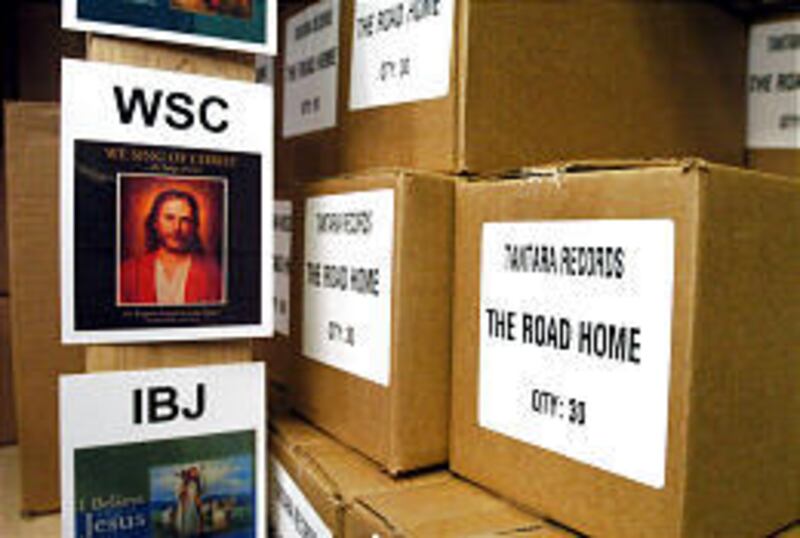

Most people are familiar with the Oxford University Press or the Cambridge University Press. But some people may not realize that Brigham Young University has a similar venue for music: the Tantara record label.
Sitting in his faculty office at BYU, which doubles as his executive office as general manager of Tantara Records, Ron Simpson explained what it's all about. The driving mission, he said, is to record and promote the music of BYU — its top ensembles, as well as its faculty artists, composers and directors.
One of the label's first CDs, "An American Thanksgiving of Folk Hymns," is a perfect illustration, Simpson said. The recording features BYU's combined choirs and orchestra performing music arranged by its own faculty. "That really is the mission of Tantara, and Tantara really grew out of the need of those projects."
It did so quite literally. In fact, it was the unexpected success of that recording that prompted BYU to start the label. "PBS didn't sponsor 'An American Thanksgiving of Folk Hymns,' but all the affiliated stations picked it up, and even used it as the pledge premium for their annual pledge drives. It was just an astonishingly successful project."
But when BYU tried to license the material, he said, it ran into problems. "The music industry perceived BYU as a non-industry organization, and so all of the publishers — it was almost like they talked to each other — decided to gouge BYU. They were quoting non-standard fees and sort of non-standard reasons for the fees, document preparation fees in the thousands of dollars."
Simpson said that Newell Dayley, who was chairman of the BYU School of Music at the time, had already conceived of its own recording label, which would function like a university press. Dayley had even thought of a name for it: Tantara, an Italian word for the horn call at the beginning of a horse race.
Fortunately, the climate was friendly for the creation of an on-campus enterprise venture. "It wasn't that they weren't convinced about making recordings, it was just that they didn't realize they had to turn it into a business," Simpson said. He added that "just by changing the way that we met the music industry, we took the aggregate licensing fee quote and cut it by two-thirds."
Now in its second decade, Simpson said that Tantara has about 40 titles in print and is staffed by two full-time employees — Simpson himself, who also acts as division coordinator of media music and associate director of the Young Ambassadors, and Benjamin Fales, its operations manager. They're also supplemented by student interns who get a firsthand look at the music industry.
The label's vision has also expanded since those first two recordings. In addition to promoting BYU ensembles, composers and artists, Simpson said that they have the Heritage Endowment to promote the works of historically significant composers and artists with ties to the LDS culture.
One example, he said, is a retrospective CD of JoAnn Ottley's work, made up from previously recorded performances of Ottley with the Mormon Tabernacle Choir, the Utah Symphony and some chamber ensembles. Simpson said that Tantara is also a distribution partner for Barlow Endowment, which is set up to sponsor and commission new works of music.
The two-man operation stays busy. Within the next few months, Tantara plans to release a recording of the Chicago Symphony Orchestra playing the music of BYU faculty composer Stephen Jones and an exclusive recording of Mendelssohn's original manuscript for the E Major Concerto for Two Pianos, Four Hands.
"The version of the concerto that is being played, and has always been played, was edited by Moscheles," said Simpson. He said that faculty musicologist Steve Lindeman has found the original Mendelssohn manuscript, which is the version that has been recorded by Tantara — a find that will be of great importance to the musical community.
An Alexander Schreiner project is also on the boards with the Heritage Label. Simpson said that Schreiner used to do radio shows at KSL where he would talk about the pieces and then improvise on the spot — performances that were never recorded twice, or edited. "That was really a magic moment in the past. Nobody now would do it that way."
Although Simpson said he can't predict the future of Tantara, he does know that it has been able to grow at a time when other classical and jazz labels have either shrunk or disappeared completely. Depending on what BYU wants, Tantara could become a lot larger, he said, or remain a small operation with roughly 40 labels in circulation at any one time.
Either way, the label has loyal customers, Simpson said. He also acknowledged that, like all record products in the industry, the few strong-sellers carry the rest of the albums.
When asked what their strongest album is, Simpson said that it has been the same for the lifetime of Tantara Records. "We thank the Lord daily for 'An American Thanksgiving of Folk Hymns,' which carries our catalog. It's still the No. 1 seller."
E-mail: rcline@desnews.com