

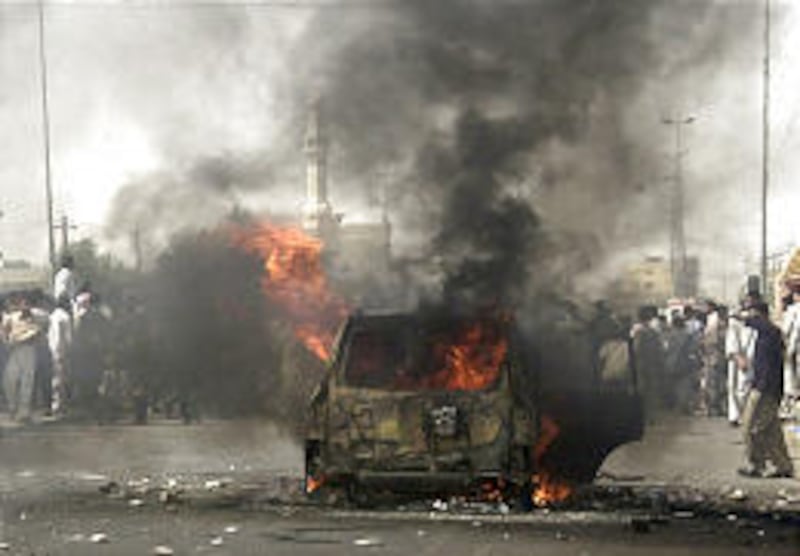
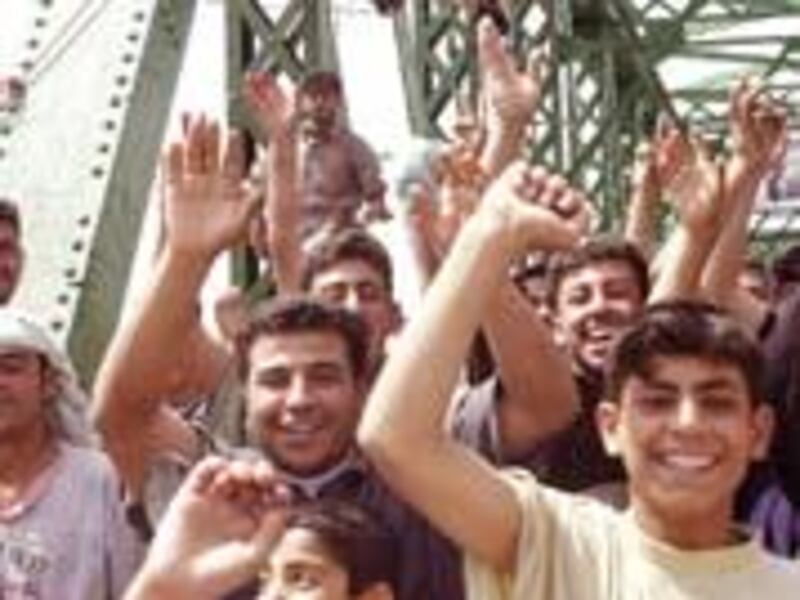
BAGHDAD — Insurgents ambushed and killed four American civilian contractors Wednesday in Fallujah, and a cheering mob then torched their vehicles, dragged their charred bodies through the streets and strung two from an iron bridge over the Euphrates River, witnesses said.
Hours earlier, five U.S. soldiers were killed west of Fallujah when their Humvee rolled over a bomb in one of the deadliest assaults on American forces in recent weeks.
The attack in Fallujah raised anti-occupation violence to a new level of brutality, and the jubilation of the crowd belied U.S. attempts to paint the assaults as solely the work of cold-blooded insurgents rather than an expression of popular anger.
The insurgents' apparent hold over the town also underscored the challenges that coalition forces face in routing the resistance there. More than six hours after the contractors were killed, neither Iraqi police nor U.S. Marines in charge in Fallujah had appeared at the scene, according to witnesses interviewed on television. The military said later it was dispatching troops but did not address the delay.
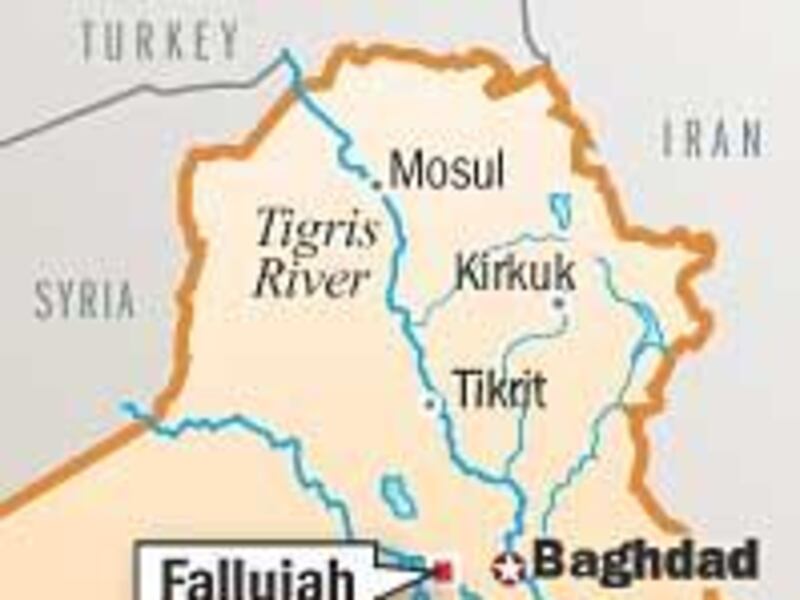
The graphic images from Fallujah were widely broadcast across Iraq on Arabic satellite television channels and were described by commentators as evidence that American troops were not in control in the Sunni Triangle, the violent region north and west of Baghdad. Fallujah, 32 miles west of the capital, has been a center of insurgent attacks against occupation forces and Iraqis cooperating with them.
The names of the American contractors were not released. The four worked for Blackwater Security Consulting, a U.S. government subcontractor based in Moyock, N.C., the company said in a statement Wednesday afternoon. The company provides convoy security for food deliveries in the Fallujah area.
The attack — the most brutal yet against any foreigner here — occurred early Wednesday as the contractors traveled through downtown Fallujah in two sport utility vehicles and insurgents fired on them with assault rifles and rocket-propelled grenades. A crowd surrounded the bullet-ridden vehicles, set them on fire, then poured gasoline on the bodies.
The television footage showed a crowd of men and young boys crying "Long live Fallujah!" as they ripped one corpse apart. Others flashed victory signs and threatened other attacks against occupation forces and other foreigners.
The Al Arabiya network showed a burned body being dragged by a rope behind a car as a crowd followed alongside. A man jabbed at the body with what looked like a long metal pipe; another yelled, "God is great!"
Other footage, captured by a Reuters cameraman, showed a crowd of what seemed to be teenagers pulling another charred body by the legs through the street. Several teenagers removed their shirts and waved them in the air in front of the body, chanting, "With our souls, with our blood, we defend Islam!"
Two bodies were lashed to an iron bridge that spans the Euphrates near the center of town, several reporters at the scene said.
White House spokesman Scott McClellan called the treatment of the bodies "despicable." Occupation spokesmen sought to portray the killings as another attack by supporters of the former Baathist regime of ousted leader Saddam Hussein.
"The people who pulled those bodies out and engaged in this attack against the contractors are not people we are here to help," said Dan Senor, spokesman for the top U.S. administrator in Iraq, L. Paul Bremer III. "They are people who want Iraq to turn back to an era of mass graves, of rape rooms and torture chambers and chemical attacks."
But witnesses quoted by wire services and on television described a scene in which the convoy was ambushed by a rocket-propelled grenade attack and small-arms fire — presumably by insurgents — and then set upon by a larger crowd of residents.
The frenzied scene was reminiscent of the 1993 street battle in Somalia in which a crowd dragged the corpse of a U.S. soldier through the streets of the capital, Mogadishu, an image that contributed to the U.S. decision to pull out of the East African country.
Asked about the parallels, Brigadier General Mark Kimmitt, the chief military spokesman here, said, "Sometimes false comparisons are not helpful."
A tribal sheik, reached by telephone in Fallujah Wednesday evening, attributed the crowd's anger to the killing of several civilians in crossfire Friday, when US Marines engaged insurgents in a downtown gun battle.
"Children and women were killed. They were innocent. They were just walking down the street," Ibrahim Abdullah al-Dulaimi, 55, said. "People in Fallujah are very angry with the American soldiers."
On March 24, the First Marine Expeditionary Force replaced the Army's 82d Airborne Division in command of AnbarProvince, which includes the resistance centers Fallujah and Ramadi. American troops had been keeping a low profile in Fallujah recently, but a large US Marine patrol entered the city center Friday before the shoot-out that killed at least six civilians and a journalist.
Companies and nonprofit organizations were cautious about describing the attack's effect on their operations, citing the need to keep security procedures secret.
The head of operations in Iraq for the Research Triangle Institute, a North Carolina think tank that has nearly 200 foreign civilian contractors in the country, said it has both foreign and Iraqi staff working regularly in Fallujah and Ramadi without incident.
"There has been a large-scale military operation going on the past 48 hours, trying to get some control, and understandably there's a lot of anger among the population," Peter Benedict said. "But we have a different mission."
Five U.S. soldiers from the Army's First Infantry Division were killed when a bomb exploded under their M-113 armored personnel carrier in Malahma, about 12 miles northwest of Fallujah. It was the deadliest single attack against U.S. troops since Jan. 8, when a Black Hawk helicopter was shot down and crashed near Fallujah, killing all nine soldiers aboard.
Coalition officials have said that in the months leading to the hand-over of power to a sovereign Iraqi government June 30, they expect attacks against occupation forces, Iraqi security forces and civilians to increase. Wednesday's deaths brought the number of soldiers killed in Iraq since the war began to 597 and the number of foreign civilians killed in Iraq in the past two weeks to 12.
Attacks against coalition military forces jumped to an average of 28 a day, from 22 a day last week, Kimmitt said. And attacks against Iraqi security forces rose to five from four a day on average.
In another display of popular anger, 10,000 supporters of radical cleric Moqtada al-Sadr burned an American flag in Baghdad, chanted solidarity with "the heroes of Fallujah," and demanded that the occupation authority allow Sadr to continue publishing his newspaper, which the US military closed Sunday for allegedly inciting violence.
The swarming supporters briefly closed down an entrance to the Green Zone, the military and occupation authority headquarters in central Baghdad.