

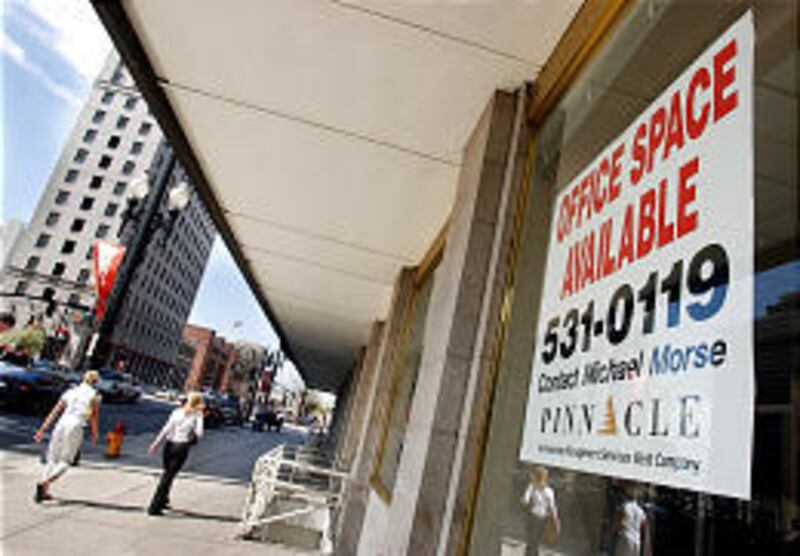
A decade ago Salt Lake City's tight office market forced tenants in need of new office space to begin their search a year in advance.
In some cases, tenants were willing to double-pay — for their existing rent and a new lease — in order to secure the space they wanted.
"It was very difficult," said Bill Martin, managing partner of Colliers Commerce CRG, who remembers the mid-1990s as the one of tightest office markets he has seen in his 28-year career. "You had to find a tenant that was in the space and figure out whether they were going to expand or contract a year in advance of their lease expiring."
But as the turn of the century turned into a national recession and layoffs became commonplace, Utah's vacancy rates began to skyrocket.
"In America, there were a tremendous amount of service, accounting, call centers, law and engineering jobs that were shipped out to India and Pakistan," said Kyle Roberts, a partner at NAI Utah, who said the offshoring phenomenon had a direct impact on Salt Lake's office vacancy rates.
Those forces put tenants in control, and in the past two years businesses have been able to relocate in a matter of months, often at negotiated leases with upgraded space and discounted prices.
But don't count on those conditions lasting much longer.
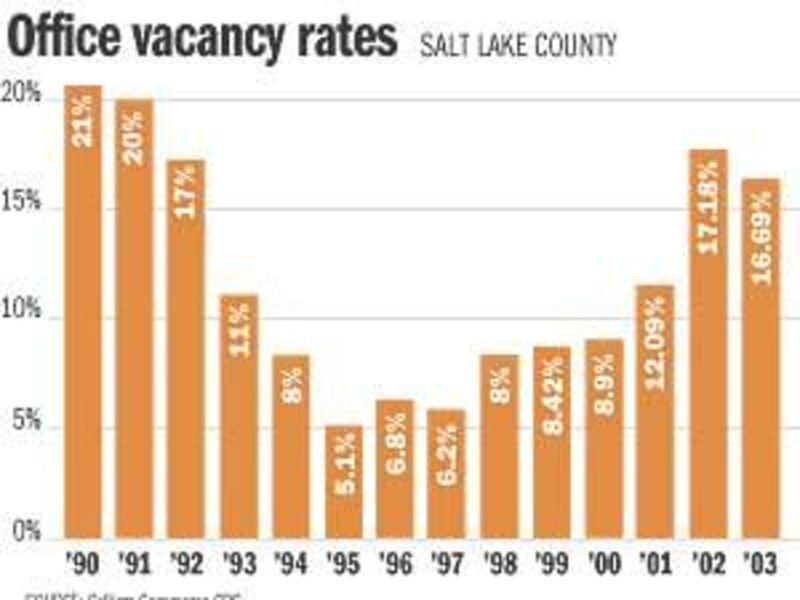
While office vacancy rates since 2002 have remained at near-record highs — hovering around 17 percent, excluding sublease space — there is evidence that Salt Lake's office scene is improving.
According to Colliers Commerce CRG, office vacancy rates have fallen during each of the past four consecutive quarters.
In the three months ended March 31, Salt Lake County's overall office vacancy rate fell to 15.68 percent, a 1.01 percentage point drop from the 16.69 percent vacancy rate in the first quarter of 2003.
The recent falling vacancy rates could indicate a new trend, one that would mirror the early 1990s, when vacancy rates hovered between 17 percent and 21 percent and then suddenly plummeted to 8 percent.
Back then, low vacancy rates spurred a construction boom, with nearly 2 million square feet of new office space added to the market each year from 1995 through 2001, according to Colliers.
But since 2001, the height of the past recession, there has been little speculative office construction. In 2003, roughly 314,000 square feet of office space was added to the Salt Lake market, a 38 percent drop from the 510,023 square feet added the previous year, Colliers said. This year new office space will again be down, with an estimated 225,000 square feet of space expected.
With little office space being added and an improving national economy propelling job growth, demand is slowly catching up with supply.
In fact, the most expensive office space, "class A," which costs anywhere from $18 to $28 a square foot, is showing the strongest demand and the lowest vacancy rates.
Local developers like Jake Boyer, a partner of Salt Lake-based The Boyer Co., said buildings like Two Gateway, an 85,000-square-foot complex at The Gateway shopping center, are running at full occupancy. Two Gateway leases at $22 to $24 a square foot.
The vacancy rate is just 12 percent at One Gateway, an office building offering 158,000 square feet and a lease rate of $20 to $22 a square foot.
The strong leasing of those two buildings prompted The Boyer Co. to begin construction last year on a third office complex, which should be ready in June, Boyer said.
"We've seen a real uptick in the leasing market," he said. "We've got quite a few deals that we're negotiating for that building. We're pretty confident that the majority of that building will get leased this year."
Boyer said there are other signs indicating an improving market, including tenants willing to renew leases early.
"We've renewed some pretty significant leases one or two years early," Boyer said. "I think they sense a shift in the market a little bit to the landlord side."
That shift may be attributable to an improving economy. The U.S. Labor Department reported last week that a total of 513,000 new jobs were added across the country in the first quarter.
Mark Knold, senior economist for the Utah Department of Workforce Services, said Utah appears to be ahead of the national trend in job growth. He anticipates 1.5 percent to 2 percent annualized job gains in 2004.
"We've been slowly starting adding jobs since last July. January and February were pretty good months," Knold said. "The national numbers started to show life here in the beginning of this year, whereas Utah started showing life the end of last summer."
Another shift in Salt Lake's office market is the drive toward suburbanization. Outlying offices like the Cottonwood Corporate Center, in the central east part of the valley, are witnessing lower vacancy rates than downtown Salt Lake City.
"People want to work and recreate as close to home as possible," Roberts said.
Martin estimates about 146 potential tenants are now looking for more than 2 million square feet of office space in the Salt Lake area. The list, of which 75 tenants are named, includes Ceredian, a software company in search of 30,000 to 35,000 square feet; World Savings Bank, 3,500 square feet; and Alamode, a technology company looking for 5,000 square feet.
E-mail: danderton@desnews.com