


Marilyn Riding is among the 1 in 5 cornea transplant patients whose body has rejected a donor cornea and another donor cornea is likely to give her the same result. She now sees only light and dark shadow with her left eye.
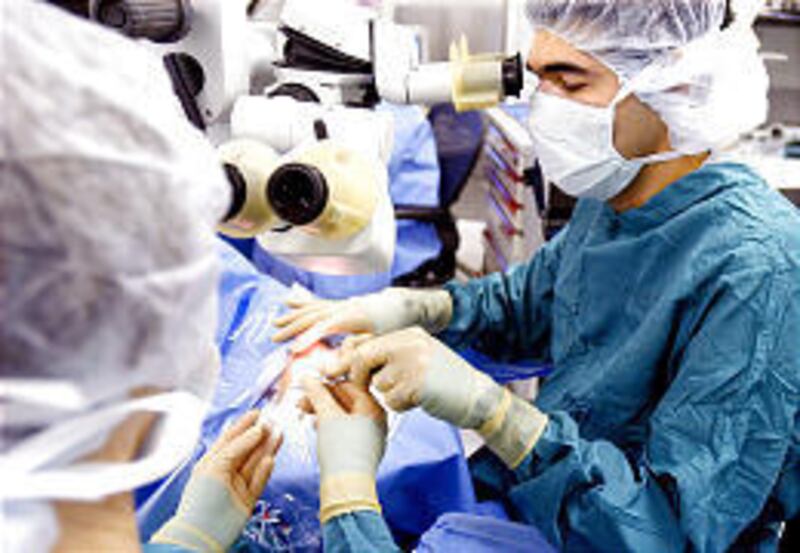
Tuesday afternoon, the Provo woman became the first patient in the Intermountain Region to undergo a cornea transplant using an artificial cornea developed in Australia. Because the material is a neutral hydrogel, rather than tissue, her doctor says it won't be rejected. The artificial cornea was in development for almost a decade and received approval for use in the United States last year. The company that makes it, AlphaCor, says it's specifically for those who, like Riding, have rejected previous cornea transplants.
Before Tuesday, Riding's damaged cornea was the equivalent of a muddy window on a sun porch, obscuring the view, though some light sneaks in. The cornea is the window on the front of the eye that both protects it and helps with the focusing process. Usually, cornea transplants are needed because of corneal injury or disease. But after her transplant, the cornea developed calcium, an unusual form of rejection.
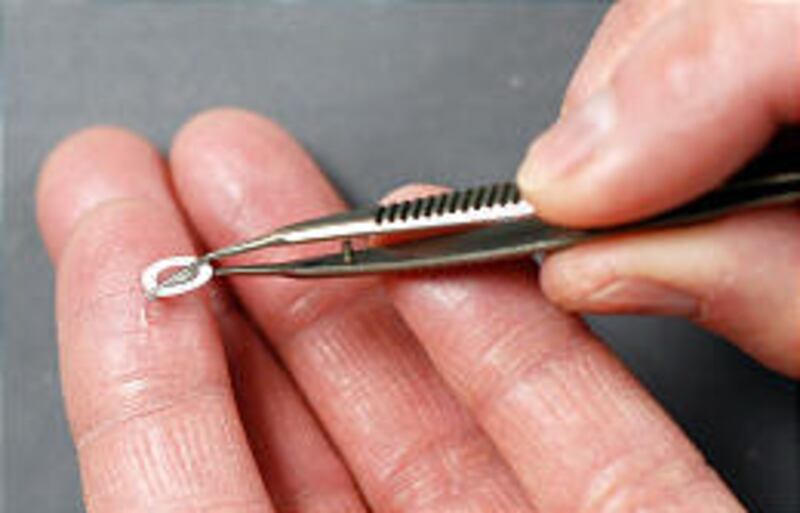
The AlphaCor cornea is about the size of a contact lens, the clear film in the center surrounded by a spongy ring called the "skirt." Dr. Majid Moshirfar, associate professor of ophthalmology and visual sciences at the University of Utah's Moran Eye Center, cut a slit in the thickness of Riding's cornea to create a pouch, making a hole on the bottom layer that covers the eye, as well. The operation is complicated and delicate, taking as many as four hours.
The outpatient procedure can be done under local or general anesthesia, and Riding will have as many as 12 to 24 stitches in her eye afterward. It's not pain free. As long as the stitches are in, her eye will be irritated. "If one eyelash irritates, imagine what 24 sutures do," Moshirfar said.
In about three months, when the tissue and blood have had a chance to grow into the skirt and make the artificial cornea part of Riding's body (she will need eye drops but not anti-rejection medicines or other drugs), he'll "open the package" by cutting out the section of her damaged cornea to unveil the artificial one. Only then will the doctor — or even Riding — have an inkling of what her vision will be like with the transplant.
The goal for Riding is not to achieve perfect vision. Moshirfar says if everything goes well, she may achieve 20/200 vision. But it should certainly be better than lights and shadows. For one thing, she should get back her color perception in that eye.
"When we do this, this is not LASIK surgery where we go for 20/20," Moshirfar said. Some patients have, however, had substantially better results.
"This is the first time we have an artificial prosthetic that can be used to restore vision" for patients with cornea damage, Moshirfar said. That may one day prove particularly important in parts of the world where there are no eye banks and eye donors.
An estimated 10 million people worldwide need cornea transplants. In Utah, on a given day, 100 people are waiting.
Riding's vision in the left eye began to fail more than a decade ago. Then she had cataract surgery that ended up with complications. After that, her body rejected the donor cornea that doctors hoped would help her sight.
The artificial cornea is an option that wasn't available to her a short time ago, and that's exciting, she says.
"This may be an intervention for some patients who have given up hope," Moshirfar said.
E-mail: lois@desnews.com