

BAYEUX, France — Today, the world marks the 60th anniversary of D-Day, when 150,000 Allied forces landed on the coast of Normandy and helped trigger a German surrender some 11 months later.
By the end of that day — June 6, 1944 — some 6,603 U.S. troops would be dead. Another 3,646 British and Canadian troops would perish. Yet most people would refer to it as the greatest day of the last "good war."
In Normandy, President Bush is joining 16 other heads of state and government, including British Prime Minister Tony Blair and French President Jacques Chirac, to mark the occasion. This year, for the first time, Germany has been asked to participate, and so Chancellor Gerhard Schroeder also is attending.
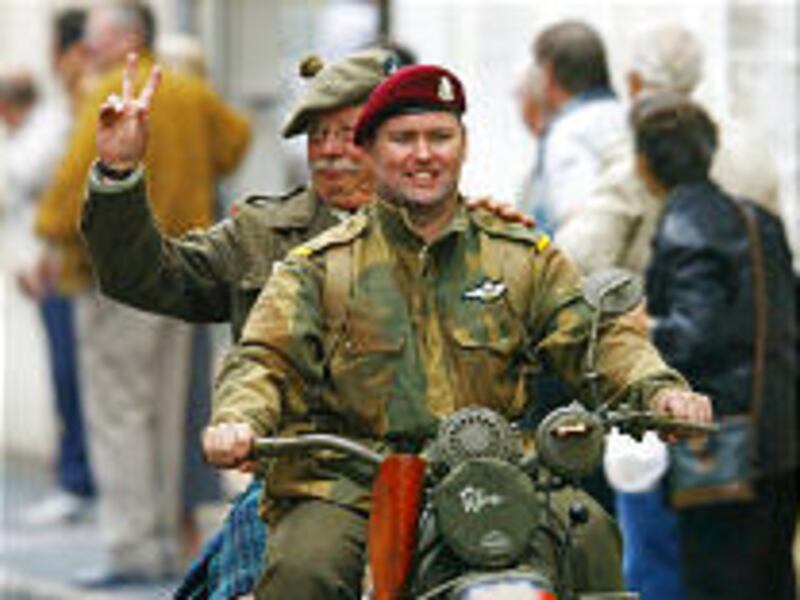
On Saturday in Bayeux, the first town to be liberated by the Allies, the mood was festive and nostalgic. World War II-era songs were played in restaurants. Merchants distributed chocolates with paper wrappers bearing an American flag and the words "I remember" printed in French.
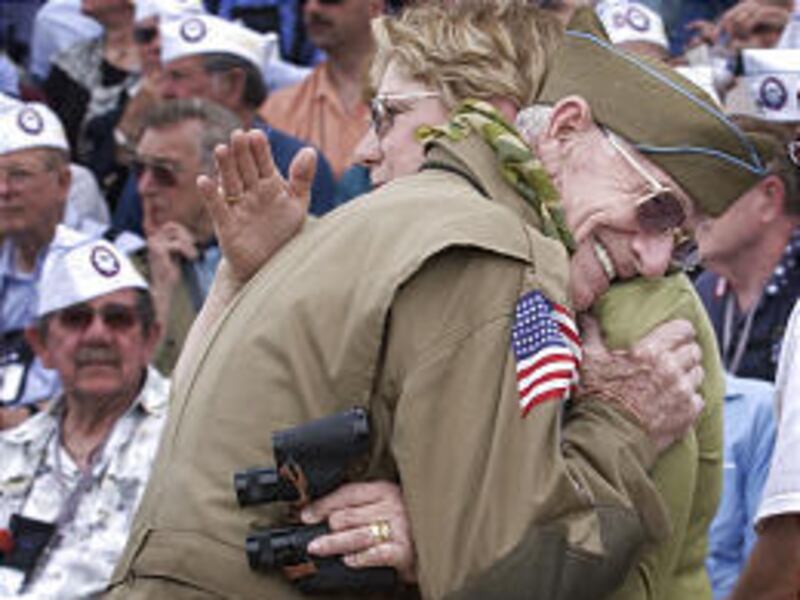
Bush and these other leaders are speaking emotionally about the sacrifices of that day to an audience that includes — perhaps for the last time — surviving veterans of the battle.
The poignant occasion is being witnessed by citizens of countries that are still locking horns over the American-led invasion and occupation of Iraq.
Sixty years on, nearly everyone hopes to gain something at this gathering of 1,300 journalists, 8,000 World War II veterans and 15,000 invited guests.
Bush hopes to gain support for a new multilateral approach to Iraq. Chirac hopes to gain a showcase for Europe's unity and strength, with Schroeder at his side. Schroeder hopes to gain a boost in his sagging popularity in Germany.
Indeed everyone hopes to gain something, except perhaps the veterans themselves. They say they only want to remember their experiences that day — on the old battlegrounds where it all happened — alongside others just like them.
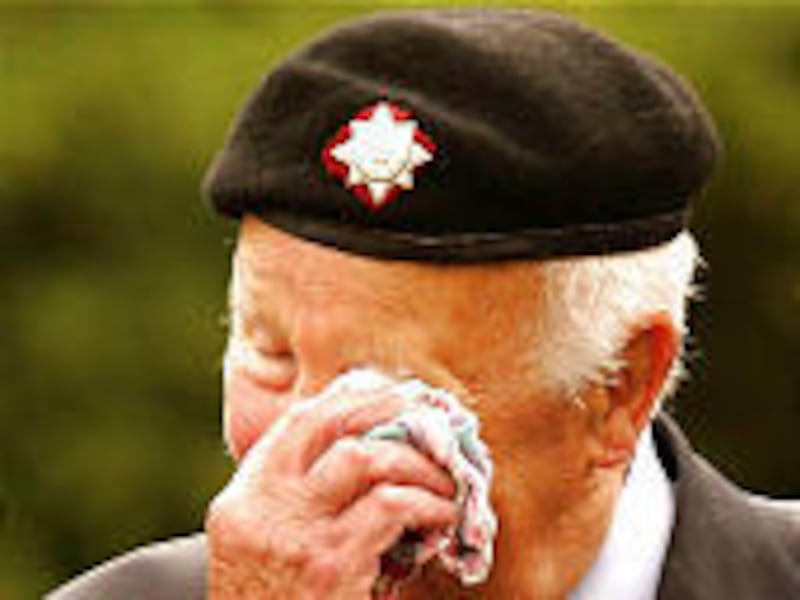
And they acknowledge they may never do it again.
"I know I'm getting up there, and it's so disappointing how many folks have died off and how now it's the children who are carrying the ball," said Len Lomell, 84, the legendary Army Ranger who personally destroyed five German howitzers on D-Day, helping to ensure the invasion's success. "We've been going back and forth to Normandy for 60 years, and so many of our friends in France we came to know so well are now gone as well."
Lomell, a retired lawyer from New Jersey, has led groups of veterans to Normandy every five years since 1967.
"This year I am bringing 100 people, but only 12 are veterans," he said. "The rest are the wives, the children and the grandchildren." -->
Bob Davis, 83, who landed at Normandy as part of the Army's 507th Parachute Infantry Regiment, activated at Fort Benning, Ga., in 1942, said that he, too, realizes this could be the veterans' "last hurrah."
Davis' regiment went into Normandy with 2,004 men and left with just over 700. It was a time he'll never forget.
"If there's one thing I want folks to take away from this weekend it's that people made sacrifices back then that are unthinkable today," said Davis, who now lives in New Jersey. "Nobody these days seems to know much about sacrifice, but it's something that has to happen when your country is fighting for something."
This is just the type of message that Bush will hone as he seeks to use his visit in France to improve his standing both abroad and at home.
"Don't forget that, especially for Republicans, the pictures of Ronald Reagan at the 40th D-Day anniversary are considered the absolute tops in patriotic campaign photos," said Frances Burwell, director of the Program on Transatlantic Relations at the Atlantic Council of the United States in Washington.
"So this trip should offer President Bush a similar opportunity for photos and video that can be used in his campaign, especially for veterans' votes, which are not automatic this year," she said.
Bush is joining other world leaders in the Normandy town of Caen and was scheduled to make remarks later at the immaculate American Cemetery in Colleville-Sur-Mer overlooking Omaha Beach, where 9,386 of the fallen lie buried.
He and the others will be protected by a massive security operation. Some 9,000 French troops have arrived here to support thousands of police officers. And private planes straying into Normandy airspace this weekend risk being shot down, French officials said.
Many of the speeches presidents have made at D-Day events in the past have been long remembered.
"The men of Normandy had faith that what they were doing was right," President Reagan said at the 40th anniversary in 1984. "It was the deep knowledge — and pray God we have not lost it — that there is a profound moral difference between the use of force for liberation and the use of force for conquest."
Burwell and other experts caution against seeing Bush's visit as any kind of turning point in U.S.-Franco relations.
"There is still a lot of suspicion and hard feelings, especially in some quarters, more so than there is with the Germans," she said.
Certainly, though, the visit will provide Bush with an international platform he can use to urge allies to unite yet again — this time in the Middle East and especially in Iraq.
But it will be a near-impossible sell.
According to a recent survey by the Pew Research Center, Bush enjoys a majority unfavorable rating in most foreign countries, from a 96 percent unfavorable rating in Jordan to 85 percent in France to 57 percent in Great Britain.
Former French Prime Minister Laurent Fabius told an audience at the University of Chicago recently that this is "the paradox of June 6."
"Bush will be welcomed as the president of brave men who died for freedom, but he will be considered as the exact opposite of the values that make us love America," he said.
Francois Heisbourg, director of the Foundation for Strategic Research in Paris, said the French people do not consider Bush to be "the heir" of the men who were here in 1944.
"The negative feelings of the people are all directed at the man — George W. — and not the American people and certainly not the veterans," he said. "In fact, the veterans will be doted over because they are seen as very special people.
"I don't think anybody will pay any attention to what George W. says in his speeches because most people see France's relationship with the administration as being beyond retrieval," he said.
Indeed, commentaries in European newspapers have asked this week: "Whatever happened to the America we loved 60 years ago?" They say that the contrast between images of Normandy beaches and Iraqi jails couldn't be more
painful and disheartening.
Meanwhile, Rodger (CQ) Payne, an expert on international relations at the University of Louisville, said that Bush likely would get a domestic boost — if not a boost abroad — from his Normandy visit.
"The focus of the trip is going to be on foreign policy and that's usually good news for any president — especially one trying to downplay unpleasant domestic news," he said. "These trips and meetings represent a great opportunity to control the political agenda, focusing attention on points the White House wants to disseminate. Any progress on
European relations is gravy."
On the veterans' part, they say they care little about the politics behind the presidential visits.
"The veterans just enjoy being together because no one else understands what it was like on that day," said Frank Naughton, 86, of Norcross, Ga.
Naughton parachuted into Normandy on D-Day as part of the 507th regiment and he has returned this weekend accompanied by Phil Walker, the Atlanta filmmaker who produced "D-Day: Down to Earth — Return of the 507th," a documentary recently shown on PBS stations across the United States.
"The last 10 years have been a remarkable time for many of the veterans in that the 50th anniversary opened up a wellspring of emotion and a wellspring of public knowledge about the war," Walker said.
"Many of them hadn't been very involved in their veterans' associations or even talked much about the war until the 50th anniversary so this will be a capping off of 10 years of involvement," he said.
Davis, one of the veterans from New Jersey, said he never talked much about D-Day until a certain incident 10 years ago made him realize he had to speak out.
"I was sitting in a dentist's chair and talking to a very nice intelligent dental technician about 35 years old who asked me where I had lost my molars," he said. "I told her I had lost my molars to an army dentist a few weeks before D-Day.
"And she said 'what's D-Day?"' he said. "It was a moment I'll never forget. I didn't know what to say. It opened my eyes to the fact that people were forgetting and I needed to get the message out.
"Now I go back to Normandy when I can and I talk about things," he said. "We can't let people forget what happened that day but they are."