


The 8-year-old boy had just stepped up to bat at a neighborhood softball game, back when Sandy had vacant lots where that was possible.
"Bobby," his mother called, "it's time for your piano lesson."
"I said, 'aw, shucks,' and threw down the bat," said Robert Cundick, "and trudged home, never dreaming that I was starting something that would become a lifelong passion."
But his mother never again had to tell him to practice, as he discovered an intense interest in, and an affinity for, making music.
Cundick's life took another turn when his local LDS Church ward acquired a Hammond organ. "Before that, we had reed organs that had to be pumped, either by the organist — a lot of work — or by the deacons. So the Hammond was a whole new world for a young boy." By age 12, Cundick was playing the organ well enough that he became the ward organist.
Not everyone finds a career path at age 12, but Cundick was firmly ensconced on one that would take him to the heights of his profession, provide a long and fulfilling life of service as teacher, composer and Mormon Tabernacle organist.
His profession would also earn Cundick numerous awards and accolades, the most recent being the Lifetime Achievement Award presented by the Faith Centered Music Association at the 2004 Pearl Awards.
Before he actively pursued his career, of course, there were more studies. During high school, Cundick studied classical music and performed in a jazz band.
Then came World War II, and the Merchant Marines. "When the A-bomb was dropped, I was on a troop ship in San Francisco, getting ready to invade Japan. We were sent to the Philippines instead."
After the war, Cundick entered the University of Utah, studying composition under Leroy J. Robertson and the organ with Alexander Schreiner. In 1955, he received a doctorate in music with an emphasis on composition.
"I was the first Ph.D. in music in Utah," he said. "I've always thought it represented the progress in music that has happened since the pioneers entered the valley. In just over a hundred years, we had developed a sophisticated education and music system capable of producing a Ph.D."
A year earlier, Cundick was a finalist in the young-artist competition of the American Guild of Organists, and he became the guild chairman for Utah.
He taught at both the University of Utah and Brigham Young University. In 1962, he was asked by the LDS Church to go to London as organist for the Hyde Park Chapel, where for two years he gave daily recitals.
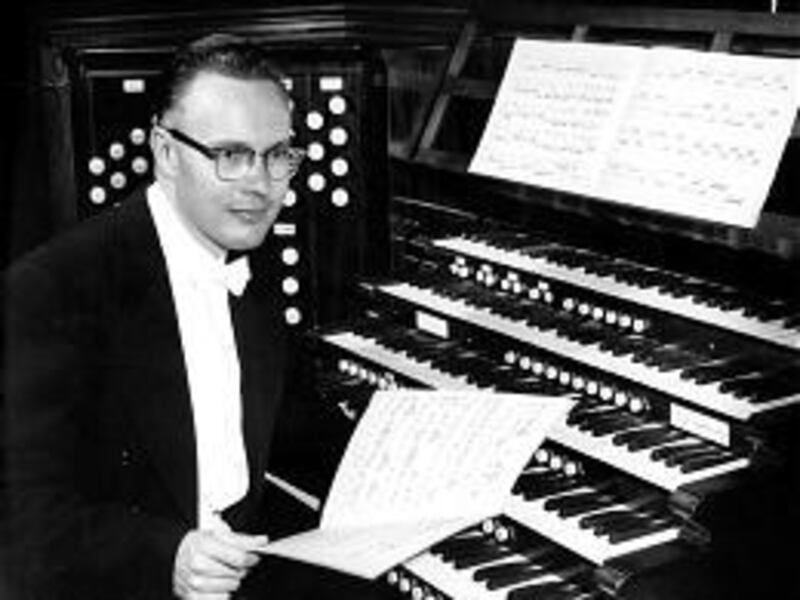
Then, in 1965, Cundick was appointed Mormon Tabernacle organist — playing for the Mormon Tabernacle Choir and its weekly broadcast — a position he held for 27 years. "For any Mormon organist, the pinnacle of achievement is to sit at that bench. I was no different. When the call came, I was elated — for about a week. Then reality set in."
The problem with being on a continuing program, he said, is that you're never done. "It was like being in a never-ending basketball season. The minute one game is out of the way, the next one is up."
Still, it is not an experience he would trade. It was a time of change and growth for the choir, "and it was exciting to be a part of that."
During his tenure, he was also happy to see women join what had been an all-male group of organists.
After retiring as Tabernacle organist in 1991, Cundick and his wife Charlotte (affectionately known as "Cholly") were asked to go to the Jerusalem Center. The last thing choir president Wendell Smoot told him before they left was not to expect the choir to come to Jerusalem. "But we got over there, and it all fell into place." The choir arrived during the 1992 Christmas season.
Cundick is also proud of the concert series he started at the center. "The Berlin Wall had just come down, and all these Russian musicians were emigrating. They joked that if a person arrived at the airport without a musical instrument case — it must be a piano player. The musicians had no place to earn a living, so they were playing on street corners. We started auditioning them and having them come play at the center."
The concert series grew, he said, "until one man told me that no musician considered his dossier complete until he had made a Jerusalem Center appearance."
Since returning from Israel, Cundick has been doing more composing. He has always done work in the area, composing not only for the organ but also for piano, choir, orchestra and chamber groups. One of his largest works was "The Redeemer," which he calls "a sacred service of music" rather than an oratorio.
He has just completed a commissioned piece titled "Remembering Joseph," which will debut for the 200th anniversary of Joseph Smith's birthday in 2005.
Cundick finds an endless fascination in creating music. "It's unique. It's so ephemeral. The performance ceases with the last note. It's the least permanent of all the arts. With painting, with sculpture, with literature, you have something there. But with music, it's all generated in sound."
For all he's done in music, however, Cundick hopes he will be remembered for being a "wonderful father, grandfather and great-grandfather." He and Cholly have five children (two are members of the Tabernacle Choir), 24 grandchildren and six great-grandchildren (with two on the way).
He hopes that he's done "something for the betterment of music culture." But the greatest satisfaction has simply come from "being able to serve others through music. Anything I've done, either through playing or composing, that has brought enjoyment to other people, has been satisfying. That's what it's all about."
If you watch
What: The 2004 Pearl Awards
Where: KTVX-Ch. 4
When: Tonight, 6 p.m.
E-mail: carma@desnews.com