

DUP marker No. 1 — "Tooele Pioneers," 520 S. Main, Tooele
On Sept. 2, 1849, the first band of Mormon settlers arrived in the Tooele Valley. Although the area had been previously used as grazing ground for Ezra E. Benson's cows, these folks had come to stay.
Josiah Call, Judson Tolman and Samuel Mecham and their families spent the first night on a little ridge overlooking both the valley and the Great Salt Lake.
They went to Salt Lake for October conference but returned to Tooele, accompanied by John Rowberry, Phineas R. Wright, Cyrus Tolman, Orson Bravett and their families, as well as several other young boys.
Deciding the best place for a settlement was nearer the mouth of the canyon, closer to both wood and water, the little band constructed a seven-room log house. And Tooele was on its way.
In 1934, the Daughters of the Utah Pioneers' first official plaque honored these pioneers.
Dr. Emil B. Isgreen, who owned the land where the first campsite was located, had contacted the local DUP camp and offered to donate the land to the city if the DUP would erect a monument.
A "sturdy cement shaft on which had been floated copper concentrates, making it look like granite," was dedicated on Nov. 11, as part of the Armistice Day celebration. "It was a grand day with many speakers and musical numbers," according to local reports.
That monument stood for 66 years, but by the end of the century, it was badly in need of repair. So in 2000, the DUP camp replaced it.
The Broken Arrow Construction Co., under the direction of Stephen Bunn and Sid Hollinger, offered to bring in a huge boulder from its quarry on Stansbury Island. The original plaque was carefully removed from the old monument and remounted on the giant stone.
Words that were spoken at the first dedication were equally pertinent at the second, noted then-DUP president Ora Bridges: "As we gather the roses of their effort, never forget that the pioneers watered the bush with tears; sometimes of sorrow, sometimes of disappointment but always with a trust in God and a determination to win."
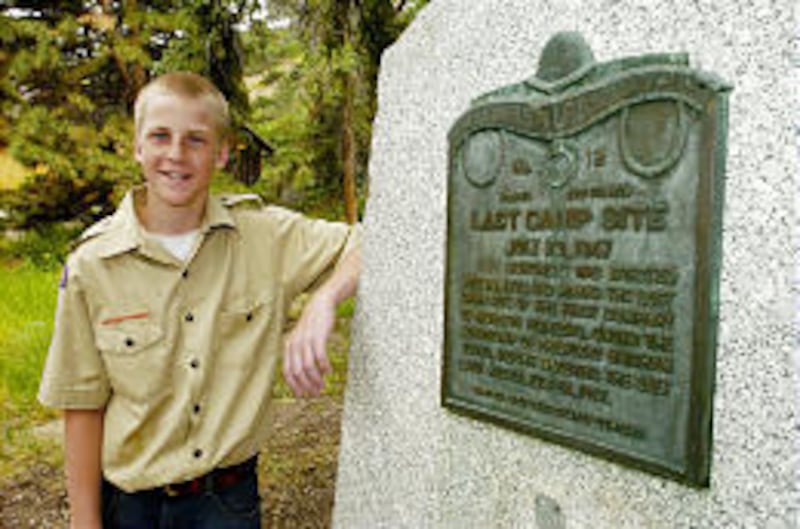
DUP marker No. 12 — "Last Camp Site," 5225 Emigration Canyon Road
As the shadows lengthened on the 23rd day of July 1847, a caravan of covered wagons arrived at a "broadening" of the canyon near Last Creek (now Emigration Creek) and set up camp formation.
Already most of the group had gone on to the valley ahead and, indeed, were already plowing and planting. But this small group, slowed by an ailing Brigham Young, had one more night on the trail.
That last night must surely have been one of great anticipation, perhaps mixed with some trepidation. With 110 days and thousands of miles of trail behind them, they were perched on the edge of a new era of Mormon history. Yet, no one knew quite what the future would bring in this faraway place.
Tucked among the houses that now line Emigration Canyon is a monument that honors both the feelings and the achievements of that Last Camp.
The first monument, with words cut into the stone, was placed at the location in 1933. In 1936, due to both damage to the original monument from road repairs, and because the DUP was now placing its distinctive bronze plaques on monuments, they decided to replace the original with a granite slab and plaque.
"We hope it will always stay here so we can so honor our first pioneers," said Gwen Shurtleff. "We never drive up this lovely canyon that we don't think about our great pioneers." But that marker, too, was replaced in 1972.
The original marker was left at the site, but over the years it and the monument's foundation got covered over by dirt and debris. This month Scout Craig Jeppson offered to clear away that dirt and clean up the area as as his Eagle Scout project.
Jeppson, a great-great-grandson of pioneer and later church president John Taylor, thought it would be a good way to honor his pioneer heritage. When he started, he didn't realize the concrete foundation and old monument were even there. To uncover them and make the whole area look nice, he says, "was pretty cool."
DUP marker No. 155 — "Union Cemetery," 1484 E. 7830 South (Creek Road)
When Rufus Forbush arrived in the valley in 1847, he settled on Little Cottonwood Creek, east of Fort Union. In the winter he came down to the settlement to live but spent the rest of the year on his farm.
On Aug. 22, 1851, Rufus' wife Polly died, and because there were no graveyards outside Salt Lake City, "he chose the highest spot of ground on his farm and buried her there," noted great-granddaughter Lucy E. Graham Green.
"During the winter a severe epidemic of black smallpox broke out in Sandy, an adjoining town, and when Great Grandpap went back to his farm in the spring, he found that other graves were made upon his land. There seemed nothing to do but turn the land over to the community for a cemetery."
Although official records of the cemetery have been lost over the years, the local DUP chapter has been able to identify about 150 people (78 of whom were children) who were buried there. The last burial occurred in 1942. On Aug. 22, 1951, to commemorate the 100th anniversary of the first burial, the DUP placed a marker there.
A few of the original headstones remain, but many have been lost and broken. When the DUP decided to clean and restore it, "the field was a cow pasture covered with high weeds," says Joyanne Vincent.
Of particular interest is the grave of Green Flake, one of three black pioneers who arrived in the valley in 1847. Born as a slave in North Carolina in about 1828, he moved with his owners, Madison and Agnes Flake, to Mississippi, where they were all baptized as members of the LDS Church. They joined the body of the church in Nauvoo, and for a time, Green served as a bodyguard to Joseph Smith.
Green came to Utah with the first company of saints. After Madison's death, Agnes decided to go to California in 1850, and she left Green to "work for the church as a way of paying the family's back tithing."
Green worked for Brigham Young and Heber Kimball for a year or two and then was given his freedom and a plot of land at Union Fort. He married, had a farm and a herd of cattle.
Upon his death in 1903, Green was laid to rest in the Union Cemetery, under a marker that notes "In my father's house are many mansions."
SUP marker Z — "All Is Well," Brigham Young Grave, 138 E. 1st Avenue.
When Brigham Young died in 1877 — some think now of complications from acute appendicitis — there were already three graves tucked into the family plot. One of his wives (Emeline, 1826-1875), and two children (Joseph, 1834-1875; and Alice Young Clawson, 1859-1874) had been laid to rest there.
After Brigham, three more wives (Mary Ann Angel, 1805-1882; Lucy D., 1822-1891; and Mary V. 1844-1884) were buried there, as was Eliza R. Snow, 1804-1887.
The grave of the second president of The Church of Jesus Christ of Latter-day Saints and pre-eminent colonizer of the West was marked by a plaque installed by the Utah Trails and Landmarks Association in 1938. But over the years the little cemetery fell into relative obscurity.
In 1974, the Sons of the Utah Pioneers commissioned a statue titled "All Is Well" in tribute "to the Mormon Pioneers who sang joyously 'all is well' amid their trials and rigors on the long trek from Nauvoo, Illinois, to the Salt Lake Valley."
The statue, along with plaques honoring both William Clayton, author of the popular hymn, and poet and author Eliza R. Snow, author of "O My Father," among other works, were installed at the cemetery, along with benches, walkways and flower gardens.