

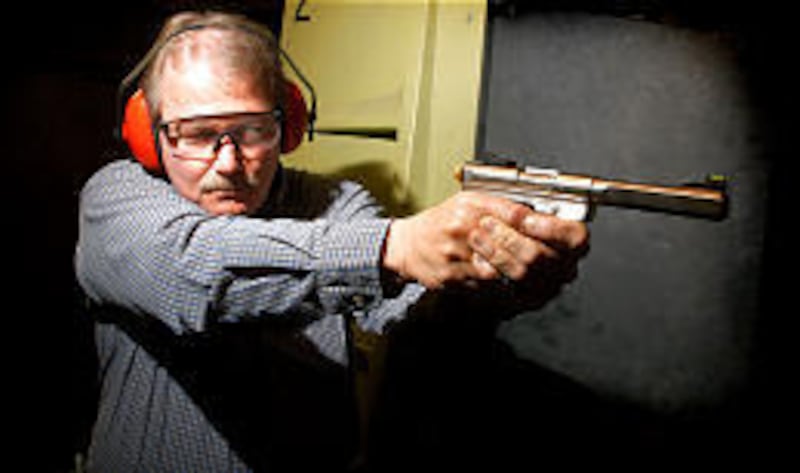

It seems simple enough: Aim, take a deep breath and pull the trigger.
And, to put a hole in a paper target the size of a large dinner plate at 10 meters is — as it would seem — pretty easy.
To put 10 shots or even 20 shots or upwards of 60 in the center of a target where the bull's-eye is no larger than a dime at that distance is quite another story.
It's what separates Olympians from recreational shooters.
As Dave Larsen of Doug's Shoot 'N Sport points out, however, it doesn't really matter, "It's all fun."
Shooting events in the Olympics go back to the earliest of times. The rapid-fire pistol event, for example, was introduced into the Games in 1896, along with the free pistol event. Free rifle prone came in 1908. Sport pistol, air pistol and air rifle shoots came in 1984.
Olympic events are broken into two categories — air and rim fire.
The air events refer to .177 caliber pistols and rifles to propel a lead pellet with a burst of air.
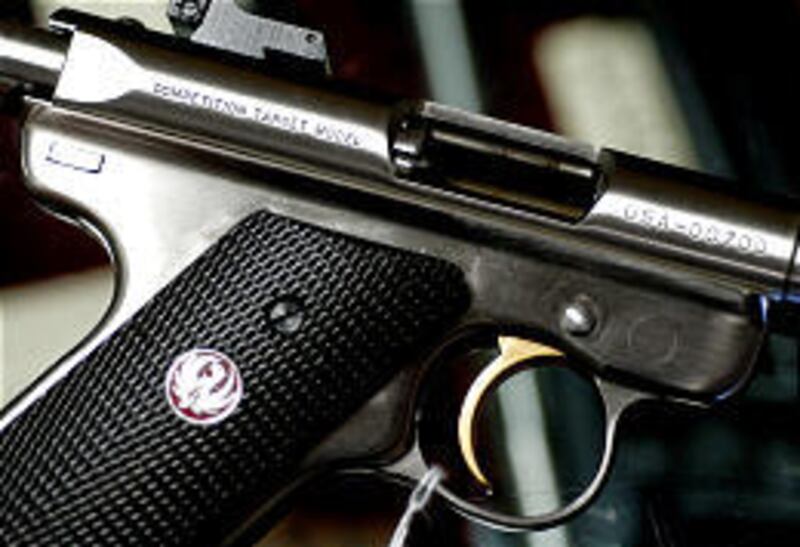
The rim-fire events refer to pistols and rifles firing .22 caliber short shells.
For most people, said Larsen, a .22 caliber pistol or rifle is a good way to get started in target shooting.
"The .22s don't cost a whole lot to shoot, they are moderately priced and are usually pretty high quality," he added.
"Many people, however, want a multi-facade application, so they usually decide to go with something a little larger, like a 9 millimeter, .40 (caliber) or .45 (caliber)."
"They buy the weapon for safety reasons, but once they start shooting," Larsen continued, "they find shooting is an enjoyable sport and it's challenging, and they want to get better and better."
In the Olympics there are four pistol events, three rifle events and a running-target event.
There are a number of ranges — indoor and outdoor — scattered about the state that will give people the opportunity to test their shooting skills.
Larsen suggested that people take a little time to learn some of the basics of shooting.
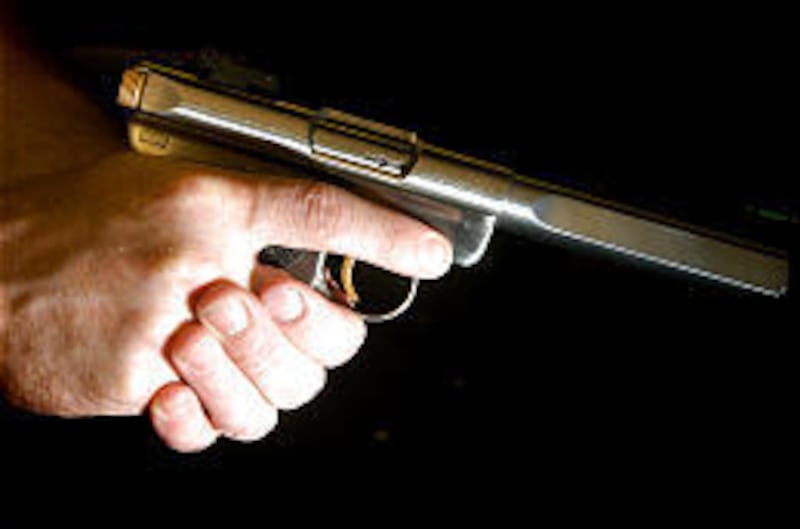
"If people would just come in and listen to us for 10 or 15 minutes, they'll find it's not difficult to become a decent shooter. The learning curve is very sharp in the beginning. Most people never learn the basics . . . they never learn how to properly grip a gun, or properly squeeze the trigger or sight the gun. Doing the little things right can give people a lot of skills real fast. Getting to be a very good shooter, however, takes a lot of time."
A little time spent at a range will give individuals a much greater appreciation for the Olympians. Putting 60 shots in or close to a target the size of a dime is not easy.
There are nine indoor lanes at Doug's Shoot 'N Sports, 4926 S. Redwood Road. This is a 25-yard range were targets can be set at varied distances on a power pulley system. A 10-visit pass is $30, and there are rifles and pistols for rent.
Following is a brief description of the upcoming Olympic events:
Air pistol — Competitors shoot an air pistol at a target 10 meters away. The men have an hour and 45 minutes to shoot 60 shots, the women an hour and 15 minutes to shoot 40 shots. The last Olympic medal won by the United States, a silver, was in 1988.
Rapid fire pistol — Only the men shoot this event. Competitors use a .22 caliber pistol and shoot five shots at a 10-ring target 4 inches wide. The three time limits for each five-shot series are eight, six and four seconds. The last U.S. Olympic medal, a gold, was won in 1960.
Sport pistol — This is a women's event. Competitors use a .22 caliber pistol and shoot both precision and rapid-fire at a distance of 25 meters. They shoot 30 shots for precision and 30 shots in rapid fire. The last medal, a silver, was won by the U.S. in 1984.
Free pistol — This is a men's precision event and competitors shoot .22 caliber pistols. They have two hours to shoot 60 shots. They are allowed to take a break during shooting. The last U.S. medal, a silver, was won in 1964.
Air rifle — Men and women shoot air rifles at targets 10 meters away. Men take 60 shots in an hour and 45 minutes, women 40 shots in an hour and 15 minutes. Here, again, competitors are allowed to take a break during shoots. The last medal, a gold, was won in 2000.
Three-position rifle — Men and women shoot .22 caliber rifles at a target smaller than a dime at 50 meters while standing, prone and kneeling. Men shoot 40 rounds from each of the three positions, women 20 rounds per position. The last medals, a gold and silver, were won in 1992.
Free rifle prone — This is a men's event where competitors lie on their stomachs and shoot .22 caliber rifles at a bull's-eye target 50 meters away that is smaller than a dime. The last medal was won in 1984.
Running target — This is a men's event where competitors shoot air rifles with four-power scopes at paper targets moving across a track 10 meters away. Shooters fire 30 shots at targets on a slow run and 30 on a fast run. They have five seconds to find and fire on the slow run. And 2 1/2 seconds on the fast run. The U.S. has never won a medal in this 10-meter event.
E-mail: grass@desnews.com