

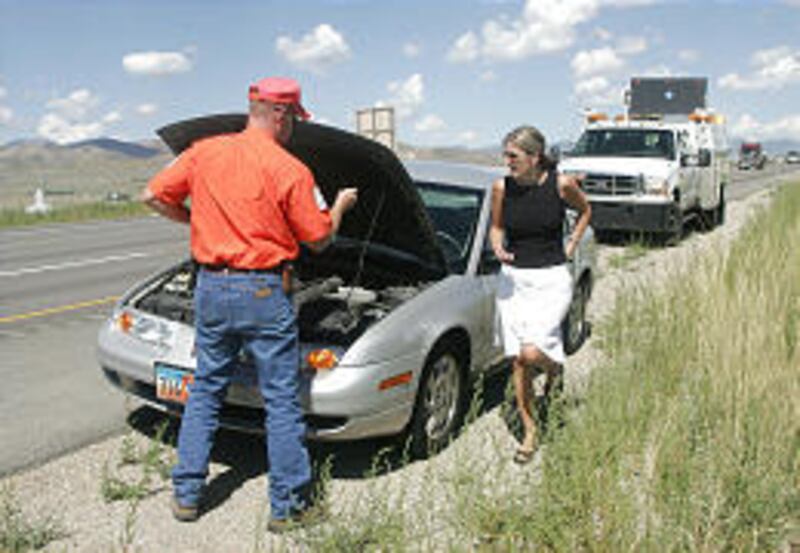


OREM — Steve Johnson understands that when someone gets a flat tire, runs out of gas or breaks down on the highway, it creates a situation that can be stressful, time-consuming — and expensive.
Johnson's happy he's in a position to help. That also goes for Jared Jeffs and Robert Woolsey. The three men make up the Incident Management Team for the Utah Department of Transportation Region Three, which includes Utah County.
The three are well prepared to come to the aid of a stranded motorist, whatever the trouble. They are trained to put out engine fires, cool down an overheated radiator, clamp a leaking hose, call a tow truck or even push a vehicle off the road if necessary.
They can lend a traveler a cell phone or provide a ride.
The assistance they provide is often critical in preventing secondary accidents and keeping freeway traffic moving.
Johnson said a disabled car can quickly plug the crowded freeway system, bringing traffic to a grinding halt.
"If we can help them out, get them off the road, we're preventing a minor thing from becoming major," Johnson said.
Johnson and his crew have been working the highways in Region Three for the past two years trying to "keep the flow going."
They are one of three such crews in Utah and one of a growing number of service patrol teams operating in 40 states.
They are on the road from 6 a.m. to 6 p.m. five days a week and serve on an on-call basis on weekends. They have three specially equipped Ford Supercabs waiting for the opportunity to help people with the kinds of things that go wrong on the road.
In July, they logged 11,399 miles helping 325 individual motorists, helping with 34 accidents, removing 103 pieces of debris from the highway and dealing with 54 abandoned vehicles. They also assisted with traffic control in 37 other situations.
Whatever the need, the IMT can help, Johnson said.
"We carry a few items like clamps, hoses. We have gas, we can give you enough to get you off the exit to a gas station," Johnson said. "We're somewhat limited, but if we can't help, we try to find someone who can.
"We also have a light sign (atop the truck) and 36-inch (high) cones," Johnson said. "We have bigger, brighter lights and arrowboards that attract the motorist's attention a little better than red and blue flashing lights."
With help from the IMT crews, the clearance time for highway incidents has dropped from three hours and 20 minutes in 2001 to just under two hours in 2003.
The IMT program also frees Utah Highway Patrol troopers to deal with speeding motorists and more serious situations. And, Johnson said, the highways are less dangerous because stranded motorists aren't walking the freeways to find help.
"We actually are better equipped (to help the stranded motorist) than troopers are," said Johnson, a former mechanic and police officer.
The work of the IMT crews is not without hazards. On a typical day, the crew can go from kneeling on road base to changing a tire to racing along the emergency lane to an accident to getting cussed out for trying to stop a motorist from driving through a freeway median.
They often find themselves standing in traffic trying to slow vehicles as they approach an accident scene or other trouble spot to prevent additional problems.
The stack of letters on Johnson's desk attest to the fact that most motorists are grateful for the help they receive.
But, Johnson notes, some drive away without a word and others are downright rude.
Johnson, Jeffs and Woolsey said that doesn't detract from their enthusiasm. They still enjoy the daily opportunity to be knights in shinning armor.
"The best part of the job is when you help someone or you get a grandma hug," Johnson said, "And if we have a day with no secondary accidents, we consider it a good day."
E-mail: haddoc@desnews.com