


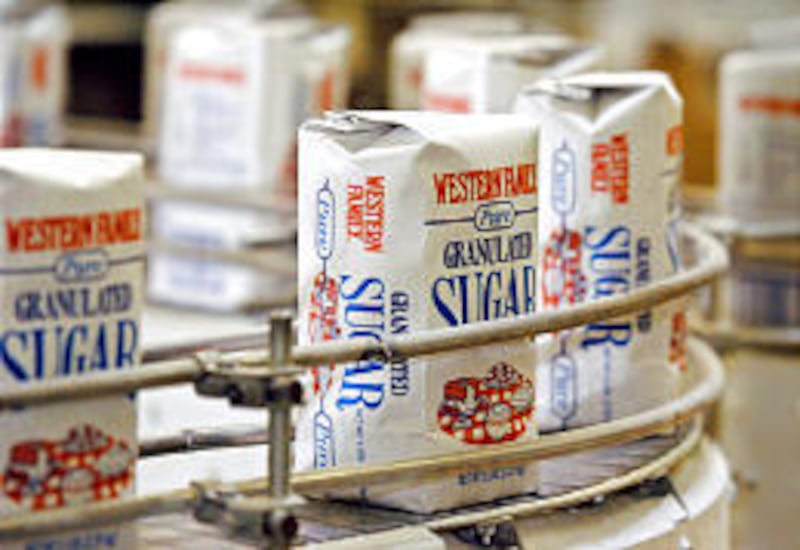
NAMPA, Idaho — In the middle of a summer with 100-plus degree temperatures, Amalgamated Sugar Co.'s plant is boiling beets and spinning the hot syrup into tons of granulated sugar for the nation's bakers and confectioners.
Moved from Ogden, Utah, in 1942, the Nampa plant is evidence that the Mountain West's sugar beet industry, which had its beginnings about 150 years ago among Mormon settlers, has all but vanished from that state and relocated in Idaho with its vast tracts of land watered by the Snake River.
Sugar bolstered the Utah economy for generations, but there are few reasons to remain there, Amalgamated President Ralph Burton said. The company now is moving its offices north as well.
"There isn't any acreage left in Utah," he said. "It made sense to move closer to our operations. In our general office in Ogden, there were about 70 people. We're about half done in our move and some people will be coming up in the spring."
Amalgamated and other American producers have fine-tuned their operations to reach maximum efficiency, but they must contend with exports from developing nations, the latest diet crazes and artificial sweeteners.
Utah, the "Beehive State," was a leader in sweeteners for about 150 years.
Shortly after arriving in the Great Salt Lake Valley in 1847, Mormon leaders set about making sugar. A plant was constructed in the 1850s in the Sugar House area south of Salt Lake City, according to the Utah History Encyclopedia. Beets were raised, but its founders could not convert the crop into sugar because of the alkali soil.
English horticulturist Arthur Stayner solicited the support of the church and business leaders to create the Utah Sugar Co. and finish the $400,000 plant in Lehi.
It was the first to use beets grown with irrigation and to produce its own beet seeds and served as a training base for future leaders in the industry.
David Eccles and C.W. Nibley built factories in Ogden, Logan and Lewiston, Utah. In 1897, they formed Ogden Sugar Co. The Ogden mill merged with other factories in 1915 to create the Amalgamated Sugar Co., according to the encyclopedia.
Utah was bullish on sugar for generations. But by the 1980s, sugar beet farming had shifted north and there were no sugar factories in Utah. Amalgamated has four: three are in Idaho at Rupert, Twin Falls and Nampa; and one in Nyssa, Ore.
More than 1,100 Idaho sugar beet growers paid $400 an acre in 1996 to create a cooperative and buy the four Amalgamated processing plants from Dallas-based Valhi Inc. for $266 million. The co-op kept its Ogden headquarters for years, but decided to move where the business is. Shifting to Boise headquarters also brings officials closer to the Idaho Legislature.
Of the 225,000 acres Amalgamated processes, 210,000 are from eastern and southern Idaho, about 10,000 in eastern Oregon and 4,000 in Washington, Burton said.
Amalgamated buys about 6 million tons of beets each year, from which 1.7 billion pounds of sugar are produced. It represents 20 percent of the beet sugar produced in the United States and 10 percent of all American sugar, including cane.
Burton said the company has annual sales of about $500 million. Its major brand is White Satin, but it supplies about 30 brands.
The beets are hauled to the plant sites. Beginning in the fall, beets are sliced and soaked in hot water, producing raw juice. Lime from Oregon is added to extract any particles which are not sugar, said Kent Quinney, Nampa plant manager.
Some of the tanks in the factory were made in the early 1900s, while new equipment renders the process largely automatic. Employees monitor temperatures and other information on digital screens.
The liquid is boiled and spun in centrifuges. The result is sugar and desugarized molasses which becomes cattle feed. The sugar is hauled off in containers, from tiny bags for the kitchen to rail cars.
There is a big market for that sweet stuff.
The American Sugar Alliance said the United States is the world's largest consumer of natural sweeteners — about 10 million tons of refined sugar each year and about 12 million tons of corn sweetener. It is the world's fourth largest sugar producer, trailing only Brazil, India and China.
America produces about 80 percent of the sugar it consumes, importing the remainder from 40 foreign countries. The rub is that as the United States negotiates trade agreements with developing nations, those countries are able to flood the American market with their sugar.
The latest inroads could come through the proposed Central America Free Trade Agreement.
"It's clearly bad news for the sugar industry and our growers and workers in the Northwest, but we believe the agreement is wrong for the American economy in general," Burton said. "We simply cannot allow more jobs and more strength of the U.S. economy to be driven off-shore."
The sugar industry also is buffeted by the current low-carbohydrate diets and the advent of no-calorie sweeteners like Splenda. Burton said everyone needs carbohydrates and a teaspoon of sugar is only 15 calories.
Farmers growing other crops should be protective of Idaho's sugar industry, Burton said.
"It could be a concern for potato producers," he said. "If the sugar industry goes under, the most immediate group to get whacked is potatoes. If we have to cut back sugar, growers are going to go to other crops. Potato prices are often on the margin."
A recent University of Idaho study completed for the grower co-op at Amalgamated estimated that if no beets were planted in Idaho, an additional 8.8 million hundredweight of potatoes would be grown, leading to a 17 percent decline in the potato market price.