


The smell is almost overpowering — so rank and sour that it seems to permeate the skin.
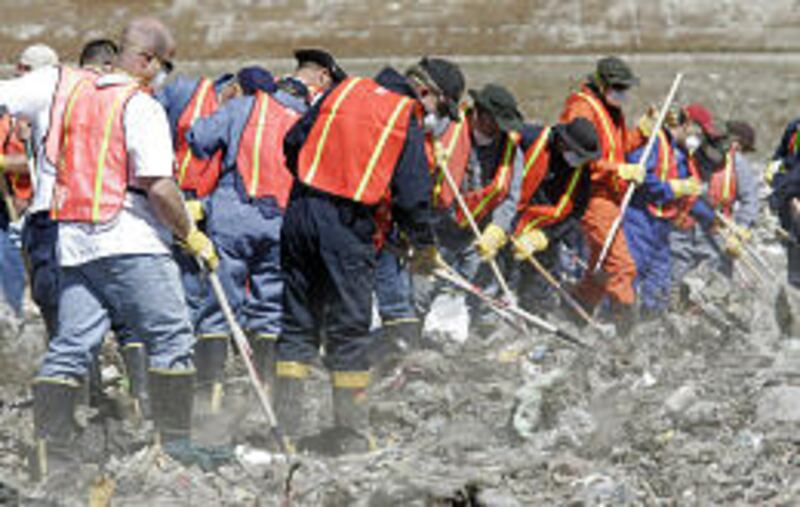
In spite of that, 38 police officers and firefighters waded into 2-foot piles of landfill waste Tuesday as the second phase of the search for Lori Hacking began.
Shoulder to shoulder, dressed in coveralls, steel-soled firefighter boots and face masks, officers took bent pitchfork-like garden tools in hand and began poking and prodding through a field of 100 tons of garbage, looking for the body of the 27-year-old jogger who police believe was shot and killed by her husband on July 19.
The search will continue this way — 10 hours each day from Tuesday to Friday each week — for as long as it takes, Salt Lake City police detective Dwayne Baird said.
"We'll be out here during the day over the next several weeks or the next several months if it's necessary," Baird said. "(The search) is for evidentiary value that adds to this case, but equally so for the closure for the family. We do not want this to be (Lori's) final resting place. "
Included among the evidence police would like to find is the .22 caliber rifle Mark Hacking allegedly used to kill his wife as she slept.
Mark Hacking, 28, originally reported his wife missing to police, saying she had gone for a jog in Memory Grove and never returned.
But within hours, police knew Mark Hacking's story, like many that he told about his life, was a lie.
Mark Hacking is now at the Salt Lake County Jail facing charges of murder and obstruction of justice. Bail is set at $1 million.
In an alleged confession, Mark Hacking told his brothers he killed his wife and left her body in a Dumpster near the University of Utah. A preliminary hearing in the case is scheduled for Sept. 23.
Tuesday marked a return to the Salt Lake Valley Solid Waste Facility, 6030 W. California Ave. (1400 South), after a little more than a week. In phase one of the search, police used cadaver dogs to search the more than 4,600 tons of refuse dumped the same day Lori Hacking was allegedly murdered. After about two dozen nights of such searches, the decision to switch to a hand search was made.
The differences between phases one and two amount to more than the difference between four-legged and two-legged search teams. In phase one, five dogs and their handlers spent night after night plowing through a pit of garbage at depths between 35 and 45 feet deep. In this second phase, teams of 30 or more searchers will work 10-hour day shifts, with garbage hauled out of the pit and spread out on the ground in 100-ton segments that are about two feet deep, Baird said. As each segment is cleared, it will be pushed back into the pit and replaced with another heap of garbage.
In both cases, however, the job is slow, methodical and fraught with hazards.
Much of the waste in the area where the body is believed to have been dumped is from facilities or companies near the University of Utah Medical Center and in the research park area just south of the U. Much of it is medical waste, including syringes with needles, tubing and bed sheets that may contain blood. Searchers were offered inoculations for hepatitis and tetanus as a precaution during a pre-search briefing that began at 7 a.m.
Baird said Salt Lake police are "as convinced as we can be" that Lori Hacking's body will be located in the landfill.
"We won't be 100 percent sure until we find her," he said. "We realize that with the amount of material . . . it's not going to be easy. We're here for the long haul."
Salt Lake has help from law enforcement agencies across the Salt Lake Valley, including the state Department of Public Safety and members of Utah One, an urban search and rescue (USAR) team that worked at ground zero after the World Trade Center attacks. Each searcher has volunteered for the dirty duty, Baird said.
"It's not fun. It's gross. It stinks. It's not the kind of place you want to spend a lot of time in," said James Kangas, a community-oriented police officer from West Jordan. "But I'd liked to think someone would do it for my family. It's a good thing to do."
Kangas said that, as his pitchfork churned through the first 10 or 15 feet of waste, he had come across rope, sheets and plastics. There also were cushions from furniture, toys, newspapers, electrical cables and almost anything that could be imagined.
"Anything that you would throw away at your house ends up here," landfill public information officer Jill Fletcher said.
Keith Bevan and his wife, Jennifer Litster, are both firefighters with the Unified Fire Authority and members of USAR.
The landfill search reminds Bevan of ground zero in that even up close the piles of garbage don't look like much of anything. Everything is brown, dirty and dusty with one item virtually indistinguishable from another until things are separated. And like the debris at ground zero, the pieces, which have been shuffled and squashed as they were moved from Dumpster to dump truck to landfill piles, are small, he said.
"(This) is a lot easier. We know what to look for and there's not rebar and steel," said Bevan, who volunteered for this duty more than a month ago. "As far as just an absolute mess, it's comparable."
E-mail: jdobner@desnews.com