

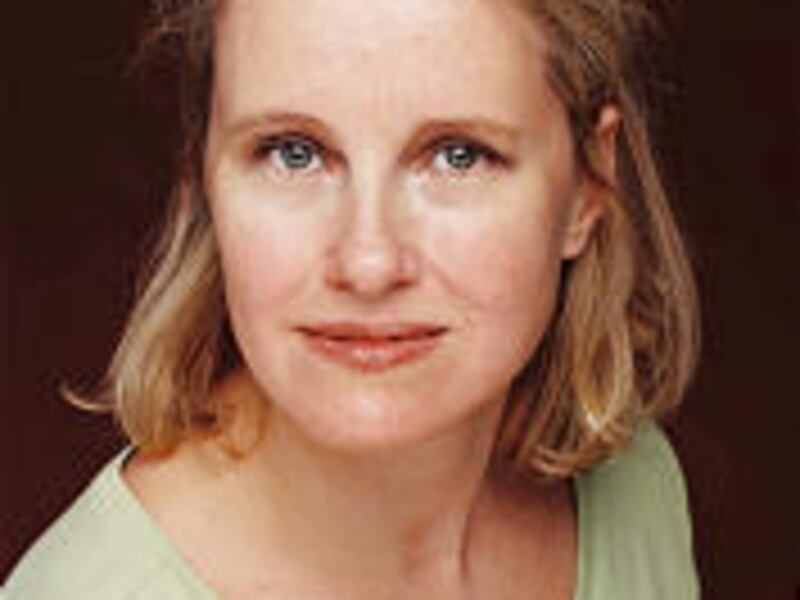
Although her college degrees are in literature, Lorraine Adams has worked as a journalist for the Washington Post for almost 20 years. Now she wants to be a novelist.
"I have a backlog of stories I feel compelled to tell," Adams said by phone from her home in Washington, D.C. "If you go to an editor with something that is not a stereotype, he may say, 'You can't write a story like that!' I went into journalism because I was curious about the world, but I found I just couldn't tell about what I had seen under the strictures of journalism."
Eager for a life change, Adams hung on to her Post job and wrote the novel "Harbor" in the evenings. It is a story about today, an intimate portrait of a group of young Arab Muslims living in the United States, with a focus on one of them, Aziz Arkoun, a 24-year-old stowaway who enters America through the icy waters of Boston harbor.
The inspiration came from numerous conversations Adams had with Algerians, Moroccans and Arab-Americans during the years she covered the Justice Department for the Post.
"When you're reporting," Adams said, "you hear a lot of stories, and the ones that are most soul-changing are those that say 'You can't use this' or 'This is off the record.' So 'Harbor' is an effort to write about those 'not-public' stories.
"There are newspaper stories from the '90s about stowaways who leap from gas tankers into Boston Harbor. But what I have written here is entirely fiction. There is nothing in my book that actually happened."
Even though the New York Times reported that her book "is based on her reporting . . . on the arrest of Abden Ghani Meskini and the FBI investigation of a terrorist plot," Adams denies this is the case. She says anyone reading about Meskini from newspaper files would discover that that case and the story told in her novel are completely different.
Adams writes hoping to capture the realism of the lives of terrorists, but she also tries to insert compassion. "Journalism does not allow for compassion. Fiction produces a more true-to-life experience. Journalism produces a text that is very unreal. That is the reason for a lot of frustration with the media."
In the book, Adams tries to think about 9/11 and the horror and reality of terrorism. "One of the first things government must do is protect its citizens. What is not clear is how we can, as a democracy, protect our own soil. Do we kill terrorists or innocents? My book hovers around those issues."
In her writing, Adams intentionally takes a man's point of view. "That is because men are mostly the actors in our world. I know so many people in power, and they are more likely to be men. The women in the Muslim culture are not permitted to speak with reporters. So, many times I would go to an apartment and many people, including women and children, would be present, but the woman would never say anything. It was always the man."
She also gained access to some electronic untranslated surveillance tapes. When she had them translated she was surprised to find that "it was just like listening to guys talking. I got to hear how they talked when I wasn't there." These conversations revealed the subordinate status of women expressed in colloquialisms, but Adams also found evidence for "a lot of love and respect for women. It's never exactly like the stereotype."
Adams takes pride in her nonpartisan stance, not only to her work but to the world. "I think it's important to be intelligent, to look closely to determine the factual basis of any event. I'm just so interested in what is happening." When asked what changes her research suggests need to be made in approaching terrorism, Adams said, "Human intelligence (not electronic intercepts). One big problem is that the United States did not have someone inside Afghanistan in the 1990s who could come close to the al-Qaida circle. Government operatives literally sat on all kinds of data — and the data gives us a false sense of security. You can't win the war on terror with technology alone."
The second factor, according to Adams, is "the importance of language. We must be acquainted with the many Arabic dialects because it is the main language of the Muslim world. If we are not familiar with the language, we can't begin to do anything. I actually supported our going into Iraq. I'm not a pacifist — but you can't know what the hell terrorists are planning without a deep understanding of their language."
Arguing the importance of nuance in the meanings of words and phrases, Adams remembers that during the Cold War many Americans became proficient in the Russian language. "We're not there yet with the Muslim world. It's not a priority. We need to put our money and resources into it."
Terrorism aside, Adams sees her book as a good story that she hopes will hold up in any era. "The book is only about terrorism in the sense that 'Moby Dick' is about whaling. It is about dislocation. It is about how we see and understand the world. Aziz has to make life and death decisions based on his own perspective. That is the human condition. We are human and can't see everything.
"That is the heart of this novel — we have an incomplete picture of reality, and trying to make it more complete is the highest good."
E-mail: dennis@desnews.com