

Lots of money, little space.
With record tax revenues and temporary cramped offices and chambers, the 56th Utah Legislature convenes Monday on Capitol Hill.
While every Legislature is different, this one is really different. New faces and new buildings. New ideas, even new parking spaces.
As the 104 part-time legislators raise their hands to be sworn into office, apparently one major decision has already been made: No general tax cuts this year, say legislative leaders and Gov. Jon Huntsman Jr.
And that's fine with most Utahns.
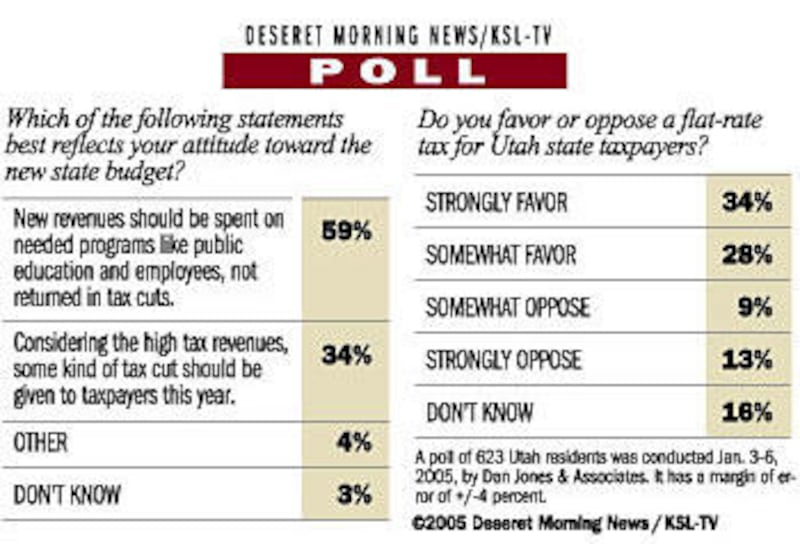
A new Deseret Morning News/KSL-TV poll shows that 59 percent of Utahns want the record-setting new tax growth and one-time surpluses to be spent on state needs, not returned in tax cuts.
The Dan Jones & Associates survey of 623 adults statewide found that 34 percent want taxes cut, 4 percent offered other ideas about the funds and 3 percent didn't know.
Jones also asked about another big issue on the Hill: tax reform.
Huntsman says as the session proceeds he'll be asking legislators to look at phasing in removal of the corporate franchise tax and/or examine getting rid of the capital gains tax along with a few other changes to help "jump start" his economic development efforts. "But individual income tax and sales tax reform will have to wait" until the 2006 Legislature, he said.
Still, Utahns like the idea of a flat-rate personal income tax — modeled along the lines of proposals put forward by former Gov. Olene Walker, who left office two weeks ago. Sixty-two percent like a flat-rate income tax, Jones found, while 22 percent oppose it.
Taxes and money will be part of the discussions that take place over the next 45 days, along with considerations of more than 300 bills and the adoption of an $8 billion-plus budget for fiscal 2005-06.
The legislators will be sworn into office at 10 a.m., with newly installed House Speaker Greg Curtis, R-Sandy, and Senate President John Valentine, R-Orem, making remarks. And after official observances for the Martin Luther King Jr. holiday, lawmakers will get down to business in their new chambers, located in an office building behind the plastic-shrouded Capitol Building.
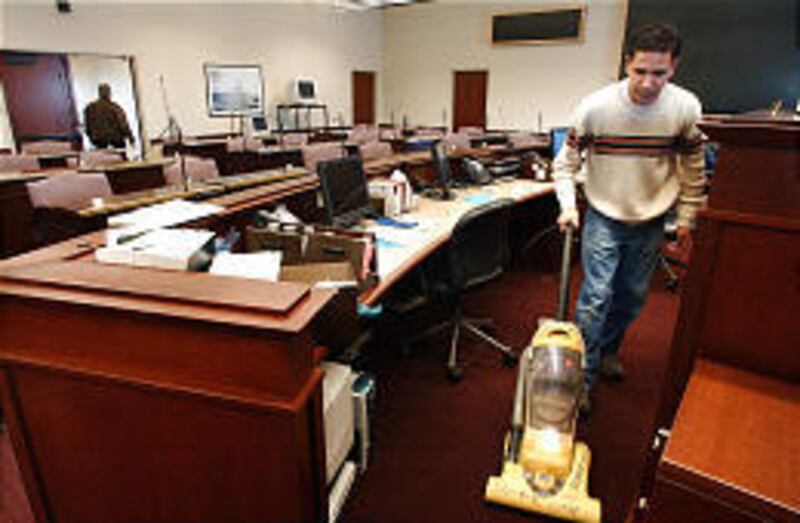
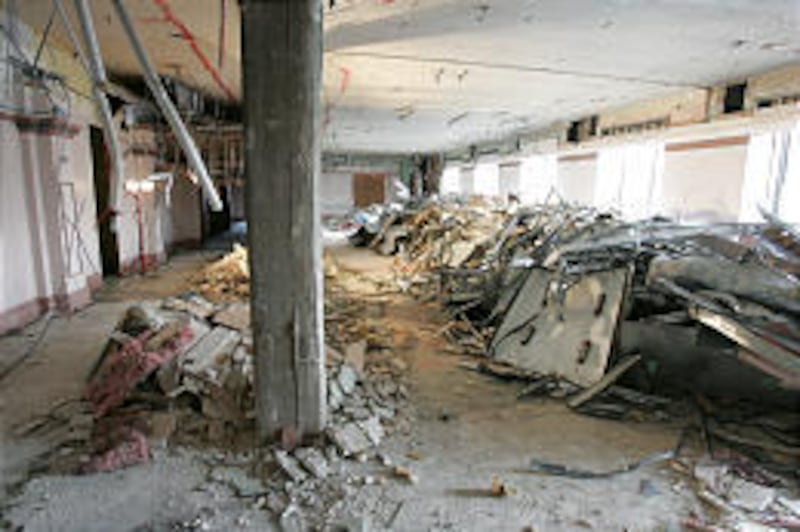
For the next four years lawmakers, lobbyists, state department bosses and the public will crowd into the temporary legislative quarters during the general sessions while the Capitol undergoes a $200 million earthquake proofing and renovation.
Across the plaza's oblong reflection pond (still under construction) sit the temporary digs of Huntsman, his staff, Attorney General Mark Shurtleff and other elected officials.
Upcoming key decisions:
Divvying up nearly $600 million in new money, both in growing ongoing tax take and one-time revenue surpluses.
Reforming the state's tax structure. Huntsman wants some things done now, like cutting some business taxes to promote economic growth. Huntsman, whose family owns one of the largest businesses in Utah, said he knows some people are saying: "There goes Huntsman trying to pay off his corporate friends. But that's not the case." Real tax reform must come, this year and onward.
After lawmakers adjourn March 2, he wants in-depth studies of the most basic taxing matters. "We have a tax system based on taxing mining, manufacturing and agriculture. But we're a service economy."
Taxing some services — like attorney bills, haircuts and landscaping — must be discussed, says Huntsman.
"We're hearing real concerns about the idea of a one-rate sales tax," said Curtis, "How will the arts get their share of sales tax; businesses are worried about the streamline sales tax proposal."
Reorganizing parts of state government. Huntsman wants to split the Department of Community and Economic Development, bringing tourism promotion and economic growth directly into his office. Other smaller changes must be made, too, like pooling all information services and personnel functions in one place.
Finding millions of dollars for a growing school-age population.
Getting pay raises for state workers and teachers. "We have to really do something with the pay package, help those who were loyal state employees who sacrificed during the lean years," says Valentine.
Figuring out how to rebuild I-80 in eastern Salt Lake County and expand a number of Utah County roads and freeways.
Defining reciprocal benefits for the partners of people who aren't married, both in heterosexual and homosexual relationships.
Toughening ethics standards for public officials, at least for the executive branch.
Hate crimes. Legislators will again consider a bill killed in the past several sessions that would enhance criminal penalties for those who attack people based on the victim's race, gender, sexual preference, age, ethnicity or other characteristics.
Divorce. Should Utah's "no fault" divorce law be repealed, forcing the finding of specific wrongdoing before a divorce is granted? Should divorcing couples be required to attend at least one counseling session before a legal divorce is given?
You're not invited
While most Utahns don't visit Capitol Hill during a legislative session, leaders are specifically asking some groups not to come this year.
"We sent letters to all school principals explaining that we really can't accommodate large groups of students like we did before," said Curtis. Two House galleries will hold around 35 people each; the Senate gallery is even smaller.
Valentine says the almost-daily special information exhibits that were set up in the old Capitol rotunda to educate legislators and the public about a host of issues won't fit in the new building. "We're working to have some presentations being made at lunch time in empty hearing rooms, but those will have to be scaled back, too."
Curtis promises that chairs will be set up in hallways so lobbyists and the public can rest while legislators toil on chamber floors. "We'll have folding chairs if I have to set them up myself," Curtis said.
Three hearing rooms will have TVs, allowing bystanders to watch floor action in the House and Senate. In addition, legislative staffers have expanded the old Internet "streaming" capabilities, so more people can watch floor action from their personal computers, if they have a high-speed connection.
"For Democrats, it's all about education," said House Minority Leader Ralph Becker, D-Salt Lake. Republicans hold two-thirds majorities in both bodies, so the minority Democrats have little party power, can't stop debates or kill constitutional amendments.
"We need to make a greater investment in public and higher education," said Becker. The students and teachers deserve it, he added. "And we need to address the neediest among us, the poor and disabled."
Like all sessions, there are some "sleeper" issues that could blow up on legislators, warns Curtis.
"We have huge, complicated bills on telecommunication regulation and power facilities siting" — perhaps not that interesting to citizens until a public battle breaks out, he said.
"It's great to have some money" in the new budget, said Valentine, who has served in the Legislature since 1988.
"But more revenues is good and bad. Good because we can make up some lost ground, especially in employee pay. Bad because everyone is clamoring for it, and it's rough waters when you have some (more money) and there are all these needs," the new Senate president said.
Here are some of the issues lawmakers will discuss, and perhaps act on, in the following areas:
Public education
The chief battle will be over money.
School bosses want tens of millions of dollars to help kids achieve higher academic standards, add to the per-student funding formula and keep up with basic needs.
Others want vouchers and tax credits for parents sending kids to private schools. And those issues are expected to be the most controversial.
A bill to give up to a $2,000 tuition tax credit to parents paying private school tuition, and another credit to a business or person giving to a private school scholarship foundation, will resurface. Rep. Jim Ferrin, R-Orem, has said he might scale the tax credit to favor low-income families and join his bill with another that includes money to bail out districts hurt by the credits. The efforts could attract key moderate votes.
Another bill vetoed last year will re-emerge through Rep. Merlynn Newbold, R-South Jordan. Carson Smith Special Needs Scholarships would set aside $1.4 million in general — not school — funds as vouchers for parents sending children with disabilities to private schools.
Huntsman supports both bills' concepts, unlike his predecessors.
Education leaders oppose the measures philosophically and fear they will take money from cash-strapped public schools.
Higher education
College presidents and Utah System of Higher Education officials have been turning up the volume in recent months about losing their best and brightest faculty to higher paying jobs outside of Utah.
In addition to the need to fund three "critical" building projects, the big push this year will be to get more state money for pay raises. The goal that the USHE shares with other state agencies is a 3 percent salary increase for all state employees with additional support for health insurance.
Huntsman's recommendation, however, appears to fall short of expectations for a salary increase.
The USHE also wants $3.75 million to establish an account for funds that institutions could use as bargaining power when threatened with the loss of key faculty and staff to the lure of more money elsewhere.
The highest profile request for building funds will be the University of Utah's Marriott Library. The U. needs $48.5 million in state monies for a $71 million project that includes major seismic upgrades, renovating the inside and a new high-tech book retrieval system.
In all, USHE is asking for $102 million to fund the U. library, a new digital learning center/library at Utah Valley State College and a new health sciences building for Dixie State College.
Huntsman's proposal is to fully fund the request for the U. library and to put over $18 million toward the UVSC building.
Health/human services
Lawmakers will be expected to tackle a number of proposed changes in child welfare, demands for more Medicaid dollars and family issues dealing with everything from divorce law to new paternity guidelines.
While not as likely to get as heated as it did last year, the debate over how much control the state has on parental rights will likely capture lawmakers' attention, as well as protests by the low income to restore nearly $7 million to fund Medicaid benefits for adult dental and vision services.
Two legislators who saw their bills fail in the 2004 session that invoked sweeping changes to the state's child welfare law are planning to revive their efforts, and another measure has been introduced that would safeguard a parent's choice to made medical decisions for his or her child.
A variety of other health-related measures deal with access to medical care, allowing certification of direct entry midwives and the creation of a preferred drug list.
Lawmakers will be asked to shore up some funding gaps for this fiscal year, including the allocation of nearly a million dollars to help local mental health centers serve non-Medicaid eligible clients. A request is also on the table for money to re-open the 26 beds in the forensic unit of the state's mental hospital — beds that remain empty due to the state's fiscal crunch of the past three years.
Environment
Nuclear waste, federal rules that some fear could block road access, keeping an eye on Dugway Proving Ground, a resolution against atomic bomb testing in Nevada — all are among environmental issues the Legislature faces when the session begins Monday.
By far the most contentious involves the long-running debate over importing low-level B and C radioactive waste. Currently only one facility in the state, Envirocare of Utah, disposes of nuclear waste, and it handles Class A material, which is less toxic.
Activists have campaigned for an outright ban on B and C waste. Recently, a legislative task force concluded that a ban might have unwanted legal repercussions. Instead, the group supported current regulations that require separate authorization from Utah's Department of Environmental Quality, the Legislature and the governor before such waste can be imported.
Any potential resumption of nuclear testing at the Nevada Test Site is the target of a resolution sponsored by Rep. Michael E. Noel, R-Kanab.
In a different arena of the environmental jousts, Noel is sponsoring a bill, not yet assigned a number, that would require federal land managers to consider state plans, laws and regulations when promulgating their own land management plans.
Respecting road rights of way and allowing access to water diversion points, communication towers and mineral resources are issues that the Bureau of Land Management, Forest Service and other federal agencies should have to comply with, he said.
Corrections/public safety
Treatment for first-time drug offenders and harsher punishment for repeat violent offenders are just two bills expected to get attention among lawmakers. The Drug Offender Reform Act asks for $6.3 million to start a drug treatment program, which will allow judges to divert non-violent drug offenders to outpatient treatment in lieu of prison. A second bill proposes to hit three-time violent offenders with first-degree felony charges and would expand an existing list of violent crimes that qualify for the enhanced penalty.
Other bills would allow judges to better enforce victim restitution and also allow judges to freeze the assets of people charged with financial fraud.
Children justice centers are asking for $200,000 in additional funding to expand services for abused children.
Although none of this year's bills show to be terribly controversial, lawmakers say funding will be the big issue.
Transportation
Lawmakers are calling transportation one of the most important issues that will be debated this session, with nearly $5.5 billion in improvements needed over the next 10 years.
Members of the Transportation Task Force have met with local officials and transportation planners over the past two years to develop a $4.5 billion funding package that will be debated this session.
The catch: Lawmakers say they can't fund everything, but transportation planners and business officials are crying for the whole package — and more.
It's perhaps the most aggressive push they've made for money since creation of the Centennial Highway Fund.
Other sticky issues include a proposal to shift control of state roads to local governments. Local leaders oppose the measure, because funds would not be transferred with the responsibility.
Minority issues
Lawmakers will be asked to create a new category of relationship: "mutual dependence."
Sen. Greg Bell, R-Fruit Heights, said SB89 would make a way for two adults who can't legally marry obtain certain rights and responsibilities regarding property ownership and health-related matters. Same-sex couples would qualify, as would a person caring for an elderly parent or roommates of the same sex.
Bell said his new contract is different from civil unions rejected by voters when they approved Amendment 3 in November because it's not limited to same-sex couples.
The state constitutional amendment, which took effect this month, bans same-sex marriage and other "domestic partnerships."
Some of those who supported Amendment 3 haven't commented on the legislation, saying they'd have to study it to ensure it doesn't conflict with Amendment 3, and have questioned whether it's needed.
Financial institutions
The war between banks and credit unions is expected to reconvene this year under House Joint Resolution 1, "A Joint Resolution Related to Financial Institutions." The proposal affirms actions taken during the 2003 Legislature, creating a "non-exempt" class of credit union and asks the U.S. Congress to re-examine the rulings of the National Credit Union Administration and the tax structure for financial institutions.
It also asks Congress to "affirm the authority of states and local governments to determine whether federally chartered credit unions may be taxed the same as state chartered credit unions." Not surprisingly, credit union advocates are fiercely opposed to HJR 1 and have vowed to marshal their forces (and resources) to defeat it.
Cities and counties
How cities and counties spur economic development and boost their local revenues, especially with redevelopment areas, will be a primary focus for local officials this year. At least three bills concerning RDA rules are planned, two of which could significantly curtail the projects by prohibiting locally patronized retail and allowing school boards to opt out of a project. A separate bill, on the other hand, would actually increase RDA opportunities by allowing former gravel pit sites to qualify as "blighted" and for an RDA to be created around a transit stop without the required blight study.
Cities and counties will also be looking for other ways to improve safety and increase revenue through such efforts as the repeal of a law prohibiting the use of a photo radar, which city leaders such as Salt Lake Mayor Rocky Anderson are hoping to use to capture drivers who run red lights and speed. There may also be bills dealing with bicycle safety, allowing a service fee for the payment of fines and local taxes with a debit card, and an attempt to give police departments the ability to create a special district for their services.
Contributing: Joe Bauman, Amy Joi Bryson, Deborah Bulkeley, Geoffrey Fattah, Josh Loftin, Jennifer Toomer-Cook, Brady Snyder, Erin Stewart, Nicole Warburton