


Protecting the archaeological resources of Range Creek Canyon used to be the self-appointed responsibility of a single landowner. Now the job belongs to the Utah Legislature.
Last June, state officials announced that Utah was the new owner of property once protected by rancher Waldo Wilcox near the Carbon-Emery county border. The property was purchased by the Trust for Public Land, a conservation group, and then Congress appropriated money to help the state acquire it.
Altogether, the site about 130 miles southeast of Salt Lake City includes about 4,000 acres in new state land. It controls access to another 50,000 acres of federal and state school land, much of it in two wilderness study areas.
It is rich in the homes, art and artifacts of people who lived there 1,000 years ago. Because of Wilcox's diligence in keeping looters off his ranch, most of the sites are undisturbed by vandals.
The Legislature is considering budget requests to continue the work of protection, make repairs to the Wilcox ranch buildings and to fund archaeological surveys, inventories and artifact cataloguing.
Amounts sought are $104,000 in ongoing funds through the Department of Natural Resource Appropriation Subcommittee; a $57,000 one-time appropriation for the DNR in the same subcommittee, and $50,000 through the Higher Education Appropriations Subcommittee. Higher Education is involved because the Utah Museum of Natural History, located on the University of Utah campus, is spearheading the archaeological surveys.
Darin Bird, deputy director of the DNR, pointed out that the department and higher education requests regarding Range Creek are spelled out on the same sheet "so legislators would get the big picture." The $57,000 one-time funding was not listed by the state's fiscal analyst office, which discussed the governor's budget requests; it probably will come up near the end of the session, he said.
Range Creek is an important resource for the state, Bird said. "For those who understand archaeological sites, it's a great area."
Duncan Metcalfe, curator of archaeology at the natural history museum, said a couple of public weekends are being considered, when the canyon would be open to public viewing. "We've been looking into the idea of using concessionaires to give guided tours into the canyon," he said.
These guides would be "local folks who are familiar with the place."
Meanwhile, nearly 300 sites have been discovered. About 90 are isolated granaries, 50 are the pit-houses the residents lived in, and rest are rock art panels "and various combinations of the three things," Metcalfe said.
"I'm still awed by the density of archaeological sites. We've actually looked at certainly less than 10 percent of the drainage, and we're up to . . . almost 300 sites so far," he added.
"There are thousands of archaeological sites."
The Utah Division of Wildlife Resources has been working on a memorandum of understanding that sets out some of the canyon's future, including hunting.
Corinne Springer, a candidate for a master's degree in archaeology at the U., lives on the ranch and helps protect it. "She monitors the archaeological sites, she patrols the road and just keeps the place up," he said.
With help from the Utah Division of Parks and Recreation, workers reroofed two of the ranch houses and put in a new septic system. The Division of Wildlife Resources installed a pair of new gates.
"This year we'll probably work on the culinary water system and reroof the third house," he said. The ranch complex will be a good research station for archaeologists working in the canyon.
The U. has joined with Salt Lake Community College and the College of Eastern Utah, Price, to field student survey teams. So far, they are cataloguing sites but later may dig some small test pits to check stratigraphy, preservation and depths of deposits.
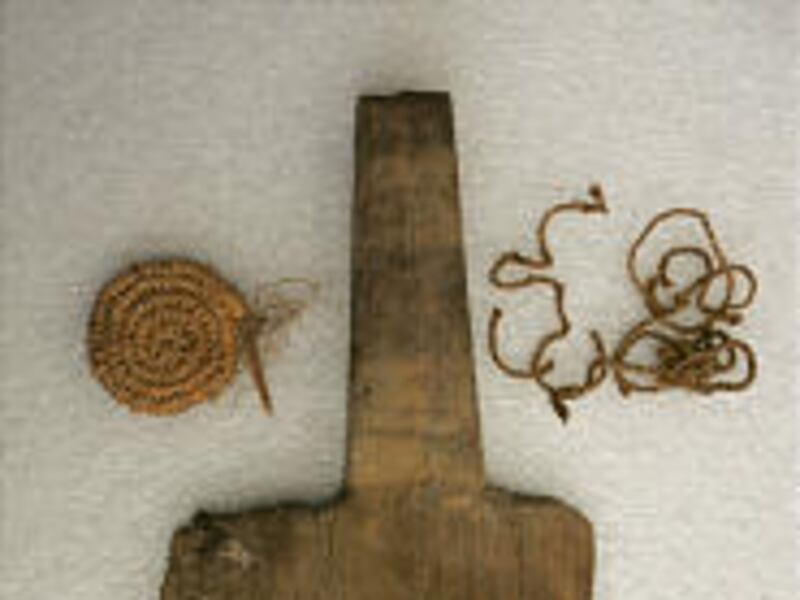
"Organic preservation is pretty good," Metcalfe said. "We recovered a cache of arrows last spring, we recovered basketry fragments, the kinds of things we don't expect to find in open sites."
One surprising artifact is a wooden shovel, discovered on a rock ledge about 100 feet above the canyon floor. It was found in a place the scientists have dubbed "granary row" because of the structures along the cliffs.
"It's about 6 inches wide, maybe 8 inches long, and it's got a handle on it that looks as though it's been painted, originally."
The shovel is made of cottonwood, which is a soft wood. "We don't think they were actually using it for digging," he said. Perhaps it was used to mix mud into mortar when granaries were built.
So far, 99 percent of the sites were occupied by the Fremont Indians, a group that thrived from about 500 AD to 1350. Three corncobs, from corn grown by these early Utahns, have been radiocarbon dated from about 900 to 1100.
What people are represented by the other 1 percent? Probably folks called Archaic, from pre-Fremont times.
It's hard to tell how extensive the Archaic settlement in Range Creek was because the place has not been excavated. At other localities around Utah, where illegal pot-hunters have damaged sites, archaeologists can check out the holes they dug and get an idea about underlying habitation levels.
"These sites haven't been looted," said the delighted Metcalfe. "We can't see beneath the ground. There's no holes in it.
"It's what makes this place so phenomenal as a research opportunity."
E-mail: bau@desnews.com