

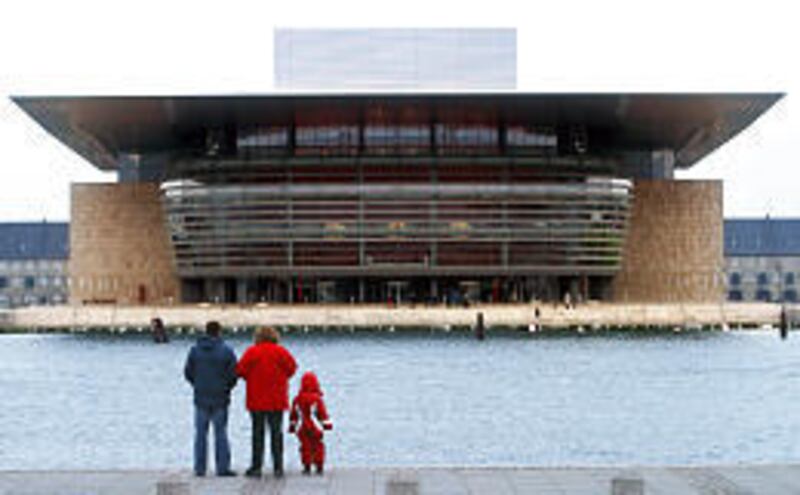
COPENHAGEN, Denmark — Seen from the outside, Copenhagen's new Opera House — with its bubble-faced front gently squeezed by a flat, thin roof — is akin to a giant lantern on the city's waterfront.
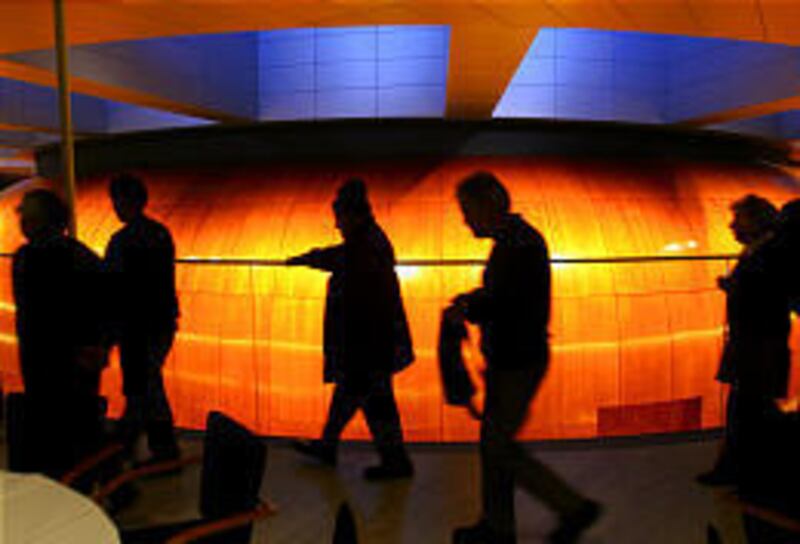
The front lodges a five-story foyer and another bubble, inspired by a conch, covered with golden Danish maple. The main auditorium is coated on the inside with dark maple and has three horseshoe-shaped balconies. It can seat up to 1,700 people.
Besides the main stage, the opera has five side and back stages. Hydraulic machinery can change their size and enlarge the orchestra pit to hold up 120 musicians.
Maersk Mc-Kinney Moeller, one of Denmark's wealthiest men, changed his initial sketches for a $231 million concert hall into a monument to Danish design that ended up costing nearly twice as much. He said it didn't matter how much it cost to build — the money was his and not from the government. The Opera House was recently inaugurated by Queen Margrethe.
For decades, the city's opera buffs, ballet dancers, dramatists, thespians and musicians have complained about the lack of space at Copenhagen's downtown Royal Theater, a structure that dates back to 1770. While Denmark, a careful cultivator of the arts, pledged new space, successive governments failed to agree on what and where to build — and how much to spend on it.
The government's sole expense will be to run the new opera, which will cost $25 million annually.
The 91-year-old Mc-Kinney Moeller, who is said not to be an opera fan, is known for being demanding, meticulous and discreet. He declined numerous requests by The Associated Press for an interview, saying through a spokesman that he rarely speaks to the media.
To design the building, Mc-Kinney Moeller picked Henning Larsen, one of Denmark's leading architects who created the Saudi Arabian Foreign Ministry building in Riyadh, among other projects. And for the interior, Mc-Kinney Moeller ordered works from renowned local artists Per Kirkeby, Per Arnoldi, Lars Noerregaard and Olafur Eliasson, who created three huge light balls for the airy foyer.
Bo Wildfang, an aide, said that Mc-Kinney Moeller "was thoroughly committed to select the material to be used." Mc-Kinney Moeller picked German limestone for the exterior walls, smoked oak and Italian marble for the indoor floors, maple to coat the main auditorium and 105,000 sheets of hammered 24 carat gold to adorn its ceiling. The outdoor plaza is Chinese granite.
The benefactor flew to Britain, Italy, France, Spain, Sweden, Finland, Poland and China in his private jet to see operas there, Wildfang said, adding that Mc-Kinney Moeller "has been following the construction very closely."
The Danish businessman stepped down last year as chairman of the AP. Moller-Maersk group but remains active as senior partner. Mc-Kinney Moeller's foundation partly owns the group operating Maersk-Sealand shipping company, a shipyard, an airline and holds the rights for oil and gas exploration in Denmark's North Sea continental shelf.
At first, Mc-Kinney Moeller wanted to donate a new concert hall. But his aides pointed out that the state-funded Royal Theater was more in need of an opera house than another music auditorium. And since the foundation, which had paid for major restoration works across Denmark and which is estimated to be worth $6.1 billion, was footing the bill, Mc-Kinney Moeller ruled.
"I am the one who pays; I am the one who decides," Mc-Kinney Moeller, whose personal fortune is estimated to be $908 million, told the DR-1 television channel in September in the only interview he has given about the opera.
Along the way, he decided that the building also should have facilities for ballet. The main stage had to be enlarged so a special floor could be rolled out; extra rooms were added.
Mc-Kinney Moeller also paid for the expertise of British acoustics experts to design the new opera, said Michael Christiansen, the Royal Theater's general manager.
"The result is outstanding," Christiansen told the AP. "The quality of the performances that will be played in Copenhagen will be lifted considerably. The acoustics and the stage facilities are not just a lot better, they are several light years better than what we use to have."
Mc-Kinney Moeller also ordered architect Larsen to add vertical steel bars to his glass bubble, prompting a Danish newspaper to compare the front with the grille of a 1955 Pontiac.
"From the beginning I said I didn't want a glass front. It doesn't age gracefully," Mc-Kinney Moeller told DR-1.
The final bill for the 49,200-square yard opera house came to $443 million. The first public show — Giuseppe Verdi's "Aida" — will be held Jan. 26.
Ballets requiring large orchestra will be staged there. Others will be performed at the Royal Theater's Old Stage with its red velvet padded walls, seats and golden balconies, the opera's press officer Louise Pedersen said.
The Opera House also has a small experimental stage that can seat 200, and music recording facilities.
On the harbor's opposite side is the construction site of the Royal Theater's new $132 million playhouse to be completed in 2008.