



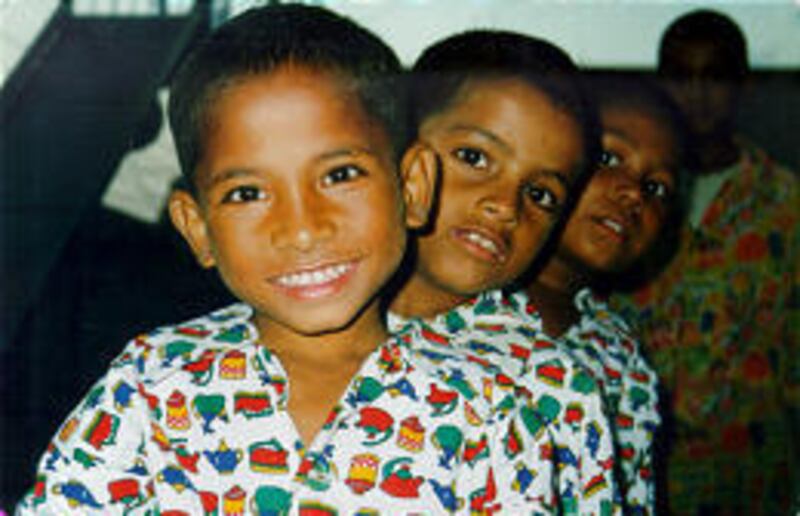

It's been 20 years since Cecile Pelous, a Parisian, made her first visit to India. The people she met there touched her deeply. She began going back twice a year to work in the ashrams, caring for orphans or the elderly.
It's been 15 years since she founded her own Asha Ashram, or House of Hope, an orphanage next to a school that was already in existence in Nepalganj, Nepal. This year, the orphanage is caring for 113 children.
Many children the orphanage first cared for are now in their late teens or early 20s, and Pelous has formed yet another nonprofit to help them live together and further their education in the capital city of Katmandu.
All that time, while raising money and supervising the schooling of a growing horde of children, Pelous has worked in the world's finest fashion houses — Christian Dior, Nina Ricci, Yves St. Laurent. It was Pelous' job to turn a designer's sketch into a garment from which a pattern could be made and a line could be produced and sold.
She retired a few months ago. Now, full time, she will raise funds and direct the affairs of Action Autonomie Avenir (Action for a Self-Sufficient Future) as well as the U.S. counterpart of that French nonprofit, First Hope. She continues to visit Nepal twice a year to oversee the work at Asha Ashram and in Katmandu.
Pelous is in Utah this month, making what has come to be an annual visit. Having joined The Church of Jesus Christ of Latter-day Saints 30 years ago, she comes to Utah to work on her genealogy. She also meets with the board of directors of First Hope.
It costs $900 a year to care for a child in the orphanage/school. It takes $1,200 to sponsor one of the older orphans in Katmandu. Pelous said she is audited every year by the Nepalese government. Her administrative costs are only 2 percent of the budget. She gets a lot of materials donated, she said.
While she's in Utah, Pelous will speak, as she did two years ago, to employees of Franklin Covey. This year the public is invited to hear her talk about the needs of children in Nepal. Her presentation will take place Tuesday at 10 a.m.
Back in 1999, when Pelous visited Utah, Diana Peterson (who majored in French) and her husband, Joel (who served an LDS mission in France), were excited to meet Pelous in order to practice their French. When Pelous told them of her work, the Petersons both cried. Diana Peterson is sure that Pelous saves children from a life of prostitution, which is one reason she has become the president of First Hope
Meanwhile, the CEO of FranklinCovey, Robert Whitman, had also met Pelous, and in 2003 he brought her to FranklinCovey to speak to the employees. Employees wanted to donate to her work, and the company offered to match their gifts. FranklinCovey sponsored 17 orphans that year.
This year, according to human resources director Lori Smith and public relations director Debra Lund, FranklinCovey wants to help with in-kind donations. They plan to send trainers from India to instruct the House of Hope kids on the seven habits of highly effective teenagers. Lund and Peterson both plan to visit the orphanage next year.
Smith said, "This group of kids truly can become the next leaders of Nepal." It is exactly what Pelous hopes for them.
When Pelous travels, carrying a stack of photos of wide-eyed, grinning children, lots of people ask her to help them adopt Nepalese kids. But Pelous doesn't want the children to move to Paris or Utah. "My objective," she said during an interview at the Deseret Morning News," is to keep Nepalese culture."
And yes, with Maoist separatists blockading the city of Katmandu, and the Nepalese government reinventing itself every few months, her task is becoming more difficult. (The Maoists know her and leave her alone, she said. She does not mention that she gets a small portion of her total budget from American donors.)
"Ah, la-la," she lamented several times as she spoke of the task of getting identity papers for some of the children. As soon as the orphans reach the age of majority, they go back to the village where they were born to get identity witnesses (seven or eight are needed, Pelous explained).
Some have discovered they own property in their village. One young man discovered he was actually given away by an elder cousin who wanted the property for himself.
One boy was greeted in horror when he returned to his village. He looks so much like his dead father that the villagers thought he was a ghost. When he explained who he was, he was feted and made to feel so welcome that he "was very impressed and wrote 10 pages in his journal" about his parents' village, Pelous explained.
Most of the children come from lower castes. They would never have had a chance for an education were it not for the House of Hope.
Once, some years ago, Pelous took in a number of children who had been orphaned when their village was flooded. A year later a German nonprofit was offering money to rebuild the village, and the local leaders came to the Asha Ashram to reclaim the orphans.
Pelous wanted them to stay and get an education. The Nepalese government sided with the village elders. Since that time, Pelous makes a point of legally adopting the young children in her care.
She is now the single mother of 79 gorgeous children. They are listed on her genealogy chart.
If you go . . .
What: Speech by Cecile Pelous
Where: FranklinCovey, 2200 W. Parkway Blvd. (2495 South off Redwood Road)
When: Tuesday, 10 a.m.
How much: Free
Phone: 817-1776
E-mail: susan@desnews.com