

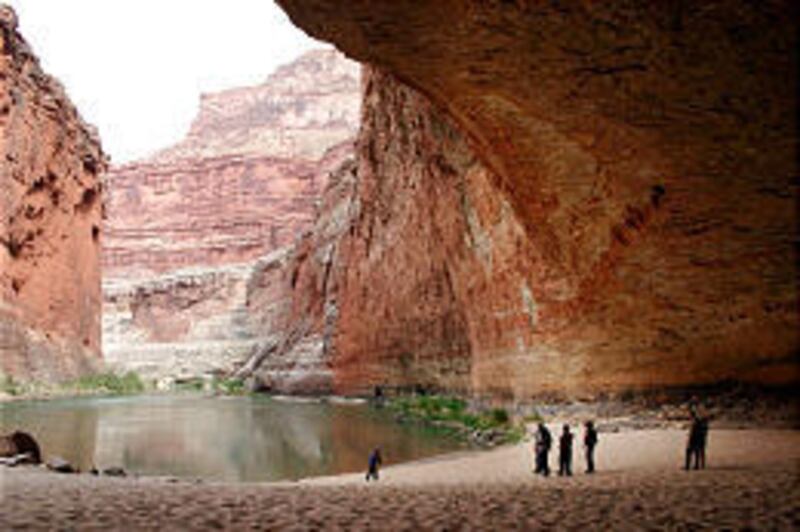
GRAND CANYON NATIONAL PARK — Tom Vail, who has been leading rafting trips down the Colorado River here for 23 years, corralled his charges under a rocky outcrop at Carbon Creek and pointed out the remarkable 90-degree folds in the cliff overhead.
Geologists date this sandstone to 550 million years ago and explain the folding as a result of pressure from shifting faults underneath. But to Vail, the folds suggest the Grand Canyon was carved 4,500 years ago by the great global flood described in Genesis as God's punishment for humanity's sin.
"You see any cracks in that?" he asked. "Instead of bending like that, it should have cracked." The material "had to be soft" to bend, Vail said, imagining its formation in the flood. When somebody suggested that pressure over time could create plasticity in the rocks, Vail said, "That's just a theory."
"It's all theory, right?" asked Jack Aiken, 63, an Assemblies of God minister in Alaska who has a master's degree in geology. "Except what's in the Good Book."
For Vail and 29 guests on his "Canyon Ministries" trip, this was vacation as religious pilgrimage, an expedition in search of evidence that God created the Earth in six days 6,000 years ago, as many creationists believe.
That same week, a few miles upriver, a decidedly different group of 24 rafters surveyed the same rock formations — but through the lens of science rather than what Vail calls "biblical glasses." Sponsored by the National Center for Science Education, the chief challenger to creationists' influence in public schools, this trip was a floating geology seminar, charting the canyon's evolution through eons of erosion.
"Look at the weathering; look at the size of the pieces," Eugenie C. Scott, the center director, said of markings in Black Tail Canyon. "To a standard geologist, to somebody who actually studies geology, this just shouts out at you: This is really old; this is really gradual."
Two groups examining the same evidence, traveling nearly identical itineraries, snoozing under the same stars and bathing in the same chocolate-colored river. Yet, standing at opposite ends of the growing creation-evolution debate, they seemed to speak in different tongues.
Science unequivocally dates the Earth's age at 4.5 billion years and the canyon's layers at some 2 billion years. Even the intelligent design movement, which argues that evolution alone cannot explain life's complexity, does not challenge the long history of the earth.
But a core of creationists like Vail continue to champion a Bible-based theory of the canyon's carving. And polls show many Americans are unconvinced by scientific knowledge: Though it did not ask specifically about the global flood or six-day creation, a November 2004 Gallup survey found that a third of the public believes the Bible is the actual word of God that should be taken literally, and 45 percent think God created human beings "pretty much in their present form" within the past 10,000 years. Gallup found in another poll that 5 percent of scientists, and fewer than 1 percent of earth and life scientists, adopted the "Young Earth" view.
The twin rafting trips epitomize the parallel universes often inhabited by Americans with polarized positions. Members of both groups said they had signed up for these charters to be surrounded by likeminded people. Indeed, all the American adults on Vail's boats voted for President Bush last fall, while all but two on the evolutionists' rafts cast ballots for Sen. John Kerry.
When not running the rapids, Vail's group, which included three pastors, sat in makeshift sanctuaries of sand and stone to offer prayers of praise for their surroundings. Some were committed creationists, and others were still asking questions. But all began with a literal interpretation of the Bible, seeking examples in the rocks to support its story that God did it all in less than a week.
When they made camp, Scott's rafters, nearly half with Ph.D.s in science, had evening discussions of tidal patterns and plateau shifts, as well as tutorials on tactics in the evolution debate. Most of them ardently secular, a few practicing believers, they started with what they see as unchallengeable facts about the Earth's age and dismissed creationism as unscientific. After each "geology moment," Scott play-acted the creationists, saying sarcastically of their evidence, "My part of the lesson is always a lot shorter and less detailed."
Vail, whose book on the Grand Canyon scientists tried to ban from park stores last year, describes this natural wonder as Exhibit A for Young Earth creationists. Scott calls it a scientists' Louvre.
To Kathryn Crotts, 56, a pastor's wife from Greensboro, N.C., touching the canyon's basement rock was a spiritual moment. "In the book of Genesis, it talks about God walking the face of the Earth," Crotts explained. "Maybe his footprints are there."
But to Charlie Webb, 58, an emergency-room doctor in Colorado Springs, Colo., it is evolution that answers "the great philosophical questions — why are we here, where did we come from."
"Evolution is the basis of biology; biology is the basis of medicine," said Webb, dismissing the flood explanation as "childish" and "pathetic." "You're messing with something important when you mess with evolution."
For eight days and 280 miles, with a reporter along for half of each journey, the groups relaxed on motorized rafts, hiked the hills, dined on Dutch-oven delicacies, frolicked in waterfalls and admired rainbows, each awed by what they see as truth.
About 4.5 million people visit the Grand Canyon each year, peering over the rim and perhaps popping into a gift shop, where Vail's book, "The Grand Canyon: A Different View," ranked 17th among 800 products sold last year. Some 22,000 hardy souls raft its river.
Vail, 57, a former corporate computer manager, took his first trip in 1980 and soon "turned in my three-piece suit for a pair of flip-flops." He had been guiding full time a dozen years when a pilot celebrating her 40th birthday rode on his raft and whispered the gospel in his ear.
That fall, in a tent in the Himalayas, he recited the Sinner's Prayer in the Bible she had sent with him, and, he said, "I came home a child of Christ."
Back on the river, Vail said, "I started asking, 'How does what I see here in the canyon relate to what I read in God's word?"' He attended creationist seminars, married the airline pilot and in 1997 founded Canyon Ministries, which brings some 200 Christians to the river each year. His 2003 book, a coffee table-quality photo gallery with quotations from Scripture, has sold 40,000 copies, despite science organizations' protests of its sale in park shops.
Scott, 59, first chartered a canyon expedition in 1999. A former professor of physical anthropology, she has run the National Center for Science Education, a 3,800-member advocacy group based in Oakland, Calif., for 17 years.
Among the rafters on this year's trip were Susan Epperson, 64, a former high-school biology teacher who was the plaintiff in the 1967 Supreme Court case that found Arkansas' law banning the teaching of evolution unconstitutional, and Ken Saladin, 56, a professor at Georgia College and State University in Milledgeville who has been protesting any mix of church and state for 30 years.
"I won't defend evolution," Scott said in exasperation one evening. "We don't defend the spherical earth. We need to stop defending, as they put it, Darwinism, and just make them show they have a scientific view."
At orientation, when the rafters marked their names on mugs, Libbi Hendley, 52, who owns a newsstand in Boone, N.C., with her husband, marked hers with the Christian fish symbol. In the other group ,Eric Hildeman, 34, a Milwaukee seminarian turned atheist accountant, wore a cap with the same symbol, only it was filled with the word DARWIN.
Worshippers
"Isn't this a wonderful cathedral to meet in?" the Rev. Stephen Crotts, a pastor in Greensboro, N.C., asked the congregation encircling him on a Sunday morning.
The worshippers sat on the ground, many of them barefoot. The rushing river and canyon wrens accompanied the impromptu choir along with Vail's wife, Paula, on flute, and 17-year-old Andrew Panes, who brought a guitar from England.
"What is this place that God created saying to you and me?" asked Crotts, 55. "One of the things it says to me is I'm small, and God and the world He created is huge. This is a man-dwarfing place."
Diana Panes began questioning evolution, which she had studied in school like almost everyone else, seven years ago when Andrew came home from school asking whether Genesis was fable or history, and about dinosaurs dating back millions of years. "I was gobsmacked," Panes recalled. So she started reading, attending lectures, watching creationist videos. "I don't want to believe in fairy tales. I'm interested in truth," Panes said.
Convinced that Jesus Christ himself believed the global flood and genealogy of Genesis were true historical accounts, "the whole thing becomes his reputation at stake," Panes, 54, said of why she felt compelled to come to the canyon to see for herself. "For years, there were huge areas I couldn't answer. My faith was devotional." Of the explanations offered by Vail and other creationists, she said, "For me it was just the most immense relief that it didn't have to remain a mystery forever."
But Brenda Melvin, 46, a nurse practitioner whose own search began with her daughter's delving into the evolution debate for a senior project, was not so sure. "My Christian heart wanted to believe, but my scientific mind had questions," Melvin said. "I believe totally that God created heaven and earth — I don't know how he did it; I don't know exactly when he did it. I don't know that we're ever going to learn the answers here."
Her pastor, Paul Phillips, also did not accept Vail's explanations of rock layers and fossil remnants without question. "Whatever he says, I'm just trying to think: There's a really smart person, there's tons of really smart people, that think the other side," he said.
For Phillips, 42, the most profound revelation came not about when the canyon was carved, but why: Genesis recounts the great flood as God's harsh judgment on a world filled with sin.
"If I'm a sinner, and this is the punishment for sin, then I might want to rethink my position before God," he said. "If you acknowledge a creator and a designer, then you have to deal with that entity. If it just happened, then I don't have to worry about an entity that ripped apart the Earth."
Faith in science
"I've always believed in evolution," Irene Rosenthal, 71, a semi-retired psychologist, said over soup one night.
"Accepted evolution," interjected George H. Griffin, 58, a retired law-enforcement officer Colorado. "That's what Genie wants us to say," he said, referring to Scott, the science group leader. "Genie said anyone who said 'believed' would have to walk home."
Scott and others cringe at creationists' charge that Darwin's theories have become dogmatic faith, that creationism and evolution are just two parallel belief systems, equally plausible and unprovable. "We have faith in science, but it's not a religion," said Herb Masters, a retired firefighter. "It's a faith in a body of knowledge."
While the creationists sang hymns, Scott taught her crew an old biologist's ditty about the amphioxus, a fishlike invertebrate in the human evolutionary line, to the tune of "It's a Long Way From Tipperary":
It's a long way from amphioxus — it's a long way to us.
It's a long way from amphioxus to the meanest human cuss.
Goodbye, fins and gill slits,
Hello, lungs and hair!
It's a long, long way from amphioxus,
But we come from there.
Most on the science trip were atheists or agnostics, dismissive and at times disrespectful of religion. Standing under a gushing waterfall, they joked about baptism. When a white dove appeared after a harrowing hike, Scott teased, "It's a sign!"
But six of the rafters said they belonged to churches or synagogues, four attending weekly. Alan Gishlick, with silver-painted toenails and a shoulder tattoo of a Buddhist word puzzle meaning "Knowledge makes me content," said he was a "devout Christian."
"Ultimately, creationism is not just bad science to me — it's bad Christianity, it's Bible worship," said Gishlick, 32, a paleontology Ph.D. "There's just no reason to look at these patterns of layered sediment, or in the fossil record, or at the stars, and think that what you're seeing isn't what you're seeing. God doesn't require you to be stupid, to deny what you see, to deny what you know."
Epperson, who sings in the choir at her Presbyterian church and brought her Bible along on the trip, said, "The more you learn about science, the more magnificent God is.
"I can look at a rainbow, and I know that white light can hit water droplets and it gets dispersed and the light spreads out and has lots of different colors," she explained, "and I also say, 'Thank you, God, for the rainbow.' "
She said she asked God whether her role as an evolution advocate was meant to be her mission. "I say, 'God, if this is wrong, if I'm wrong, please strike me with lightning, because I don't want to be walking down the wrong path.' "