

Utah officials are betting mass evacuations like those that gridlocked Houston highways before Hurricane Rita won't hit roadways here.
In fact they are so confident that a large-scale exodus won't happen that Salt Lake County's Emergency Management Plan doesn't offer any evacuation plan.
"It certainly wouldn't hurt to have a plan, but in emergency planning you're limited in resources, and you want to devote your time to what is most likely to happen," said Lt. Robert Sampson, former homeland security manager for the county. "After what happened in the Southeast, it's so hard to anticipate, but I would never think we'll be in the same position, based on our geography."
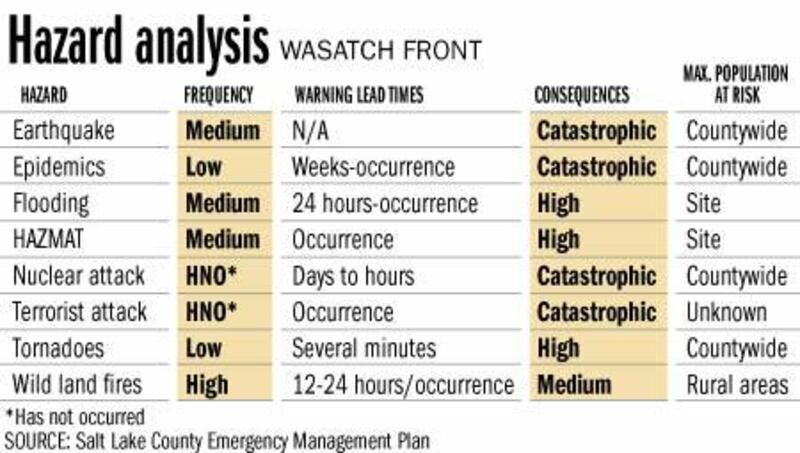
Rather than hurricanes with days of warning, the Wasatch Front is susceptible to floods, brush fires, chemical spills and of course, an earthquake. Those potential disasters don't lend themselves to mass evacuations or to much lead time to vacate the county, said Bob Halloran, emergency services manager for the Unified Fire Authority.
Instead, localized evacuations would be assessed on a case-by-case basis before any evacuation order was issued, he said.
"If earthquakes would give us three days' advance notice, maybe we could have an evacuation plan. But we cannot predict when or where," Halloran said. "Even in an earthquake, few residents would ever want to evacuate or leave their homes. It would be nothing on the scale you would have in Houston."
Traffic flow
A large-scale evacuation isn't at the top of the state's planning priority list either, said Utah Department of Transportation spokesman Nile Easton.
But there are ways to manage a large-scale movement of people.
One of the benefits of living in Salt Lake County is that I-80 and I-15 converge at the freeways' "spaghetti bowl" interchange and go in four directions, said Easton. To relieve congestion, traffic can be guided in each of those directions, instead of the one-way traffic flow that happened during the evacuation of Houston.
Also, lanes can be reversed so traffic could move in the same direction on both sides of the freeway.
"It would be slow going, but traffic would be moving," Easton said. Capacity on I-15 and I-80 is about 2,000 cars per lane per hour — about the equivalent of evening traffic into Utah County.
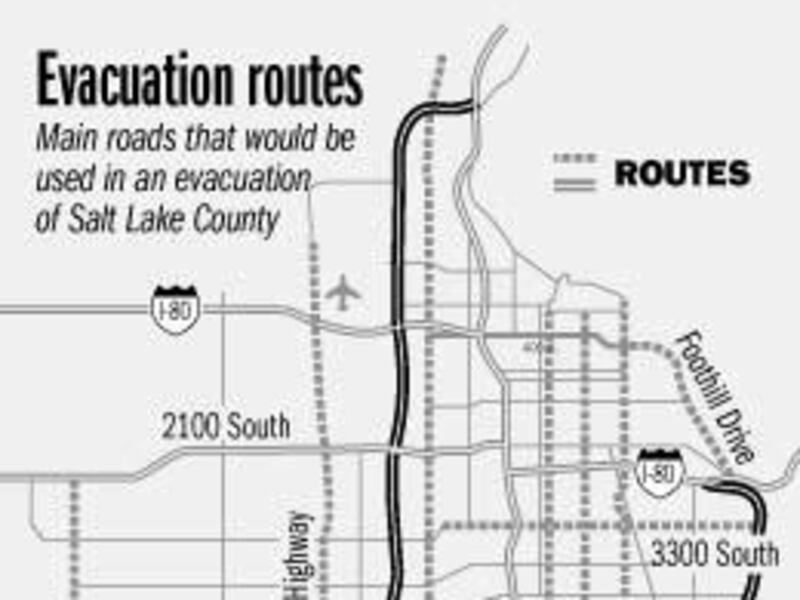
While I-15 and I-80 are the most likely conduits for any evacuation, Halloran said the county's emergency plan steers clear of having any predetermined evacuation routes. Instead, the county's plan includes more general emergency response protocols and handles all evacuations based on the situation.
Verdi White, director of the state's Division of Homeland Security, said that many times a predesignated escape route could be more dangerous than taking a wait-and-see approach.
"You have to be flexible. The plan is how you organize yourself when a disaster hits," White said. "You make those evacuation plans as you see what the lay of the land is."
Chemical spills
In the case of a chemical spill, a predesignated route may direct residents into the hazardous area. Pre-selected routes might also be impassable because of debris or structural damage.
The response of local officials to a chemical spill in March is a prime example of how on-the-scene assessment is necessary before any evacuation plan can be determined, Halloran said.
When a railcar began leaking hazardous chemicals in South Salt Lake, local officials first responded to the scene. After assessing the situation, calls were made to the state, and ultimately more than 6,000 people were asked to evacuate.
UDOT was asked to assist in closing several roads and highways in the area, including I-15. UDOT's call to assist came from the state Department of Public Safety, which in turn took commands from local government in assisting with the evacuation.
In an evacuation situation, UDOT says the agency will act as requested by DPS.
Priority repairs
But if a road required immediate repairs — as during an earthquake — UDOT employees would act on their own, said deputy director Carlos Braceras. The department has shown in some situations that a road can be repaired within hours, he said.
This August, after a 70-foot-wide crater was blown into U.S. 6 in Spanish Fork Canyon by a truck carrying explosives, UDOT repaired the road within two days, using an emergency list of contractors and state resources to repair it.
Critical roads for the state include I-15 and I-80. After an earthquake, top priorities for UDOT would be to ensure those roads are drivable. Interstate bridges would also be checked for structural integrity — another top priority, according to UDOT officials.
The county also has certain "critical roadways" that are a top priority in an emergency. Roads including 3300 South, 9400 South, 1300 East, 2100 South and U-111 will be the first county roads cleared to allow residents to leave downtown or the county if necessary.
"Our emphasis in the county is not so much getting out of town if a disaster hits but to use a mitigation plan so the overall effect is lessened," he said.
Coordination
Much of that plan includes the county's basic Emergency Management Plan directing agency heads how to coordinate with the state and local governments and how to notify the public of any evacuations or emergencies. Each division within the county also has a more specific plan outlining responsibilities for each employee to ensure county and state programs do not fail in case of an emergency.
The Utah Transit Authority, which has more than 500 buses and 1,700 employees, would likely be called in to help in a large-scale county crisis.
Randy Park, UTA manager of special projects and emergency preparedness, said his agency has a priority list of about 10 groups of people who should be assisted before others, including the elderly, those in hospitals and children.
"We would concentrate our services on those life-safety issues, helping the hospitals, senior citizen centers, schools, disabled community — the transit-dependent," Park said.
Bus drivers and other UTA employees have been asked to prepare food stores at home and have a plan for their family so they can serve without worry during an emergency. Caches of food and water have also been prepared at each of UTA's major operation divisions.
"We feel reasonably confident we know who the players are, the agencies we have to work with both publicly and privately," Park said. Each month, Park's group meets to discuss recent disaster scenarios and determine a course of action if the event happened in Utah.
Staying up-to-date
Division supervisors at the county are also expected to go over the emergency plan annually with each employee, but Halloran is working to get a mandatory emergency training session in place for each county manager.
In most crisis situations, many people "sink to the lowest level of training," he said. Intense training and practice drills are the best way to prepare.
"That plan will never even come down off the shelf in an emergency," he said. "Hopefully people already understand what their responsibilities are. They don't need to revert to a handbook."
That written plan, however, is updated at least annually to keep up with new technology, changes in positions and new threats, Halloran said. The Emergency Services Bureau of the Unified Fire Authority is responsible for keeping the manual up to date.
The latest version of the Emergency Management Plan is dated July 2004, but Halloran said it has been gradually updated throughout the year. Some specific position titles are wrong, however, because the organization structure has changed recently.
The 2002 Winter Olympics also pointed out some flaws in the county's emergency plan, he added, the biggest of which was trying to overcome the county's fragmented approach to law enforcement and emergency response, he said.
Although the Unified Fire Authority is in charge of emergency response for the entire county, Halloran said, local agencies often want too much independence or don't coordinate with the county.
"When we do things like the Olympics on a large scale, it points out weaknesses in the system," he said. "I think we're doing pretty well, probably better than most counties. We still have a long way to go."