

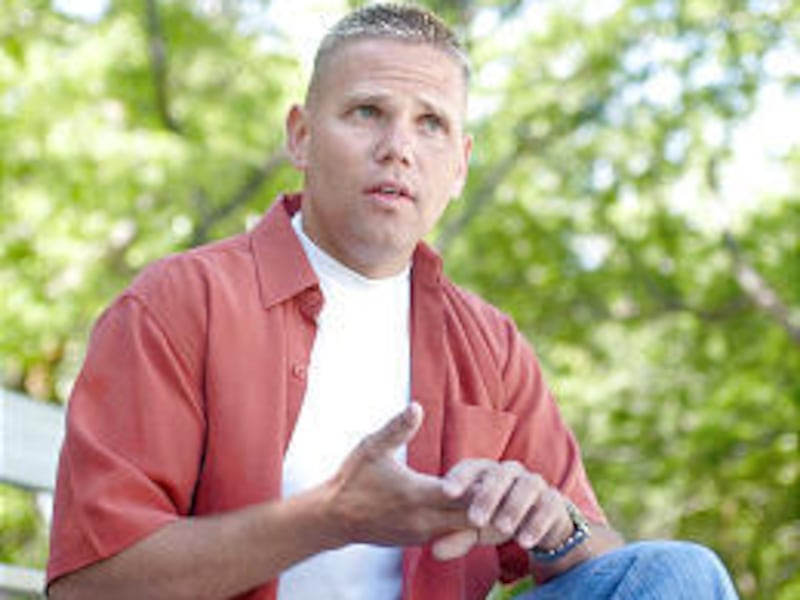

Salt Lake County sheriff's detective Doug Lambert remembers specifically when he first heard about it.
Another deputy had been called to investigate a party at an apartment complex off Fort Union Boulevard. It was a Sunday morning in the winter of 1999.
As the officer approached the apartment he could hear loud music coming from inside, where high school to college-age people partied. As he was questioning a male inside the apartment, he spotted a girl out of the corner of his eye trying to push a bag out of sight.
The deputy gained consent to search the bag. Inside he found 50 to 60 pills and some other substances with which he was not familiar.
The deputy took a bottle of an unknown liquid and asked the man hosting the party what was in it.
"It's GHB," the man replied.
"What's GHB?" the deputy asked.
"The kid laughed at him," Lambert recalled. "He said, 'You don't even know what GHB is?' "
That inquiry launched Lambert into becoming an expert in Utah's underground rave culture. He was one of the first law enforcers in the state to go undercover, posing as a young raver for a couple of years. With the knowledge he gained, Lambert soon became a sought-after lecturer to educate local and national law enforcement agencies, lawmakers and even church groups on the "club drugs" and partying that were attracting thousands of teens and young adults.
As a result, he is credited with curtailing what was a growing problem and probably saved many teens and young adults from becoming victims of the new drug culture.
Going undercover
The deputy investigating the party called his supervisor, who also had never heard of GHB. The supervisor in turn called Lambert, who was new to the sheriff's Narcotics Unit and had recently taken several classes. But even he wasn't sure what was happening at that party.
In addition to GHB, the bag in the apartment also contained Ecstasy pills and Ketomine. The man hosting the party that night was a rave DJ.
Lambert struck a deal with the DJ to educate him on the rave culture. The DJ became a valuable informant for the sheriff's office and took Lambert to his first rave.
"It blew me away. I was awestruck. It was a buffet of drug use right out in the open," Lambert said.
He reported back to his supervisors the following day.
"We have a huge problem," Lambert recalls telling them. "This had been going on under our noses for two years and no one ever knew about it."
The DJ told Lambert that those involved in the rave community banked on the fact that adults, including law enforcers, didn't know what was happening. He recalled a rave in Salt Lake City where police busted the party, searched him and found some pills. But he walked away because the officers didn't know what the pills were.
"He walked out of a rave with over 100 pills of Ecstasy," Lambert said in disbelief.
Realizing the problem needed immediate attention, Lambert said, the Salt Lake County sheriff's office gave him its full support, allowing him to do whatever was needed to investigate — even become part of the rave culture.
The drugs in the rave culture were not being used by long-haired, scraggly-looking types traditionally associated with drug use. These were clean-cut, kids-next-door types consuming these new drugs, he said.
So, Lambert, now 35, cut his hair and shaved his goatee to reveal a youthful looking face. In fact, he once posed as a 14-year-old to arrest a man who arranged on the Internet to meet a person he thought was a young teen.
When he rendezvoused with Lambert, who was wearing a baseball cap and riding a skateboard, the man "had an accident in his pants" when Lambert pulled out a badge and gun and placed him under arrest, he said.
Not only did Lambert have to look the part, he also had to learn the lingo to blend in. He learned terms such as "E," "G," "candy flipping" and "rolling." His name in the rave community was "TJ." Lambert obtained his own pacifier, glow sticks and other items commonly found at raves. Lambert and the sheriff's office were so serious about attacking the rave problem that through the help of their DJ informant they even planned on hosting their own rave. The sheriff's office was going to rent a facility, purchase lights and music and the DJ was going to invite all major Ecstasy dealers in town to attend.
"I don't think another administration in the valley would entertain such a thought," Lambert said.
Just days before the rave was scheduled to happen, the DJ got cold feet and backed out. The rave planned by the sheriff's office never happened. But Lambert said it showed the kind of commitment the department had to addressing the problem.
Educating the public
As Lambert became more involved in the rave community he was introduced to several Ecstasy dealers. He made several buys from these dealers as "TJ" and then would return later as himself with an arrest warrant in hand.
Lambert invited officers from any agency who fit the part to join him during his undercover outings so they could see for themselves what was happening. Soon, several officers from departments across the valley were part of Lambert's quasi task force.
On one memorable evening, Lambert went to a club as "TJ" with arrest warrants for five alleged Ecstasy dealers. As the group was dancing, Lambert used a laser pointer to pick out the dealers to other undercover officers.
One by one, the alleged dealers were silently grabbed by officers and carried off to a back door and thrown into the back of a van outside and arrested.
But Lambert knew the solution to the club drug problem involved more than arresting people. It also involved education.
"I felt it was important to get the word out now," he said.
Lambert began hosting lectures for other deputies in his department as well as other police agencies. But because the problem involved mostly juveniles, he knew that the word needed to be spread among teachers and school administrators.
Lectures were organized for educators across the valley. Soon Lambert was in high demand from other groups wanting to know about this new problem affecting the state's youth. He received speaking invitations from the Utah Judicial Conference, the State Office of Education, state lawmakers, the Utah Attorney General's Office, the Salt Lake District Attorney's Office, national police organizations and was even invited to speak at a three-stake fireside for adult members of The Church of Jesus Christ of Latter-day Saints, an event that he said was "standing room only."
"It accomplished a lot. It opened a lot of people's eyes," he said of his lectures.
By the end of his undercover days some of Lambert's reports were even being published nationally.
But by being so public about his lectures, Lambert knew he was also putting himself at risk. Although efforts were made to control who attended the classes, there was always the possibility that a drug dealer would sneak in and learn Lambert's true identity.
On one occasion Lambert was about to close a large Ecstasy deal at a downtown Salt Lake City club. He was sitting at a table with the dealer and several of his acquaintances. One of those men sat across from Lambert and stared intensely at him.
"Out of the blue he said, 'You're a cop,' " said Lambert.
A sinking feeling immediately came over Lambert who played it off and told the man he was crazy. But the man insisted he had seen Lambert before. After some discussion, Lambert was able to walk away keeping his real identity a secret. But the dealer got cold feet and left before completing the transaction.
'Clean' drugs
One of the biggest concerns for Lambert and other detectives was the kind of people becoming hooked on club drugs. Many were juveniles who would never dream of doing hard drugs such as cocaine or heroin. And many came from strong, religious homes, he said.
"These were good kids," Lambert said.
But drugs such as Ecstasy, GHB and Ketomine became alluring for these teens because they were "clean" drugs. There were no needles involved and no paraphernalia. There were no odors associated with them, no hangovers and users could essentially function while they were high and get away with it without their parents noticing.
"It was becoming the new gateway drug," he said. "They put themselves on a pedestal above coke users. They'd say things like, 'We're not like the dirty drug users.' "
In one incident, Lambert arrested a man who had just come home from his LDS mission and was dealing Ecstasy to raise money to help support his pregnant girlfriend. The man felt great remorse for what he had done, according to Lambert, and soon became a top informant.
The goal of Lambert and his crew was to help these people get away from club drugs — not necessarily to fill the jail.
"We weren't all out to arrest and prosecute. We worked to offer help and offer them a way to get out of the drug community," he said. "We offered them a chance to get out. Some did not take it."
As Lambert investigated the rave community he learned of a more adult crowd that was also involved. Specifically, wealthy adults and those who looked a certain way. His original DJ informant told him the group was involved in what was known as "Trance Mission" parties.
It was through his investigation of Trance Mission that charges were eventually filed against former Zion's Bank chief financial officer Dale Moroni Gibbons. Gibbons was later acquitted of the charges. In turn, he filed a multi-million dollar civil suit against Lambert and other members of the sheriff's office. That suit was unexpectedly dropped earlier this year with Gibbons receiving no money.
By court order, Lambert and others in the sheriff's office could not comment on the Gibbons case.
No longer undercover
Today, Lambert works patrol for the sheriff's office. He was awarded the Sheriff's Star in 2004 after he and another deputy took a man pointing a loaded .44-caliber pistol at them into custody without firing a shot, although Lambert's nose was broken during the struggle.
The underground rave scene in Utah is not nearly what it was five to seven years ago and several recent reports show Ecstasy abuse is down. And Lambert believes he and others can take credit for part of that.
"I'm sure there would be thousands of kids today that would be drug addicts if not for the work we did," he said.
His commanding officer during those years praises Lambert for taking the initiative to tackle a new problem.
"He did some very good investigation. He did a lot of proactive work relative to the rave scene," said Salt Lake County Sheriff's Chief Deputy Mike Buhler. "He was especially successful in identifying the dangers in some of the drugs used by the ravers that were not as well known before."
While Lambert no longer does undercover work, there are new law enforcers across the valley who have taken over those roles and spend an unknown amount of energy and personal investment to keep the public safe.
"It's a thankless job. The public will never know their names. But we so incredibly need them," he said. "There would be more havoc in society if not for the undercover guys."
E-mail: preavy@desnews.com