

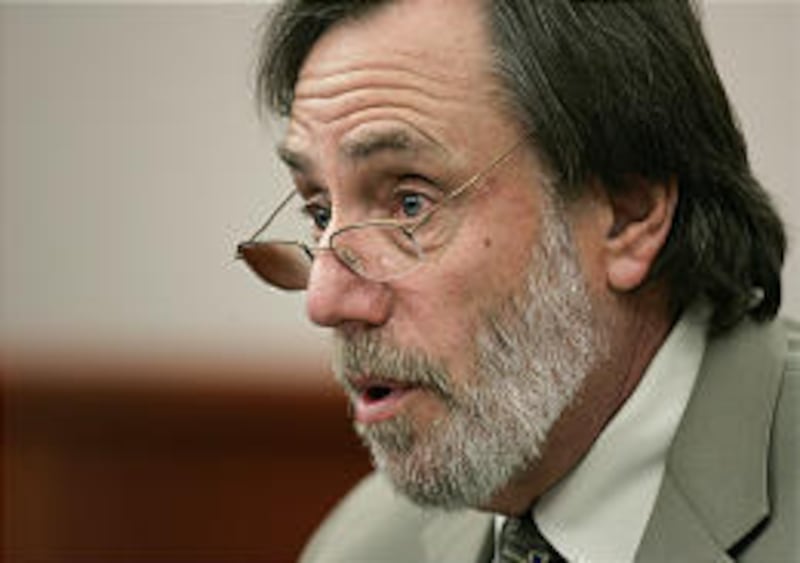

Accused Elizabeth Smart kidnapper Brian David Mitchell was portrayed Thursday in court testimony as a person under great distress who has likely suffered some type of mental illness since he was a juvenile.
In the second day of Mitchell's mental competency hearing, Dr. Stephen Golding was the only person who testified.
Golding is a psychologist who has twice found Mitchell incompetent to stand trial. In a report he submitted to the court Feb. 7, Golding said he found Mitchell suffers from both a delusional disorder and a paranoid personality disorder.
Golding said he also hadn't ruled out the possibility that Mitchell might also be paranoid schizophrenic.
The competency hearing has lasted longer than expected. Atherton set the hearing to resume on March 11, the second anniversary of the day Elizabeth Smart was found. Golding is expected to finish at that time, and prosecutors will call to the witness stand Dr. Noel Gardner, who has twice concluded that Mitchell is competent to stand trial.
Mitchell, 51, and Wanda Barzee, 59, were indicted by a state grand jury Sept. 4, 2003.
They were charged with aggravated kidnapping, two counts of aggravated sexual assault, two counts of aggravated burglary and conspiracy to commit aggravated kidnapping.
It was silent when Mitchell was led into the courtroom Thursday, as if everyone expected another outburst of song from the defendant.
Shortly after taking his seat, Mitchell began singing the LDS hymn "High on the Mountain Top." He was removed from the courtroom after just 18 seconds.
Golding said the former street preacher did not sing to be disruptive or manipulative in court. He was simply trying to soothe himself.
"He's mothering himself," Golding said. "He sings songs that give him peace."
Golding noted that Mitchell sings whether he's in court or out of court and whether he has an audience or not. Mitchell's thought process is to sing religious songs as a way of communicating, Golding said.
"He thinks in terms of hymns," he said.
Golding described Mitchell as being "extraordinarily tense" because he feels he's constantly walking a line between eternal damnation on one side and God on the other.
"He must discern signs properly or his soul will be lost" is the way Mitchell thinks, according to Golding.
During cross-examination, however, lead prosecutor Kent Morgan pointed out that Mitchell was arrested for burglary in El Cajon, Calif., during the time he had allegedly kidnapped Smart. At his arraignment in El Cajon, Morgan noted that Mitchell did not sing, even though he assumedly was also under stress at that time.
Also during cross-examination there was debate over whether eccentric religious beliefs made a person mentally incompetent. Morgan pointed out that Gandhi and members of the 1960s civil rights movement, in part, were compelled by their religions to do things that at the time were against the law.
But Golding insisted that Mitchell's delusions were more than that.
"I am sure he is beyond religious zealotry," he said.
Golding said Mitchell's delusions have intensified in recent months, and he doesn't seem to think he has a choice of the direction he takes. He thinks he is only following God's commands and that God is constantly testing him, he said.
"He is absolutely convinced that he is literally at God's mercy," he said.
There almost appears to be a constant state of turmoil in Mitchell's head between himself and his alter-ego, Immanuel David Isaiah, Golding said. He said that, hypothetically, if the prosecution were to drop all charges and tell Mitchell he was free, he would refuse because it's God's will to go through with the trial.
Golding noted that Mitchell was, at one time, a functioning member of society but that the signs of a mental disorder have been there since adolescence.
He related such examples as Mitchell exposing himself to a 5-year-old girl when he was a juvenile, giving his food to his dog because he thought someone was trying to poison him and verbally and physical abusing family members.
"(Mitchell's) history is littered with social role breakdowns, starting with adolescence," Golding said.
It was suggested during his adolescence that Mitchell be examined at the Utah State Hospital, an idea that his family rejected.
It wasn't until the middle of Mitchell's second marriage that he "really fell off the cliff," Golding said.
Even during his "normal" years, Golding said, friends and co-workers of Mitchell described him as being "wound real tight" and eventually "blew right off the face of reality and went into extreme mental illness."
At one point during Golding's testimony Thursday, he began speaking of Elizabeth Smart's time with Mitchell.
"Ms. Smart is a remarkable young woman," he said. "One of the things remarkable about her is her memory."
Golding said based on transcripts of interviews that Smart has conducted with investigators and writings from her journal, her recounting of times with Mitchell "was like watching a movie of her captivity."
But before Golding could discuss any details of Smart's testimony, 3rd District Judge Judith Atherton cut him off and called for a recess because she did not want details that could potentially be used in Mitchell's criminal case coming out during the competency hearing. When court resumed the defense asked that the competency hearing be closed, but Atherton again rejected the motion.
Ed Smart, who did not attend Thursday's hearing, told the Deseret Morning News later that Elizabeth does have a very good memory of what happened.
As to whether Elizabeth has been paying attention to the competency hearing, Ed Smart said no.
"She doesn't waste her time doing that," he said.
E-mail: preavy@desnews.com