


Compared to other states, Utah has one of the better open government records laws, according to several national organizations. But open government advocates say a law is only as good as the public officials who follow it.
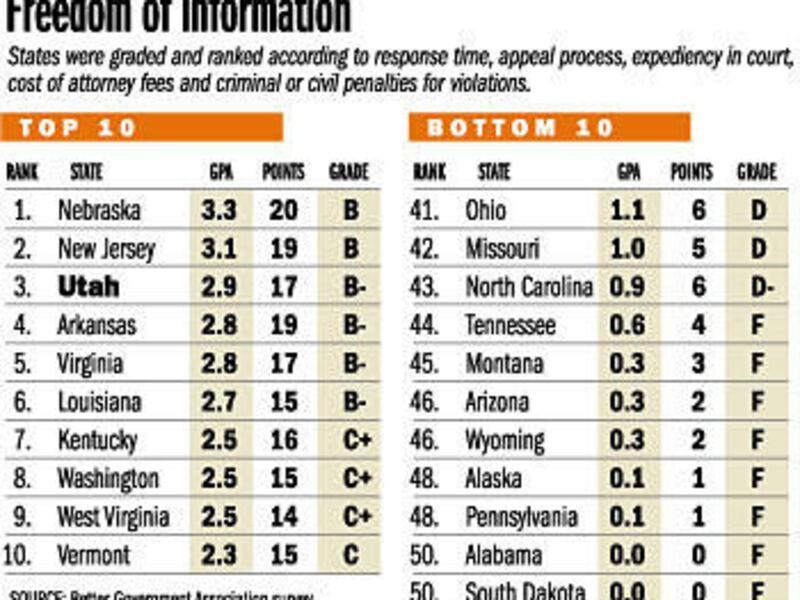
A joint study by the Better Government Association and Investigative Reporters and Editors ranks Utah third in the nation for its law that allows citizen access to government information.
Utah's Government Records Access and Management Act, affectionately known by officials as GRAMA, was given a "B-" by the study, coming in just under New Jersey and Nebraska, who received a "B" grade for their laws. No state received an "A."
Another study by the University of Florida placed Utah somewhere in the middle in a blind review of state laws by a panel of legal experts.
In a detailed study released this week, which compared state laws on 30 different categories, University of Florida researchers noted that Utah's GRAMA was one of five state laws voted the most helpful for citizens seeking to copy records, inspect records, or have records copied and delivered to them. The other states were North Carolina, New Jersey, Nevada and Montana. The project listed North Carolina, Florida, Michigan, Missouri and Indiana as the top five states offering citizens the best access to public records.
"Utah, as expected, was kind of in the middle of the pack," said Brigham Young University journalism professor and open government specialist Joel Campbell, who participated in the University of Florida project.
Experts on the subject of open government say GRAMA is one of the better laws in the United States. However, problems exist among the attitudes of some public officials who simply do not want the public or the press to have access to information.
"I think the structure of GRAMA is sound," Campbell said. "As far as practical application, that's another story. . . . I still believe there's not been enough education of public officials on how this law works."
Campbell said that, typically, government officials balk at giving out public information because some of it may prove embarrassing. "Nancy Workman, for example, that's embarrassing," he said. The former Salt Lake County mayor was charged last year and ultimately acquitted of misuse of public money.
"You can have a great, proactive public access law, but if officials don't know the law, what good is it?" said Salt Lake City attorney Jeff Hunt, who has championed freedom of information causes over the years.
Under GRAMA, an agency may charge a fee for copying or research, although the law encourages agencies to waive fees for the public benefit.
"Government has become increasingly more aggressive in charging fees in response (to) GRAMA requests," Hunt said. "I think that's just going way overboard, and at some point the fees can be so prohibitive that it effectively denies public access."
Case in point:
A University of Utah student who is an animal rights activist filed a GRAMA request for information concerning the treatment of lab primates but was told it would cost more than $300 to compile the information. The University of Utah also told the student he would be billed for having the document reviewed by an attorney. University officials explained that trade secrets, which are deemed private under GRAMA, were among the information and those had to be weeded out of the documents.
Although these incidents are rare, both Campbell and Hunt say they are concerned that slowly, government officials will erode GRAMA's presumption that a document is public unless proven otherwise.
One person concerned about keeping records public is the lawmaker who pushed for the passage of GRAMA in 1991: former House Speaker Marty Stephens.
"I've been teased a little bit at the Capitol that I've been the father of my GRAMA," Stephens told the Deseret Morning News.
On a more serious note, Stephens said GRAMA was created in response to complaints from citizens who could get information with little problem from one city or county but were stonewalled relative to the same information in another part of Utah.
After two years of intense study, legislators managed to classify every possible government record, either as private or public. They also established a time limit of 10 working days by which an agency had to respond to a request, or five days if a request were expedited. GRAMA also established an appeals process by which citizens could appeal a local agency's rejection to the State Records Committee.
"We started with the presumption that all records were open," Stephens said. "At the time the law passed, it was groundbreaking legislation and other states used the language."
Over the past 14 years, Stephens said he feels GRAMA has worked well, but he said the future of GRAMA relies on "the stewardship of governmental officials" willing to follow the spirit of the law.
"Anyone in any position can play games," he said. "You do have some citizens who are mad at some public officials who can use GRAMA to harass them in a way. You've got to have elected and appointed officials who subscribe to the theory that people have to have access to public records."
Campbell said part of the concept of "government accountability" is the public's willingness to participate in government and actually use GRAMA.
"Utahns by nature, I think, are a rather trusting people," said Deseret Morning News managing editor Rick Hall. "But maybe because of that we too easily fall into the mistaken security that government is acting in our best interest. Humans by nature are imperfect, fallible — and, unfortunately, corruptible. So, as long as humans govern humans, the work of government must be done under the bright light of public scrutiny."
But is GRAMA prepared to take Utah into the future?
Hunt says GRAMA lacks language to deal with electronic records, which have grown in use since the advent of the Internet.
"This is a law that will have to evolve over time," Stephens said, adding he hopes the Legislature will make changes necessary to deal with public access to government documents online and in electronic form, from video streaming to CDs.
In its recent session, the Legislature passed HB75, creating a joint House and Senate committee that will study making the first changes to GRAMA in more than a decade.
Hunt said many of those lawmakers who passed GRAMA are no longer in office and that many new lawmakers do not see the benefits, or reasons, behind the law.
Yet With growing concerns over identify theft and protection of private information, some lawmakers have indicated that perhaps it is time to change GRAMA's presumption that records are public until proven private to one in which documents are considered private unless proven public by a citizen.
That, says Stephens, is a dangerous move that he would actively oppose. "The presumption of openness is one of the key tenets of GRAMA," he said. "That's the heart of the law."
Since retiring from the Legislature, Stephens said he has made it a point to stay away from the Capitol. However, one of the few things that would bring him back would be an effort by lawmakers to close doors to the public.
"If they tried to change that presumption, then I would have to spend some considerable time lobbying up there against that," he said.
E-mail: gfattah@desnews.com