

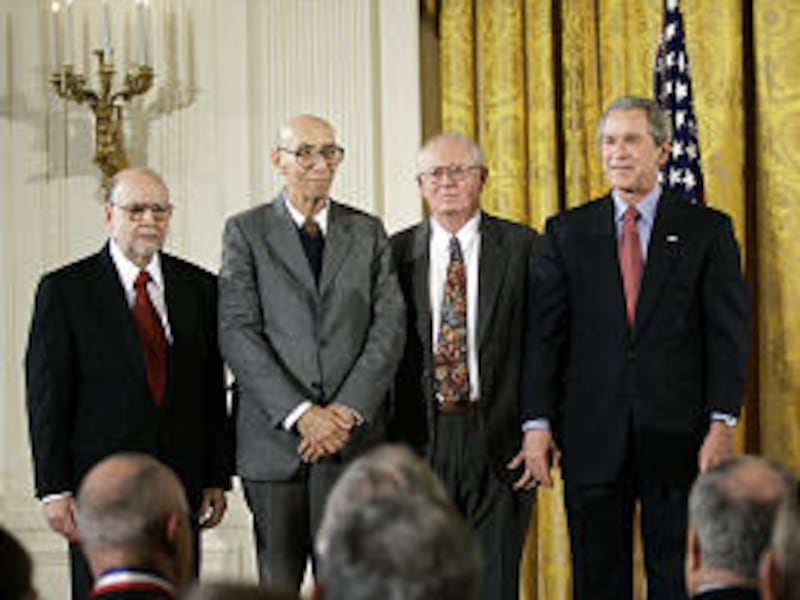

Rodney D. Bagley, a former Utahn who retired from Corning Inc. and now lives in New York state, was awarded the National Medal of Technology at the White House on Monday.
Bagley was part of a Corning team whose work in the 1970s led to the first commercially mass-produced catalytic converters for vehicles. Other members of the Corning team who were honored Monday are Irwin M. Lachman and Ronald M. Lewis, both also retired.
During the ceremony in the East Room, President Bush awarded both the 2003 National Medals of Science and the 2003 National Medals of Technology.
Altogether, eight won the science medals, while three individuals, one team and two companies were awarded the Medal of Technology. Bagley was a member of the Corning team.
According to a press release distributed by Joe Sutherland of Burness Communications of Bethesda, Md. — a firm that represents the National Science & Technology Medals Foundation — Bagley is a native of Ogden who graduated from high school in that city.
He was born in 1934 and earned a bachelor's degree in engineering from the University of Utah in 1960. He then earned his doctorate in ceramic engineering in 1964.
"Throughout his career, Bagley earned many awards, including the 1980 American Society of Metals Engineering Materials Achievement Award, the 1985 Samuel Giejsbeck Award from the American Ceramics Society and the 1990 'Mountain Man of the Year' award from the University of Utah."
The release adds that he retired from Corning Inc. in 1994 and now lives in Big Flats, N.Y., east of Corning.
Bush noted that Congress created the medals. "These are the most prestigious honors the president can bestow for achievement in science and technology," he said, according to a broadcast of the ceremony that the White House posted on the Internet.
"Today I am proud to recognize a diverse and deserving group of American citizens — what we call pioneers."
Breakthroughs made by the honorees are changing entire industries, he said. "As innovators, you heard a calling to challenge the status."
Bush added, "By pursuing your curiosity, all of you have achieved historic results. You bring credit to yourselves, to your families and to our country. You have our country's gratitude. You've earned our respect."
When a military aide called recipients to the front, the president hung the medals around their necks.
The citation for Bagley, Lachman and Lewis cited "their pioneering work resulting in the design and manufacture of the cellular ceramic substrate of catalytic converters that enabled auto manufactures to develop the first commercially mass-produced automotive catalytic converter."
According to the Technology Administration, the purpose of the medal is to recognize people who have made lasting contributions to America's "competitiveness, standard of living, and quality of life through technological innovation, and to recognize those who have made substantial contributions to strengthening the nation's technological workforce."
E-mail: bau@desnews.com